
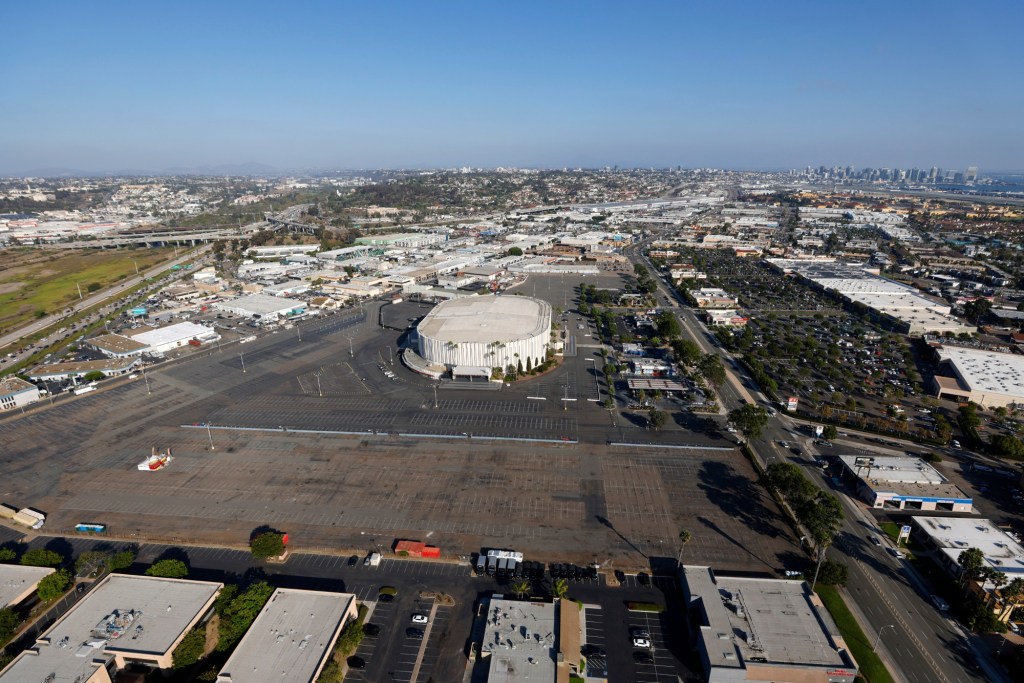
A bill introduced in the state Legislature at the request of San Diego Mayor Todd Gloria aims to insulate the Midway Rising mega project from legal challenges linked to the state’s environmental law.
Authored by state Sen. Akilah Weber Pierson, D-La Mesa, Senate Bill 958 seeks to exempt the project from the requirements of California’s Environmental Quality Act, or CEQA. The exemption is warranted, according to the bill, because of the statewide significance of the project, which promises to remake San Diego’s sports arena real estate in the Midway District with thousands of apartments and a new entertainment venue.
If signed into law, the special statute would curtail opponents’ ability to sue to block Midway Rising on environmental grounds.
SB 958 was introduced in February and is in the Senate Rules Committee, awaiting assignment to a policy committee for initial consideration, meaning it is at the very beginning of a long process through the state Senate and Assembly. The bill was first reported by the Voice of San Diego.
Weber Pierson, through a spokesperson, declined to be interviewed for this story.
“At this time, we are continuing to engage with stakeholders. SB 958 is still in the early stages of the legislative process, and its language will evolve after the first committee hearing. We’ll be able to speak in more detail once those initial amendments are in place,” Albert Parnell, the senator’s press secretary, said in an email.
The bill is sponsored by Gloria’s office.
“We’ve long seen projects in this town be discussed ad nauseam and never come to fruition. My objective is to make sure that that is not the case with this particular redevelopment,” Gloria told the Union-Tribune on Wednesday. “I was in the Midway area yesterday, and it is extremely evident that change has to come for that neighborhood. The community wants it. The voters have approved it twice. And so this legislation is a part of an overall strategy to make sure that we leave no stone unturned in making sure that this project becomes a reality.”
In September 2022, San Diego City Council members selected the Midway Rising development team to lease and redevelop the city’s real estate at 3220, 3240, 3250 and 3500 Sports Arena Blvd. The team is composed of market-rate housing developer Zephyr, affordable housing builder Chelsea Investment Corp., and sports-and-entertainment venue operator Legends. The Kroenke Group, a subsidiary of billionaire Stan Kroenke’s real estate firm, is the entity’s lead investor and limited partner.
The development plan for the 49.2-acre property, or what’s known as the Midway Rising Specific Plan, calls for 4,254 total residential units in 105-foot-tall residential buildings, a 16,000-seat replacement arena that is 165 feet in height, 130,000 square feet of commercial space, 8.1 acres of parks, and an additional 6.4 acres of plazas and public space. It memorializes the team’s commitment to build 2,000 residential units for households earning 80% or less of the area median income, or what’s considered affordable housing. The specific plan is also written to allow for buildings as tall as 250 feet on 10% of the site.
The city completed an environmental analysis of the specific plan, or what’s called the final subsequent environmental impact report, or FSEIR. It is awaiting certification by the City Council.
The Midway Rising project’s building heights were initially made possible by a 2022 voter-approved ballot measure that removed the 30-foot height limit from the Midway District. But the height limit was ordered to be restored by a state appellate court ruling, upheld by the state Supreme Court, which invalidated the ballot measure. An initial 2020 ballot measure was similarly ruled illegal.
As a result, the specific plan, environmental analysis and ground lease have been in a holding pattern as the city navigates the legal implications of the court ruling.
SB 958 is part of the city’s response.
“When the circuit court opinion came out, my team and I huddled up and said, ‘What can we do to move this forward?’ We have a range of options. We’re pursuing all of them,” Gloria said.
The Midway Rising team maintains that it can apply the state’s density bonus law to erect buildings taller than 30 feet. The city appears to agree.
Gloria said San Diego’s Land Use and Housing Committee is slated to consider the proposed real estate deal with the development team on May 14. The City Council could consider the full package, including the land-use documents and a proposed enhanced infrastructure financing district, the following week.
SB 958 uses the Midway Rising Specific Plan as the framework to provide the CEQA exemption, essentially expediting approval of any element or activity contemplated in the land-use plan. The bill would narrow substantially what project opponents could contest in court, making legal challenges based on perceived deficiencies in the environmental analysis off-limits.
The bill’s reliance on the specific plan and its associated environmental analysis means the legislation is not an end run around the public safeguards built into the state environment law, Gloria said.
“This legislation is explicitly contingent on the certification and adoption of the final EIR,” Gloria said. “This project has done an extraordinary amount of analysis and public review to meet the high threshold and high bar that a project of this magnitude and size should be held accountable to. I’m not aware of any other affordable housing project that has required two public votes and a supplemental EIR. Those are not features of your average project elsewhere in the city.”
The state Legislature has the authority to exempt the project from CEQA’s requirements, and the courts are often deferential to the Legislature, said Andrea Contreras, a former deputy city attorney now in private practice who specializes in environmental law.
“CEQA is a statute. It was created by the Legislature. … The Legislature has the right to change the law,” Contreras said. “(Midway Rising) can still be challenged by litigation, but it’s going to be a lot more difficult to challenge. You would have to show that the project doesn’t fit within the exemption.”
Courts typically uphold a legislatively mandated exemption as long as there is substantial evidence and an administrative record to support it, she said.
“The legal review standard for an exemption is much friendlier to the lead agency than the plaintiff,” Contreras said.
The bill, as currently written, makes 15 findings to justify the exemption, with the intent to demonstrate that the project, given its ability to create thousands of residential units for varying income levels and provide economic benefits to the region, is of the utmost importance to California.
“This scale makes Midway Rising one of the largest mixed-income housing communities on the West Coast and the single largest affordable housing development in California’s history,” the bill states.
The development team said in a statement that it supports the legislative assistance.
“Midway Rising has completed a rigorous environmental review with binding community improvements that will be implemented regardless of any legislation, and we are optimistic the project will come before the City Council in the coming months,” said Jeff Meyer, a spokesperson for the team. “We support any efforts to accelerate the delivery of much-needed housing for San Diego’s working families.”
The bill could stop at least one known threat in its tracks.
Earlier this year, a legal letter was sent to San Diego leaders outlining several ways in which the environmental analysis for the Midway Rising project is described as substantially deficient, particularly in the report’s handling of combined impacts with the anticipated redevelopment of the Navy’s nearby NAVWAR property.