
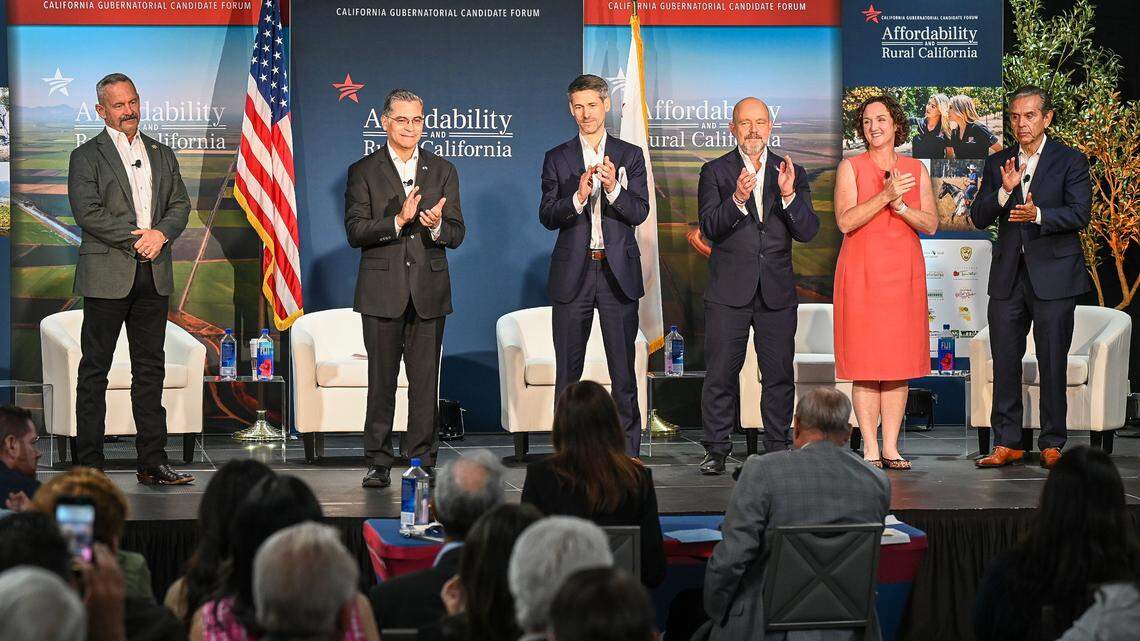
Six candidates vying to succeed Gavin Newsom as California governor made their pitch to Central Valley voters at a candidate forum Wednesday at Fresno State.
During the hour-and-a-half long forum, s the four Democrats and two Republicans were asked about key state issues including agriculture, water, energy prices, regulation and affordability.
Participants included Xavier Becerra (D), former U.S. and Human Services Secretary and former Calfiornia Secretary of State; Chad Bianco (R), Riverside County Sheriff; Steve Hilton (R) a former Fox new host; Matt Mahan (D), San Jose Mayor; Katie Porter (D), former U.S. Representative from Orange County; and Antonio Villaraigosa (D), former mayor of Los Angeles and former Speaker of the California State Assembly.
Some candidates, like Becerra and Villaraigosa shared anecdotes about their personal connections to the Central Valley: Becerra, the son of a farmworker who “picked crops all along the 99,” was born in Sacramento and his wife was born in Hanford and raised in Fresno. Villaraigosa, who acknowledged his “friend” U.S. Representative Jim Costa (D-Fresno), said he visited the Valley 55 times during his last bid for governor and more than two dozen this time around.
“Here’s my promise to you: You’re going to have a Valley kid sitting at that governor’s desk,” Becerra said. “And he’s going to invite you to be part of that, because I’ve always been part of the Valley.”
Others, like Mahan, Porter and Hilton said they came from farming families or communities. Bianco said as Sheriff he worked with the ag community to address practical issues like equipment theft.
Said Porter, who was born in Iowa: “My great-grandfather was a farmer. … My grandfather was a farmer. My father was a farmer, and I am not, and that is because of what has happened to American agriculture.”
Bianco and Hilton were forceful about their commitments to aggressively cut back regulations impacting Valley ag, and Porter raised the question of rethinking California’s controversial farmworker overtime pay.
“I love being the first Republican in this race, because it made all the rest of the Democrats have to act like Republicans, like they wanted to help you,” Bianco said. If elected, he said he would sign away any regulations “bothering” Valley farmers in his first 10 days in office.
“I am giving you your farms back,” he said.
Democratic frontrunners — U.S. Representative Eric Swalwell of Dublin and billionaire Tom Steyer — were absent due to scheduling conflicts, organizers said.
Dave Puglia, CEO of Western Growers, said in an interview with The Bee following the forum that it was “critically important” to hear from the six candidates on issues impacting the state’s agricultural community.
“All six of them, one way or another, multiple times,” he said, “reflected the reality that our members experience, that farmers experience: California is not the land of sweet honey anymore; that we have serious, serious problems that make our ag industry increasingly non-competitive with other states and other countries.”
Puglia also said he was “less satisfied” that Swalwell and Steyer weren’t there, especially because his team provided the date to all candidates well in advance.
“I would just note that there was a lot of time to make accommodation to be here,” Puglia said.
Fresno County District 4 Supervisor Buddy Mendes co-moderated the event with Kristin Olsen-Cate, a former assemblymember and supervisor who represented Stanislaus and San Joaquin counties.
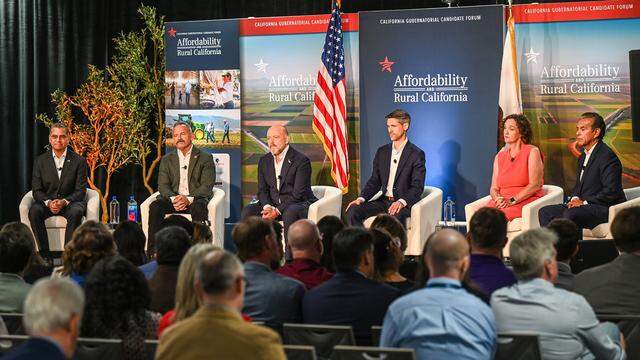 California gubernatorial candidates, from left, Xavier Becerra, Chad Bianco, Steve Hilton, Matt Mahan, Katie Porter, and Antonio Villaraigosa sit on stage during a forum hosted by the Western Growers Association at Fresno State on Wednesday, April 1, 2026. CRAIG KOHLRUSS ckohlruss@fresnobee.com Water management, storage, SGMA
Candidates agreed that California needed more investment in water sources and infrastructure, from dams to updated infrastructure to recycling as well as a more streamlined approach to the state’s 2014 sustainable groundwater regulation law.
The law, known as SGMA, threatens to take 900,000 acres of farmland out of production.
Mahan said California needs to invest in the state’s conveyance system, upgrade infrastructure to prevent leakage and invest in technology such as desalinization. “It’s not either or, but we (need to) have the infrastructure and innovation to make sure that we don’t have to trade off our environmental goals with our the health of our ag economy.”
Porter, who kicked off her time in the Valley with a campaign event in Hanford on Tuesday, said it was time for other parts of the state to bear the burden of California’s water restrictions, not just farms and rural communities. She and Mahan pointed out the many ways farmers have found to save water.
“We need to also ask our urban and suburban communities to innovate,” she said.
Bianco said farmers had been punished by California’s water policies: “Let’s don’t build the reservoir so we force you to drill it or to pump it from the aquifer, and now we’re going to punish you from pumping it from the aquifer.”
Villaraigosa said California needs “an all-of-the-above solution” on water including: recycling, recharge, dams and underground aquifers.
Hilton said he supported completing the Folsom South Canal to bring water “huge amounts of water” from the Tuolumne River and American River to the rest of the state. He also said more surface water storage and use would help with groundwater recharge and SGMA regulations.
“These are practical things we can get done for low cost and get it done quickly,” he said.
Affordability, Housing
Several candidates stressed that they wanted to drive down the cost of California housing.
“There’s no bigger piece of your budget than housing,” Porter said. If elected, she’d prioritize “building housing faster, building more housing, changing how we prevent housing and innovating in construction and design and materials.”
On the first day in office, Becerra said he’d declare a state of emergency to move forward on 40,000 shovel-ready housing projects ready to break ground: “I can bypass some of the legislature. I can move quickly.”
Mahan said as mayor he led the fight to reduce fees and cut permitting timelines. He said he’d reform California’s environmental review laws that slow building projects: “We need to completely overhaul CEQA (California Environmental Quality Act),” he said. “We need exemptions and strict limits on who can sue and how long it can be in judicial review.”
Porter — a single mother of three teenagers who said she was “the only candidate on stage who cooks dinner and pushes a shopping cart every night” — supported Hilton’s idea to eliminate California state income taxes for people earning less than $100,000. “That was a Republican idea, but I’ll take good ideas anywhere I can find them.”
Energy, oil costs
Bianco said he would eliminate the gas tax and explore nuclear energy. “We are going to be oil independent in California,” he said. “We will never buy another gallon from another state or from another country.”
Becerra said he would freeze property taxes and utility rates “until we can look behind the curtain to figure out why they’re charging us so much and making so much profit at our expense.” He also said California needs to explore every source of energy with a balanced transition to cleaner, more efficient energy that doesn’t leave people behind. He was the only candidate to mention the Iran War, saying it made the situation worse for ourselves and that people are feeling it at the gas pump every day.
Hilton said his goal would be to have $3 gas prices in California by opening up the state’s oil and gas production. He also said California has a fleet of gas-fired power stations that are running at 10% to 15% capacity because they are only being used as backup for “unreliable, more expensive wind and solar. That is insane.”
Mahan said California needs a modern energy system, to expand the energy and to speed up permitting for new projects to access new solar and wind resources. He also proposed suspending the gas tax and then backfilling the infrastructure dollars within the general fund. “It is crazy to push all the refineries out of state just to import fuel from farther away. … We lost all the jobs in the meantime. The way to get there is through innovation and investing in smarter energy transition over time, not to punish sources of energy we rely on today.”
Porter said energy demand is expected to go up in California 50% over the next five years and that the state needs to speed up its permitting process for green energy. “We need to keep all of the energy sources that we have online, and we have to be adding capacity aggressively. This is to power everything from electric vehicles to data centers to new innovations in agriculture to more air conditioning because of climate change.”
Villaraigosa said he would put a moratorium on any California Air Resources Board regulation that drives up costs. He said California needs the gas tax for its infrastructure, but that he would support a gas rebate for anything over over $5.50 per gallon. He also said California needs to build 2 million more charging stations over the next decade to support the state’s electric vehicles goals. “And if we built it, we don’t have a grid. So we have to build the grid,” he said.
Related Stories from Fresno Bee
The Fresno Bee
Melissa Montalvo is The Fresno Bee’s accountability reporter. Prior to this role, she covered Latino communities for The Fresno Bee as the part of the Central Valley News Collaborative. She also reported on labor, economy and poverty through newsroom partnerships between The Fresno Bee, Fresnoland and CalMatters as a Report for America Corps member.