
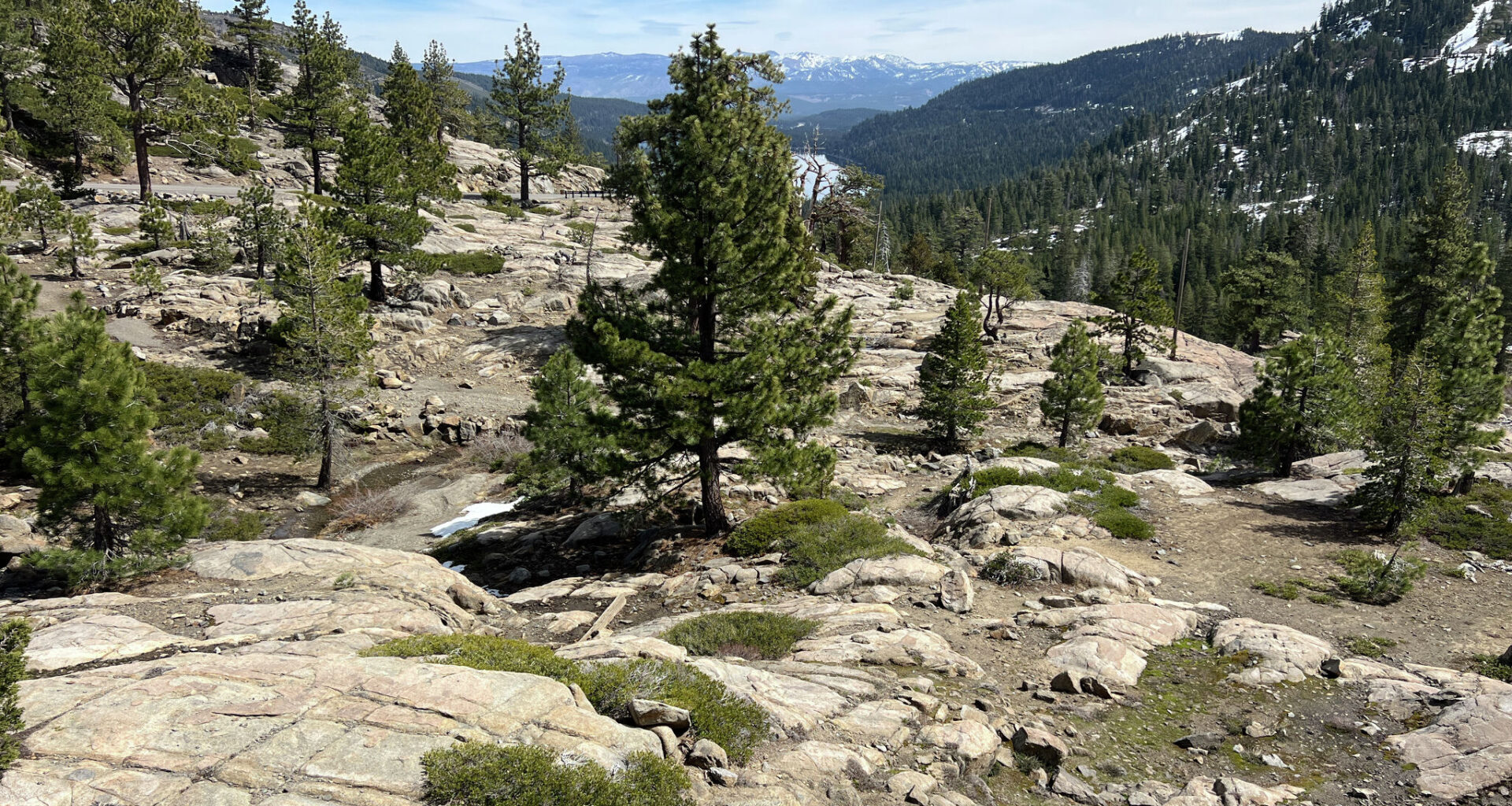
A March heat wave decimated the snowpack at Donner Pass near Truckee, Calif. (Nevada County), as seen on March 27, 2026.
Anthony Edwards/S.F. Chronicle
California is ending the winter season with its second-lowest snowpack in modern times, a troubling distinction reflective of the warming climate, which could, in coming months, pose problems for water supplies, wildfires and wildlife.
State measurements on April 1, the closely watched date when snow levels historically reach their peaks, show that snowpack in the Sierra Nevada, southern Cascades and Klamath Mountains is a meager 18% of average.
Only in 2015, when former Gov. Jerry Brown famously visited a snow measurement site near Lake Tahoe and found nothing but bare ground, were snow levels more depleted. That year’s 5% of average snowpack helped prompt the first-ever statewide mandatory water restrictions.
Article continues below this ad
Former California Gov. Jerry Brown (center) speaks at Phillips Station, a snow survey site south of Lake Tahoe, in 2015, when the state recorded its lowest snowpack on record.
Michael Macor/S.F. Chronicle
While the situation this year is not as dire, the lack of snow, which typically accounts for almost a third of California’s water supply, still means less melt-off to replenish reservoirs, temper fire risk and sustain rivers for fish and other wildlife.
“It didn’t snow where we needed it to snow, and where it did snow, it didn’t stick,” said Jeff Mount, a senior fellow at the Public Policy Institute of California’s Water Policy Center. “This is going to be an ugly summer.”
San Francisco Chronicle Logo
Make us a Preferred Source to get more of our news when you search.
Add Preferred Source
Low snow levels, and lots of barren rock and dirt, currently characterize much of the mountain West –- part of a broader decline that has accelerated over the past two decades as the atmosphere has increasingly warmed.
Article continues below this ad
For California, precipitation was close to average this year, but the heat, which included record-breaking temperatures that ran more than 20 degrees above normal in March, meant that storms disproportionately brought rain, not snow. State water officials say the snowpack was at its largest point on Feb. 24, more than a month before it has historically peaked.
Andy Reising, snow survey and water supply forecasting unit manager at the California Department of Water Resources, leads the state snow survey Wednesday at Phillips Station, off Highway 50 in El Dorado County.
Nick Shockey/California Department of Water R
Perhaps the first sign of hardship for California comes from reservoir operators warning of limited water deliveries. While most reservoirs are in good shape, with the prior three years being wet or at least average in terms of rain and snow, once the current supplies are gone, the snowpack won’t be sufficient to fill the void.
The U.S. Bureau of Reclamation, which runs the water supply system known as the Central Valley Project and its flagship reservoir, Shasta Lake, announced last week that it expects to provide only 20% of the water requested by irrigation agencies in the San Joaquin Valley, the state’s farm belt.
The State Water Project, which serves mainly urban communities, including spots in the Bay Area, is planning to meet just 30% of the water requests of most cities and towns.
Article continues below this ad
“It’s unfortunate that the allocations aren’t larger,” said Aaron Baker, a chief operating officer at the South Bay’s Santa Clara Valley Water District, which gets supplies from both the state and the federal water projects.
Donner Pass near Truckee, Calif. (Nevada County), as seen on March 27, 2026, had little to no snow after record-shattering temperatures in mid-March.
Anthony Edwards/S.F. Chronicle
Like the many other water agencies that rely on project water, the Silicon Valley wholesaler plans to lean heavily on local water sources, in this case aquifers. Baker says the agency’s underground reserves are plentiful for the year, though they can’t sustain the district indefinitely.
“I don’t know if I want to say the ‘drought’ word yet, but this low snowpack and having to use our excellent groundwater supplies, have us looking at the future,” he said.
The San Francisco Public Utilities Commission and East Bay Municipal Utility District, also among the big water providers in the Bay Area, operate reservoirs in the Sierra Nevada, which they say have ample water for the near term.
Article continues below this ad
Supply challenges for these agencies would arise after multiple dry years. This was the case last decade, when reservoirs received minimal recharge during the 2012-2016 drought, leading to declining water supplies, mandatory customer cutbacks and even fines for big water users.
Little to no snow covers the ground at Donner Pass near Truckee, Calif. (Nevada County) on March 27, 2026.
Anthony Edwards/S.F. Chronicle
“When I look out over the horizon, we’re probably going to muddle through this year,” said Mount, at the Water Policy Center. “It is next year I fear more than anything else.”
Bigger problems could play out in the coming months across California’s hills and valleys.
Low snowpack contributes to a drier and more wildfire-prone landscape while an early melt-off means a longer fire season. The National Interagency Fire Center is projecting elevated wildfire potential in Northern California, beginning in May and worsening through summer, in its April 1 forecast.
Article continues below this ad
Scientists also express concern about the health of forests, which remain fragile after spiking tree mortality during recent droughts, as well as whether enough water will nourish rivers and creeks –- and the flora and fauna that depend on them.
The state’s iconic salmon runs have been hit particularly hard in recent years. Low flows in rivers and more pumping by cities and farms during dry times, particularly as the Trump administration pledges to boost water supplies, could worsen watershed conditions for fish.
The ground is generally void of snow at Donner Pass near Truckee, Calif. (Nevada County) on March 27, 2026.
Anthony Edwards/S.F. Chronicle
The California Department of Water Resources reported Wednesday that statewide snowpack averaged 4.9 inches of “snow water equivalent, essentially how much water is in the snow when it’s melted, which represents 18% of the April 1 average.
The 2026 measurement came in below readings of 25% on both April 1, 2014 and April 1, 1977, which had previously marked the second-lowest snowpacks since state snow surveys began in the 1950s. The next lowest was 29% in 1988 and 35% in 2022.
The state’s far north, where the largest reservoirs are located, saw the biggest snow deficit this year. Snowpack in the northern Sierra, southern Cascades and Klamath mountains logged in at just 6% of the April 1 average.
In the central Sierra, snowpack stood at 21% of average and in the southern Sierra, it was 32%.
At Phillips Station, off Highway 50 in the central Sierra, where Gov. Brown in 2015 found no snow during the April 1 measurements, state surveyors on Wednesday found only patches of snow and ice.
Their official tally for the station, one of more than 260 state measurement sites, was 0 inches of snow, compared to the nearly 5 feet of depth that is typical there for the date, or 24 inches of snow water equivalent.
“We get a lot of questions about whether we’re heading into a hydrological drought,” said Karla Nemeth, director of the Department of Water Resources. “We could be. We will know with more clarity next year if this year is, in fact, the start of a hydrological drought in California and throughout the West.”