
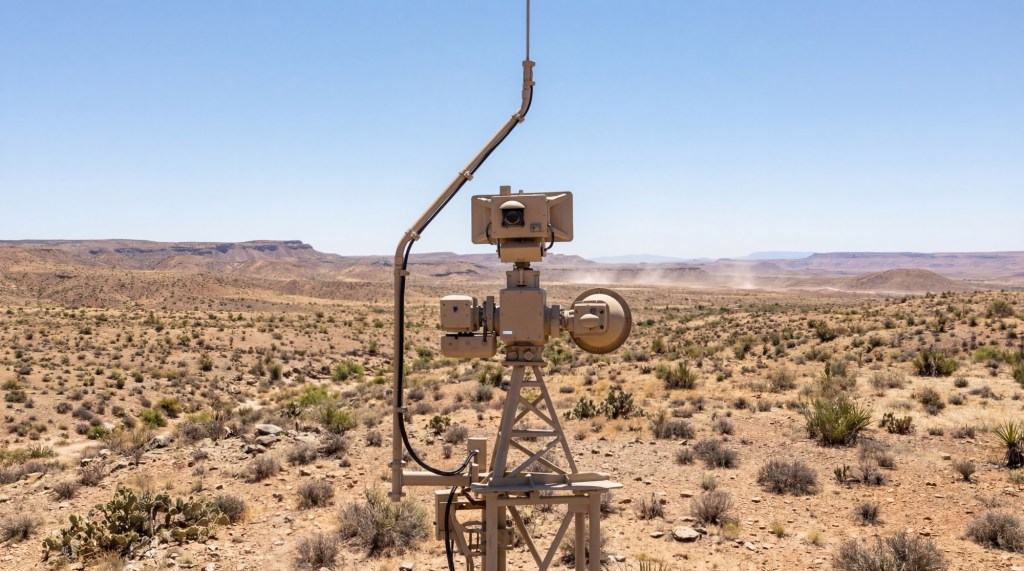
A new generation of AI surveillance towers from General Dynamics has been deployed along San Diego’s stretch of the U.S.–Mexico border.
General Dynamics uses Phoenix-based PureTech Systems’ AI software, trained on years of footage from earlier systems. Using a combination of cameras and radar, the towers can distinguish a human from a cow, and a passerby from a potential case of smuggling.
“It was trained to say, OK, that person has a long rifle on their back, or that person has a large backpack that might be carrying narcotics,” said Mike Wagner, vice president of the biometrics, border, and transportation security at General Dynamics Information Technology.
GDIT is a major business unit of General Dynamics, the $95 billion company, that provides IT services, cloud computing, cybersecurity, and artificial intelligence technology to the U.S. government.
The towers come in two sizes — 120 and 180 feet — and can monitor six to 10 miles of terrain depending on the landscape. A new modular design makes them easier and more cost-efficient to upgrade as technology evolves, Wagner said.
Running on 5G and Starlink satellite communication, the towers can monitor the border around the clock with minimal human oversight.
It’s a sharp contrast to the current reality, where a single agent sits before nearly a dozen monitors, watching hundreds of miles of desert.
U.S. Customs and Border Protection has not disclosed the exact locations or total number of towers, but the Electronic Frontier Foundation — a nonprofit defending digital privacy, free speech, and innovation — has counted at least 585 autonomous surveillance towers along the U.S.-Mexico border.
GDIT said they have deployed 203 of their own towers to date along both the northern and southern borders, surveilling 566 miles.
In San Diego, roughly two dozen autonomous towers line the boundary from the Pacific coast to Rancho del Campo.
“The technology automates surveillance, allowing agents to focus on enforcement, interdiction and humanitarian missions,” CBP wrote in an email to the Union-Tribune, adding that the towers enhance “operational efficiency” and “mission effectiveness.”
But a long paper trail of government reports tells a more complicated story that raises doubts about whether the high tech is worth the tax dollars.
“I have noticed a cycle,” said Dave Maas, director of investigations at Electronic Frontier Foundation. Maas has covered border surveillance technology for 25 years. “The Department of Homeland Security or CBP will announce a program, give it a cool title like America’s Shield Initiative or the Secure Border Initiative and then a few years later, an inspector general report, a House Oversight report, or a Government Accountability Office report will come out saying the whole thing was a waste of money.”
He cited a few recent government reports.
Internal Border Patrol memos revealed that more than 30% of camera towers were inoperable in 2024. A separate DHS-funded study found “strong evidence” that the Integrated Fixed Towers program was actually having a negative impact on apprehension levels at the border. One official said border crossers would often walk around the towers.
Maas says “It’s a theatrical system,” and the towers are just for show.
Instead, border patrol agents have more effective strategies, he said, such as driving ATVs back and forth across five-mile segments of desert, dragging tires behind them to carve a smooth dirt road into the sand.
“If you see vehicle tracks, footprints, bicycles, horse shoes, whatever, you know somebody has crossed,” said Maas. “Despite all of the high tech at the border, one of the tried and true techniques of border patrol is this ancient system.”
GDIT says it doesn’t question those government reports, but instead pointed to the government itself. The towers are built to operate in extreme environments, but they also require regular maintenance.
In 2024, when a third of those towers were dubbed ineffective, GDIT said they weren’t contracted to monitor and maintain the high-tech towers.
When the leaked internal memo revealed the inefficiencies, a government official blamed outdated equipment and outstanding repair issues.
Still, Washington is betting big on the newer approach.
The “Big Beautiful Bill,” passed in July, directed $6 billion in border funding toward AI-integrated surveillance towers. Long Beach-based defense company Anduril was initially awarded the lion’s share of that money for its AI tower systems.
GDIT didn’t disclose how much each tower costs when it announced the upgrades recently, but they have a government contract worth up to $1.8 billion for its autonomous surveillance towers.
GDIT is splitting that 14-year contract with Advanced Technology Systems Co. and Elbit Systems of America to modernize the tower infrastructure.
Now, General Dynamics is moving to expand its own footprint, backed by more than a $1 billion in government contracts.