
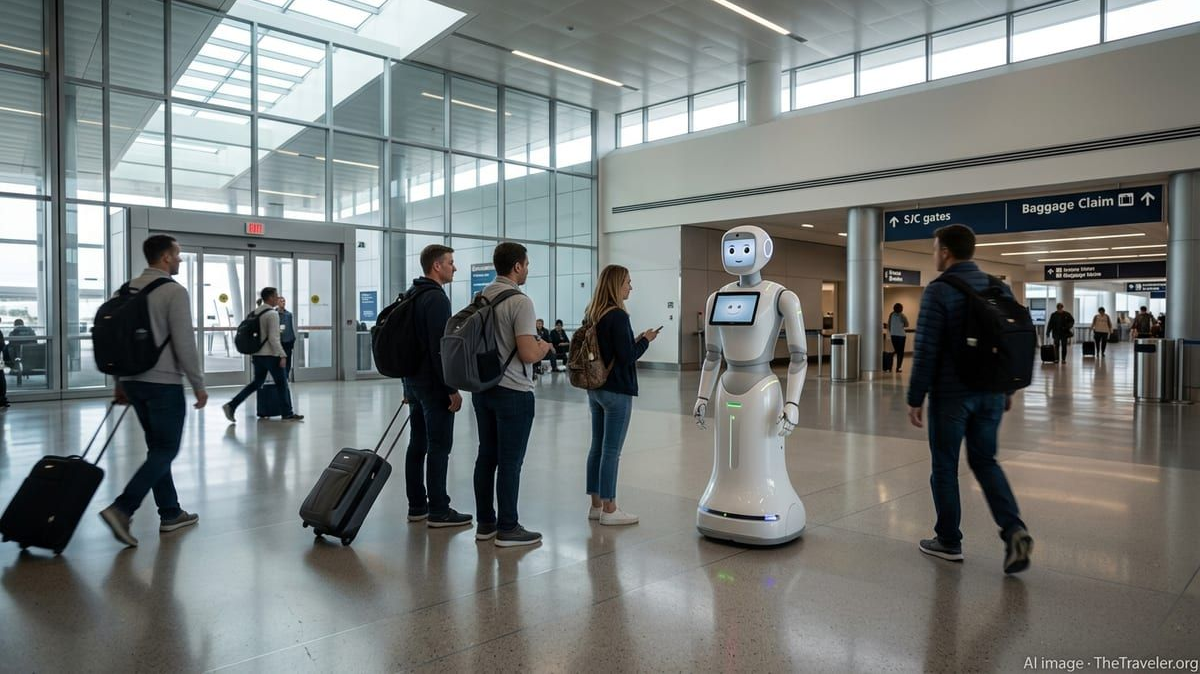
San José Mineta International Airport in California has deployed a humanoid robot named José to enhance the traveler experience. This initiative aims to address common challenges faced by passengers, such as navigating the terminal, finding dining options, and locating charging stations, as reported by Fox News.
José, which stands approximately 5 feet, 6 inches tall and weighs about 152 pounds, is currently located in Terminal B near Gate 24. Passengers are already interacting with the robot, which is designed to greet them, answer questions, and provide directions.
Developed by IntBot, a Silicon Valley startup, José is powered by IntEngine, a proprietary system that integrates vision, audio, and language processing in real time. This advanced technology enables the robot to coordinate speech, facial expressions, and gestures, allowing it to understand social contexts and interact appropriately in busy public environments.

Key capabilities of José include communication in over 50 languages, providing real-time terminal updates and directions, and answering questions in a natural, conversational manner. The robot can manage crowded spaces without requiring constant human supervision, enhancing operational efficiency. Its 700wh battery provides about two hours of operation per charge, and with more than 40 points of movement, it can navigate tight airport areas within a two-foot turning radius.
The Strategic Rationale Behind AI Robot Deployment
Airports are increasingly seeking innovative solutions to expedite passenger movement while simultaneously improving the overall travel experience. Cities also aim to showcase their leadership in technological advancements, a goal San José is actively pursuing. According to San José City Manager Jennifer Maguire, the city continues to lead in applying emerging technologies to improve daily experiences for both residents and visitors.
Lei Yang, CEO at IntBot, highlighted the significance of this deployment. “This marks our first airport deployment,” Yang told CyberGuy. “José is our first real-world test of how humanoids can help travelers navigate airports across language barriers. Our goal is to help travelers feel more confident before they depart.” The project also focuses on understanding human responses to embodied AI systems in public settings to guide future responsible development.

A Pilot Program for the Future of AI in Public Spaces
The introduction of José at San José Mineta International Airport is part of a four-month pilot program. During this period, airport officials will closely monitor several key metrics. These include assessing passenger engagement, determining if the robot reduces confusion or delays, and evaluating its reliability in a crowded environment.
Mookie Patel, director of aviation at San José Mineta International Airport, explained the airport’s perspective. “By piloting IntBot, we’re exploring how artificial intelligence can enhance the passenger journey while reinforcing SJC’s role as the gateway to Silicon Valley.” City officials view the airport as a live laboratory to observe AI performance under real-world conditions.
If the pilot proves successful, similar robots could be implemented not only in other airports but also in hospitals, hotels, and various public buildings. The broader objective is to develop “social intelligence” in machines, enabling robots to comprehend context, tone, and human behavior beyond simple command execution.

Implications for Travelers
The integration of AI robots like José could significantly transform how individuals navigate busy airports. Instead of searching for signs or waiting in lines, travelers might directly ask a robot for gate information or flight delay updates. This could be particularly beneficial for international travelers, as the robot’s multilingual capabilities can help overcome language barriers, making travel clearer and quicker.
However, the widespread adoption of such technology also raises questions. Not all travelers may feel comfortable interacting with robots, with some preferring human assistance. Concerns about data collection during these interactions and its subsequent use are also potential considerations as this technology advances.