
As more Bay Area teachers are priced out of the communities where they work, school districts have increasingly considered a costly, time-consuming and complicated solution: building housing for educators.
It took San Francisco, for example, 10 years, a free chunk of district land and a $48 million city loan to get a 135-unit affordable apartment complex built in the Sunset neighborhood at a cost of $105 million.
But what if the school districts and cities became buyers instead of builders?
An Oakland nonprofit is hoping to set that example, showing it’s a cheaper, faster and less complicated approach to getting educators into affordable apartments.
Instead of a decade to build units, it took the housing-focused Rooted just eight months to buy a 33-unit apartment building in Oakland’s Temescal neighborhood, and the organization plans to offer the one- and two-bedroom units to Oakland teachers and other education workers at half the cost of market-rate apartments. The timeframe included raising initial funding, finding the property, negotiating the deal and going through escrow, Kyra Mungia, co-founder of Rooted, told the Chronicle.
Rather than the army of city and district workers needed to get the San Francisco project from start to finish, just four people working part-time got the deal done in Oakland, with a final $12.6 million purchase price – about half what the complex sold for brand new in 2017 given the current depressed commercial real estate market in the city, Mungia said.
“It takes too long and costs too much money to build new affordable housing in the Bay Area,” Mungia said in the official announcement about the project Thursday. “The solution to keep our teachers and educators housed is to buy housing right here and right now – and there’s never been a better time as residential buildings are available and at the right price.”

Oakland teacher Melanie Turner does laundry, as son her 9-year-old son Richard Hargraves has a snack in Oakland on Wednesday. (Noah Berger/For the S.F. Chronicle)
Each unit has a washer and dryer and a little outside balcony as well as a parking space. Rooted will use a management company to rent them out, as existing tenants leave and vacancies become available. Rents are based on income and family size, with a one-bedroom, one-bath averaging $1,800 a two-bedroom, two-bath averaging $2,600.
“We know these units are going to get snapped up,” said Mungia, who is also CEO of the Oakland Fund, the umbrella agency of Rooted.
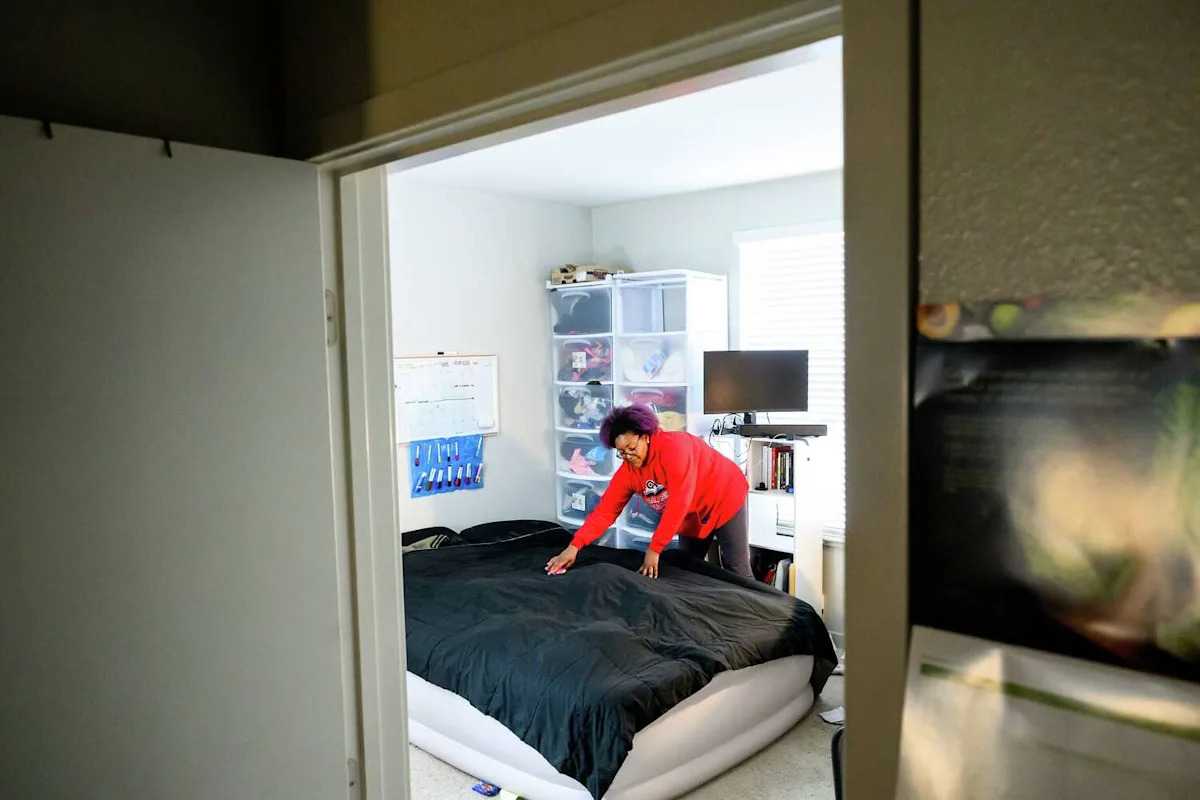
Melanie Turner is the first of what is expected to be 33 educators in the Idora apartment building near the corner of Claremont and Telegraph avenues. She is in a two-bedroom unit with her son, a fourth grader at Emerson Elementary School where Turner is a special education teacher.
“It’s affordable for a teacher’s salary,” she said of the 1,000-square-foot unit. “I’m really grateful that it’s not only affordable, it’s comfortable. I’ve never had that much space for myself before.”
She’s had to share similarly sized apartments in the past with one or two families.
The apartment is walking distance to her school, she said. It’s also close to public transit and grocery stores and more than 70 restaurants. But more importantly, it’s given her peace of mind.
She can afford to stay and commit to Oakland, where she wants to be. And she can do what is already a difficult job without financial worries.
“I’m so grateful,” she said. “It’s the natural need being met and it also takes away from stress … Who has time to worry if we’re going to be able to pay the rent or not the first of the month?”
Taylor exemplifies the thinking behind the project, said Mungia, who is a former teacher. Give educators stable housing they can afford and they are more likely to stay in the district.
Affordability is one of the biggest reasons teachers leave every year, she said, citing Oakland Unified teacher surveys.
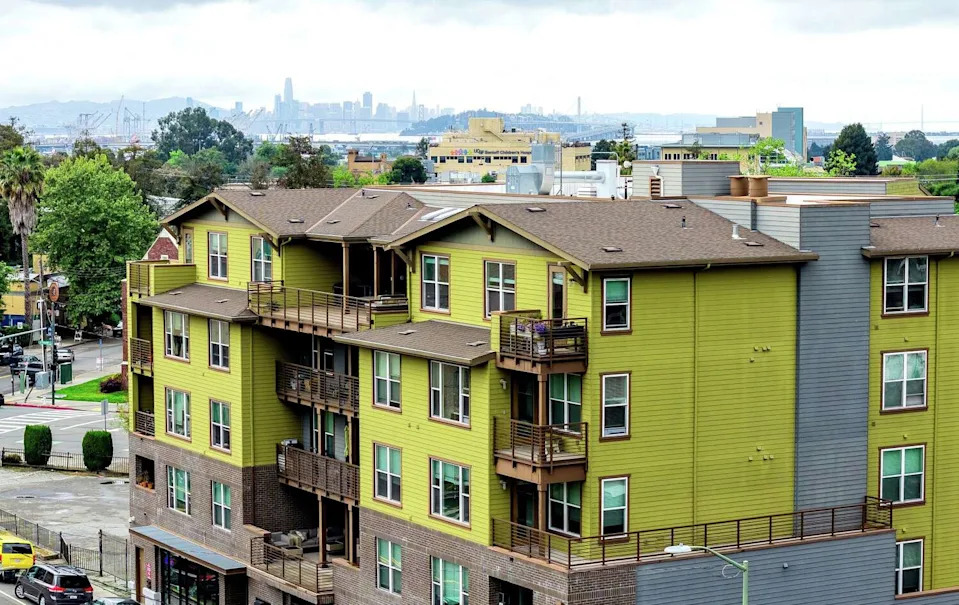
The Idora apartment building is pictured in Oakland on Wednesday. (Noah Berger/For the S.F. Chronicle)
Districts across California have been struggling with similar teacher turnover and affordability issues for years, with the cost of living increasing faster than educator salaries.
“In survey after survey, educators have told their employers that they struggle to find affordable and decent housing close to work,” according to a 2025 report on teacher workforce housing by UC Berkeley’s Center for Cities + Schools. “The gap between staff salaries and the incomes needed to afford an average rental continues to widen in most of California, despite the recent trend of salary increases.”
Low-salary districts like those in Oakland often see greater turnover, with higher rents or long commutes from cheaper housing markets spurring resignations. Each departed educator can cost up to $25,000 to process and replace in urban districts, the U.C. Berkeley researchers said.
Building affordable housing from scratch can help solve one problem, but it includes unique challenges for school districts. For starters, it typically takes more than seven years to build the new development, during which fickle elected officials and staff responsible for its completion come and go, at times throwing the project into doubt.
In addition, many educators, especially teachers, make too much to qualify for low-income housing built with federal tax credits. That has played out in Los Angeles and in San Francisco, where few credentialed teachers are among the residents in the district’s apartments, though aides and other lower-paid educators live in the units as well.
At the same time, it’s also a tantalizing option.
School districts up and down the state own about 75,000 acres of “developable property,” and land is often one of the pricier parts of building housing, state Superintendent of Public Instruction Tony Thurmond said in a 2025 statement supporting the idea.
Those acres, many of them sitting idle, could be used to build 2.3 million housing units, Thurmond said.
The land could also be sold, with the proceeds used to purchase existing housing, or leased to commercial or market-rate housing developers for other purposes, with rental payments flowing into a district’s coffers with no strings attached.
Meanwhile, the Rooted project is the first of its kind in the country, Mungia said, although a few school districts have used bond money to partner with an existing housing development project to designate some units as affordable and for district workers.
She is hoping Rooted’s trailblazing will show other nonprofits and school districts that it’s possible to buy an apartment building, with the rents paying the mortgage and management company – with money leftover for future property purchases.
“The whole idea is, how do we help government innovate, try something new, test bold ideas with private dollars, and if it works, kind of bring it into public systems,” she said.
Given tenancy laws, Rooted will place educators in the Idora apartments as current tenants leave, with a full turnover expected within about four years. Three units have opened up since the nonprofit took ownership, Mungia said.
Turner is looking forward to her fellow Oakland educators moving into the building and setting an example for other communities, describing the project as “huge” and “catalytic.”
“It’s going to be like building a village,” she said. “This is something that can be done anywhere in the U.S.”
This article originally published at ‘I’ve never had that much space for myself’: Novel Oakland project gives teachers affordable housing.