
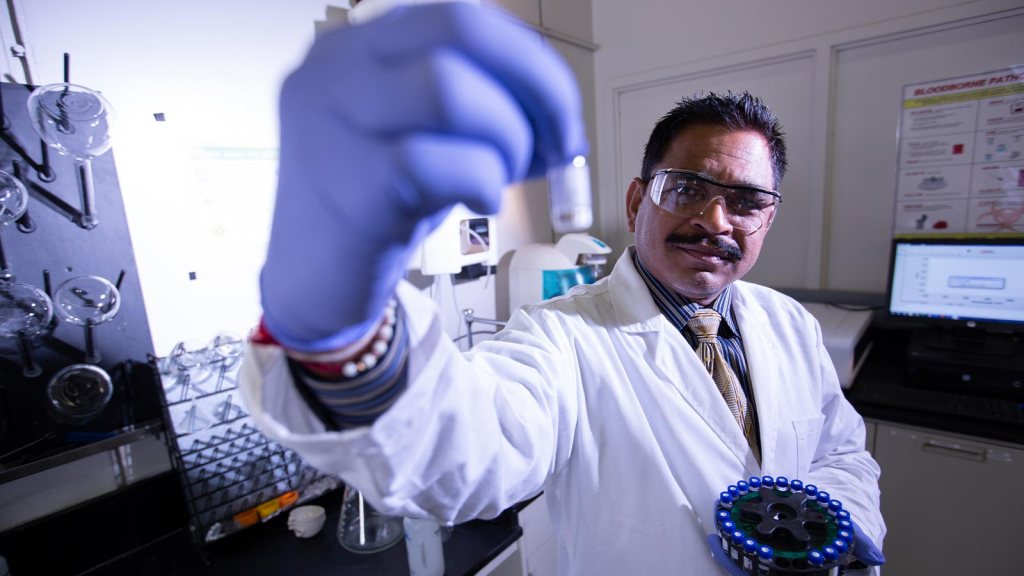
Developed in the 1940s and widely used in a variety of products and industries, the synthetic substances perfluoroalkyl and polyfluoroalkyl were lauded for their ability to repel water and grease, reduce flammability and resist degradation. But this class of substances, commonly referred to as “PFAS,” are toxic “forever chemicals” that don’t break down over time. This is a serious concern, especially given that an estimated 97% of Americans have detectable levels of PFAS in their blood, according to the Centers for Disease Control and Prevention.
This PFAS issue was the subject of a lecture by Sudarshan Kurwadkar, Cal State Fullerton professor of civil and environmental engineering, on March 25 in the campus’ Pollak Library. Focusing on our drinking water, Kurwadkar’s talk, “PFAS in California: Scale, Science, and Communities at Risk,” reviewed the magnitude and distribution of these substances in the state, their many troubling health effects, sources of contamination, government intervention and more.
“The EPA has documented nearly 14,000 types of PFAS thus far, but the main focus in the scientific community has been on two types, PFOA and PFOS, since they were produced in such large quantities,” Kurwadkar said. “They’re used in a variety of consumer and industrial products: textiles, cosmetics, food packaging, cookware and more. … And they’ve been associated with many types of diseases: kidney, prostate, testicular cancers, among others. Another element is their neuro-developmental toxicity, resulting in ADHD, lowered IQ and such. Then there’s decreased fertility. But there are many other health effects that we haven’t identified.”
More than 25 million Californians use community water systems that rely entirely or partially on groundwater, which has been polluted by PFAS. “We live in a drought-prone region,” Kurwadkar said, “and we use both groundwater and surface water sources (the latter from rain, rivers, lakes and reservoirs). However, during drought season, we really need the groundwater. … So many products that contain PFAS wind up in landfills and, as a result, groundwater becomes vulnerable. And this issue doesn’t include contamination due to the illegal discharge of PFAS.”
Kurwadkar discussed what selected water utilities in California have been doing to mitigate potential PFAS exposure through drinking water, including the installation of water-treatment systems specifically designed to remove these chemicals. In addition, he noted some of the assembly bills that California has passed to curb the use of PFAS-containing products.
“The trouble with these water-treatment units is that they don’t actually remove or destroy PFAS,” said Kurwadkar, the 2025 recipient of CSUF’s Outstanding Professor Award. “They convert it from an aqueous form into a solid form. So eventually, you’re sitting on a pile of concentrated PFAS that needs to be managed further. … PFOS and PFOA (the most prominent and studied of the toxins) were phased out in 2015, but these compounds are not degradable; they persist.”
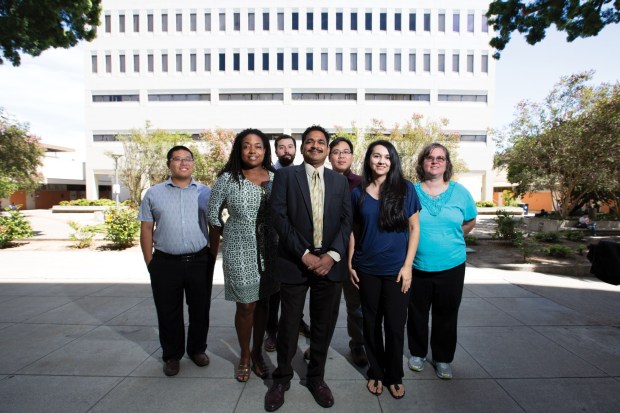 Civil and environmental engineering professor Sudarshan Kurwadkar, center, with his colleagues (Photo courtesy of Cal State Fullerton)
During his lecture, Kurwadkar stressed how those living in economically and ethnically marginalized neighborhoods are more severely affected by environmental pollution. “People living in Beverly Hills have the tools to remove impurities from their water, like at-home water filter systems,” he said. “But this luxury obviously won’t be used by those who can’t afford them. Instead, they must rely entirely on the community water system. … In addition, many of these marginalized communities are located near facilities that produce PFAS. Do you think a millionaire will live next to a PFAS-producing factory?”
Kurwadkar reviewed the evolution of the regulatory frameworks that have addressed the PFAS problem, including the March 2024 federal maximum containment level, which limits these chemicals to four parts per trillion. “That’s like one drop of water in an Olympic swimming pool,” he said. “If water in a given district exceeds this level, they have to monitor and address it. … The problem today is the current administration’s efforts to rescind this guideline; the EPA is trying to roll back its own regulation.”
Kurwadkar noted how individuals can reduce their PFAS exposure. One option is to purchase products that are now labeled “PFAS-free,” in the same way certain foods are designated gluten-free.
“It’s all about making prudent choices,” Kurwadkar said. “You can avoid cosmetics that contain PFAS. Avoid microwavable popcorn and fast-food packaging. Don’t buy grease- and stain-resistant clothing, or any type of waterproof material. Look for products that are labeled ‘no PFAS.’ For example, some PFAS-free nonstick cookware products and carpeting are labeled as such.”
Climate change is also a factor in the PFAS issue. “We don’t know if extreme climactic events, like flooding, will further contaminate our aquifer systems,” Kurwadkar said. “We’re kind of sitting here and looking at what the future unfolds. … So, it’s important that we keep government regulations in place, monitor climatic conditions and maintain a resilient infrastructure to help mitigate the PFAS risks.”