
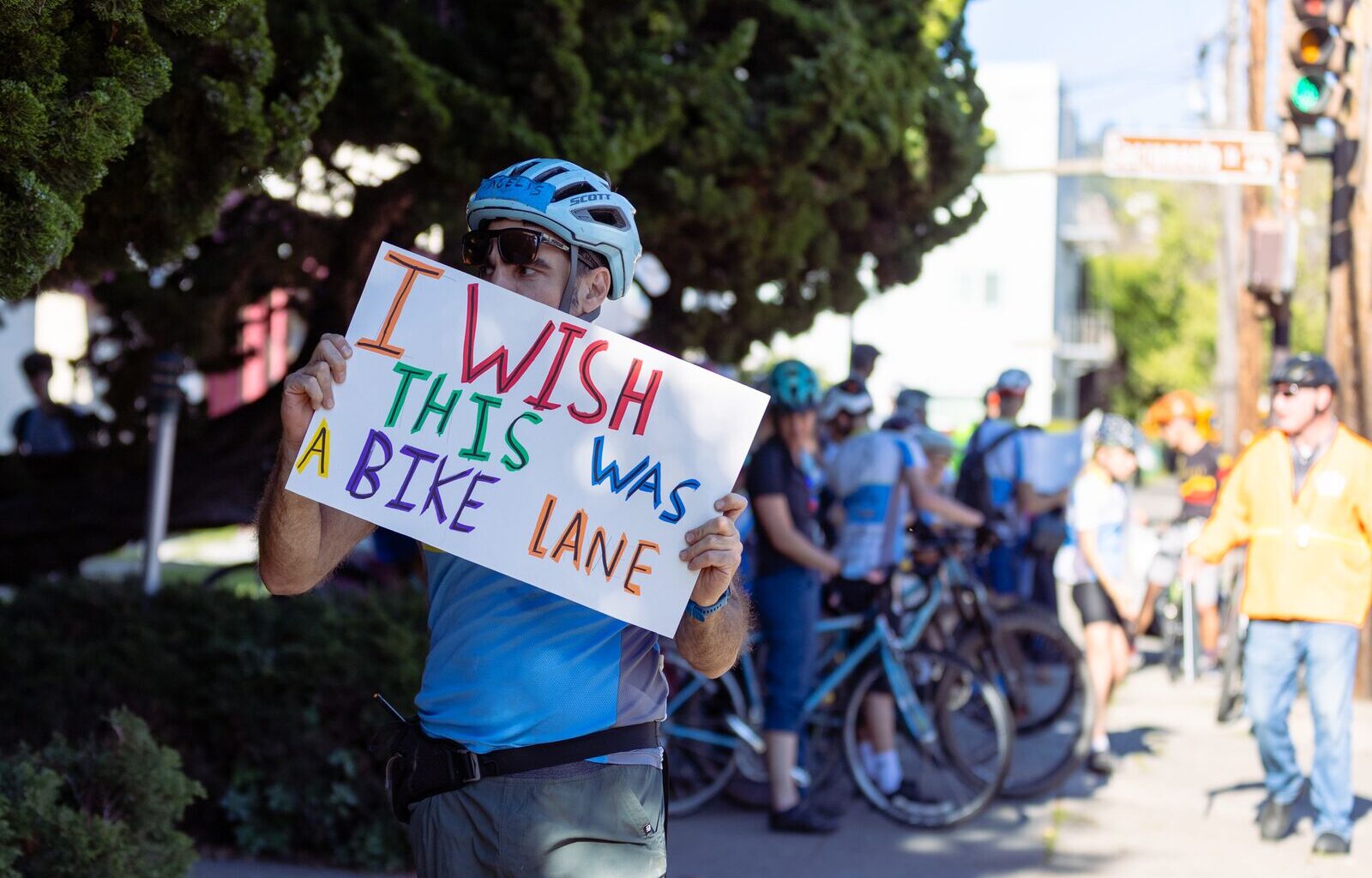
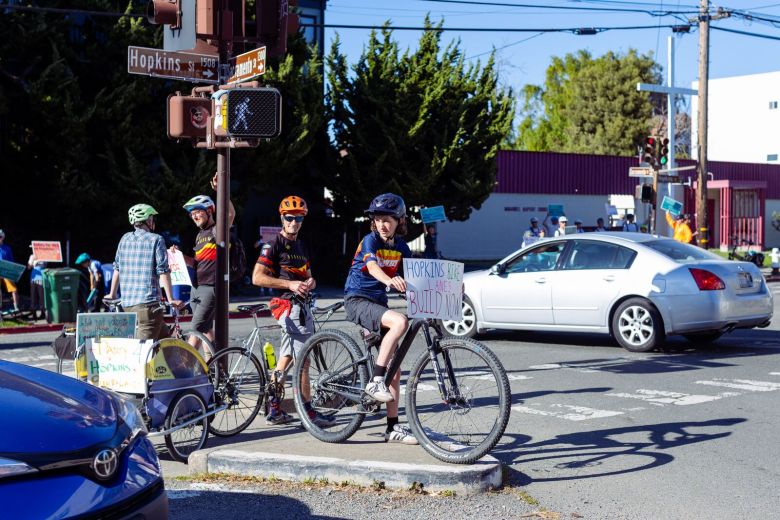
 Cyclists gathered on March 12 for a protest ride in support of protected bike lanes on Hopkins Street in North Berkeley. Credit: Estefany Gonzalez for Berkeleyside
The debate over a plan to build a new protected bike lane on Hopkins Street, at the expense of much of the parking near the North Berkeley corridor’s commercial strip and many of its homes, spiraled three years ago into a bruising battle over the future of mobility in a changing Berkeley. Its conclusion left no one satisfied, with the bike lane shelved by top city officials, the leaders of the Public Works Department that developed the project out of their jobs and the potholed street still crumbling and nearly unchanged.
Now the two City Council members who represent Hopkins have put forward a plan that would in effect kill the project for the foreseeable future.
Shoshana O’Keefe, who opposed the bike lane in her campaign for office, and Rashi Kesarwani, who vocally supported it on the council, have together introduced a proposal for Berkeley to repave the street without the protected cycle track sometime in the next two years. Mayor Adena Ishii and Councilmember Mark Humbert, both of whom have championed bike infrastructure projects in the past, have also signed onto the plan as co-sponsors.
O’Keefe contends the proposal would accomplish “non-controversial” steps to repair the street’s cracked pavement and add new features to make pedestrian crossings safer. Since Berkeley puts a moratorium on work that requires digging up freshly paved streets for five years, though, the bike lane would remain off the table for at least that long.
“Whatever happened in the past happened, and the result was that the street continues to be in desperate need of paving,” O’Keefe said in an interview. “All the safety issues are still very much there, and nothing has happened … because it became so politically toxic.”
The proposal has opponents of the bike lane cautiously optimistic that the goal of their campaign could be at hand: for Hopkins to be repaved without a major redesign, which they fear would drive shoppers away from the street’s businesses and make life untenably difficult for residents who lost parking in front of their homes.
But it has reignited activism in favor of the bike lane from cycling safety advocates. More than 100 project supporters lined Hopkins for a protest on a recent weekday afternoon, a scene reminiscent of the demonstrations many of the same advocates held along the street at the height of the debate over the project three years ago. As drivers and shoppers passed by, some of them honking horns in support, participants rang the bells on their bikes and held signs with messages such as “I wish this was a bike lane” and “I bike and I vote.”
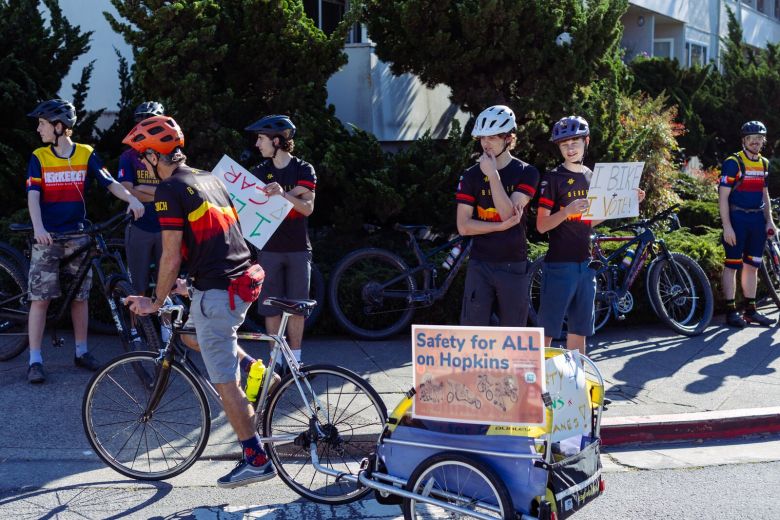 Cyclists during the March 12 protest ride. Credit: Estefany Gonzalez for Berkeleyside
The proposal from Kesarwani and O’Keefe “backtracks on the city’s plans and commitments to make Hopkins safe for all road users,” said Ben Gerhardstein of the street safety advocacy group Walk Bike Berkeley.
With the item headed before the City Council’s infrastructure committee on April 15, and council members poised to adopt updates to Berkeley’s paving plans later this spring, Gerhardstein said his group is lobbying officials to reject the proposal and instead restart planning for the bike lane.
Fractious debate centered on trade of bike lanes for parking
Much of Hopkins Street has no bike lanes today, forcing riders to share lanes with cars along some of the corridor’s busiest blocks; wider segments have only painted lanes that run between parked cars and traffic.
Walk Bike Berkeley members and other street safety advocates have long argued the city needs to install bike lanes that are physically separated from cars to better protect cyclists and encourage less-confident riders to visit the area on two wheels. They contend fears that lost parking would spell doom for the area’s businesses are overblown.
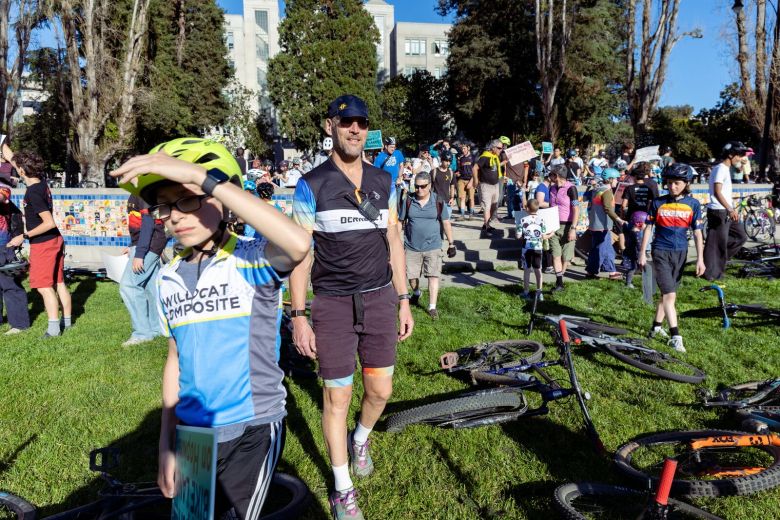 Over 100 people biked from Hopkins Street to Martin Luther King Jr. Civic Center Park on March 12 in support of protected bike lanes on Hopkins. Credit: Estefany Gonzalez for Berkeleyside
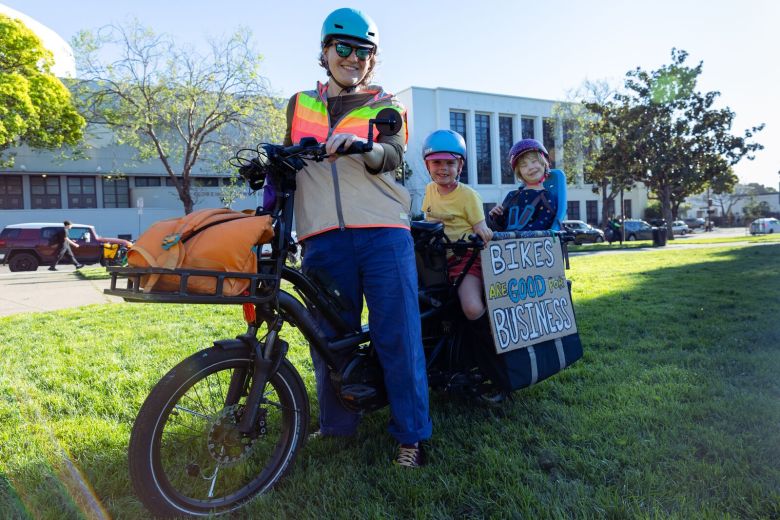 Joanna Dillon and her children, aged 6 and 3, at the end of the ride. Credit: Estefany Gonzalez for Berkeleyside
The project faced intense opposition from many of the neighborhood’s residents and merchants, however, because building the lane would require removing parking spaces and, they argued, make the road overly complex. While some spots in front of cherished businesses such as Monterey Fish Market and Magnani Poultry would be preserved, other blocks would lose all of their on-street parking.
Despite those concerns, the City Council voted to approve the bike lane plan in May 2022. The project’s critics later accused staff in Berkeley’s Transportation Division of misleading the council ahead of that vote because they did not share estimates prepared ahead of the meeting showing the specific number of parking spaces that would be removed to build the lane. Proponents argued the council already understood the trade-offs, and when then-Councilmember Sophie Hahn introduced an item in late 2022 to halt work on the most controversial segment of the bike lane, the council instead stuck with the plan.
The public debate over the project only grew more intense from there, reaching a fever pitch in the early months of 2023 with protracted name-calling battles on social media, torrents of emails to city leaders and dueling crops of yard signs, including in neighborhoods far from Hopkins. It was another example of debates that have unfolded in cities across the country over projects that sacrifice street space once dedicated to cars in an attempt to improve conditions for cyclists, pedestrians and transit riders.
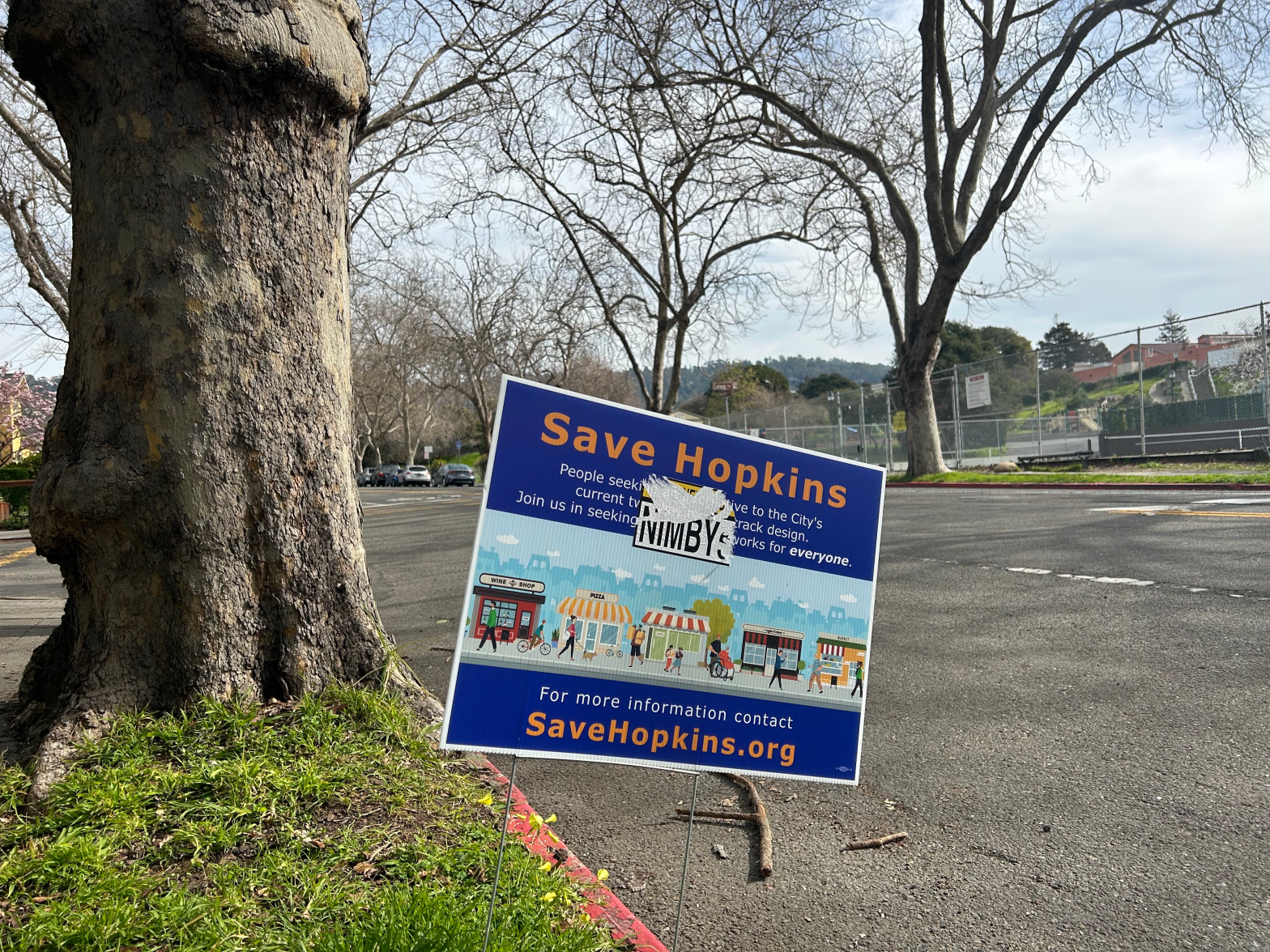 Residents and businesses opposed to the bike lane have planted dozens of “Save Hopkins” signs along the street. In this 2023 file photo, someone defaced several of the signs with stickers adding “from neighbor NIMBYs.” Credit: Nico Savidge/Berkeleyside
Then-City Manager Dee Williams-Ridley put the project on hold that April, saying the Public Works Department did not have enough staff to develop it and that Berkeley Fire Department leaders were concerned plans for the lane would not allow adequate space on the road for emergency evacuations or access. Fire officials’ concerns seem likely to be a sticking point for any effort to revive the project.
In a sign of the turmoil unfolding behind the scenes at city hall, Williams-Ridley also wrote that the city needed to take time “to convey confidence and integrity” in the work of its own transportation staff. Berkeley officials had by then launched an investigation into how those workers handled the project, and by the end of 2023 both Transportation Division chief Farid Javandel and Public Works Director Liam Garland had resigned suddenly. Neither man has commented publicly on why they left, but advocates on both sides of the Hopkins debate contend they were forced out over their handling of the project.
A few weeks after Garland’s departure, Hahn and then-Councilmember Susan Wengraf put forward a proposal broadly similar to the one O’Keefe and Kesarwani have introduced, which would have committed the city to repaving Hopkins — without the bike lane — as part of a five-year street paving plan that runs through 2028. The council narrowly rejected it, with several members saying they didn’t want to give up on the bike safety project.
Is Rashi Kesarwani’s turn against the project a practical move or election-year pivot?
Kesarwani didn’t just support the bike lane when the project came before the council in the spring of 2022 — she introduced her own proposal to extend the cycle track, which transportation officials initially proposed ending at Gilman Street, another half-mile to Hopkins’ western end at San Pablo Avenue. Kesarwani voted again to back the project later that year.
When the council voted down the proposal from Hahn and Wengraf to pave the street without the bike lane, Kesarwani gave an impassioned speech about why the body needed to have the political courage to stick with the project, then joined a 5-4 majority in voting against including Hopkins in the paving plan.
“Sometimes you have to do the unpopular thing,” she said during the meeting, pounding her hand on a table for emphasis, “because safety matters.”
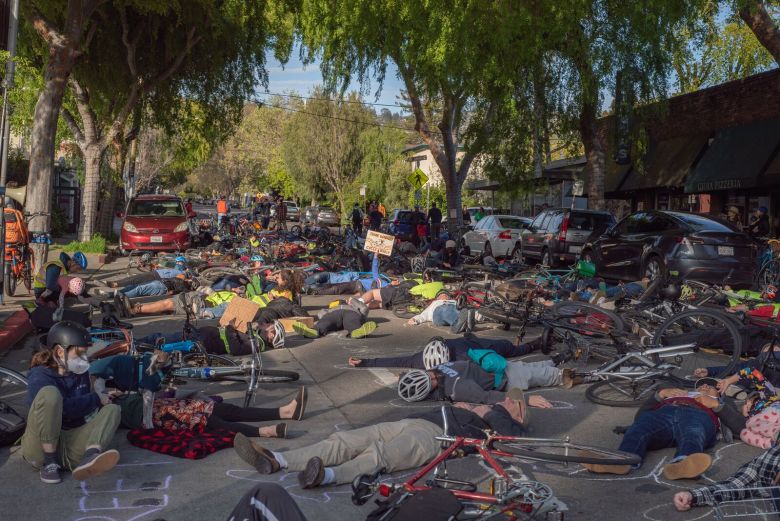 Dozens of cyclists take part in a “die-in” protest on Hopkins Street shortly after Berkeley postponed the bike lane project in 2023. Credit: Ximena Natera, Catchlight/Berkeleyside
In an interview, Kesarwani said she continues to support bike safety infrastructure, but joined with O’Keefe to put forward the latest paving proposal because Hopkins’ condition has continued to deteriorate — two of its busiest blocks are rated as “failed” — while a deep city budget deficit could render the protected bike lane too expensive to build. Kesarwani said she has requested cost estimates from Public Works officials so the council can compare how much it would cost to repave Hopkins with and without the lane.
“We need to get that full accounting of: What is the design that is safe and workable, and what is the cost?” she said. “Every year that goes by that we are in this impasse and this culture war that people are failing to resolve, the costs to pave Hopkins go up.”
The seat Kesarwani has held for two terms representing Northwest Berkeley, including the blocks of Hopkins west of Sacramento Street, will be on the ballot this November. She has declined to say whether she plans to run for another term. But asked whether the seeming reversal should be read as an election-year pivot to appease voters in her district, Kesarwani noted she won her current term in 2022 as a supporter of the bike lane.
With the city facing a more dire budget situation today, she said, “I think people are looking for an elected representative who’s going to be thoughtful about their decisions and not make decisions in a vacuum.”
Signs some bike lane supporters want to move on from Hopkins
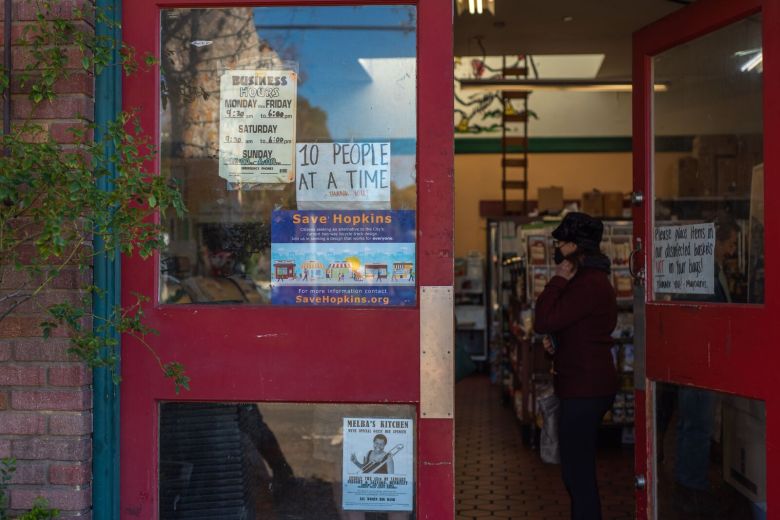 A “Save Hopkins” poster hangs at the Magnani Poultry shop’s door in this 2023 file photo. Credit: Ximena Natera, Berkeleyside/CatchLight
In addition to shutting down the bike lane project, Walk Bike Berkeley contends paving Hopkins without major changes would make the street even less safe than it is now, since drivers that must slow down to navigate the cracked pavement and potholes could instead drive faster along a smooth new road surface.
O’Keefe noted her proposal calls for changes that could slow cars, such as extended curbs known as “bulb-outs” at the busy intersection of Hopkins and Monterey Avenue, where a pedestrian was struck and killed in 2017, as well as a new raised crosswalk at Josephine Street.
And Donna DeDiemar, a leader of the anti-bike lane group Friends of Hopkins Street, says repaving will mean fewer hazards for pedestrians and cyclists who are even more at risk from the street’s potholes than drivers are.
“The condition it’s in is already massively unsafe,” DeDiemar said.
Those arguments have changed little through the more than two years since the council last weighed in on Hopkins. But the backing of Kesarwani, Humbert and Ishii for the plan to repave the street without a bike lane could indicate even supportive city officials are now looking to move on from the project.
In her interview with Berkeleyside, Kesarwani laid out a case for proponents of bike safety infrastructure to make what would amount to a tactical retreat from the Hopkins debate so they can focus the city’s money and attention on other projects. When advocates campaigned in 2024 to pass Measure FF, a parcel tax to fund street paving and safety improvements, they specified that its revenues could not be used to pay for protected bike lanes along portions of Hopkins.
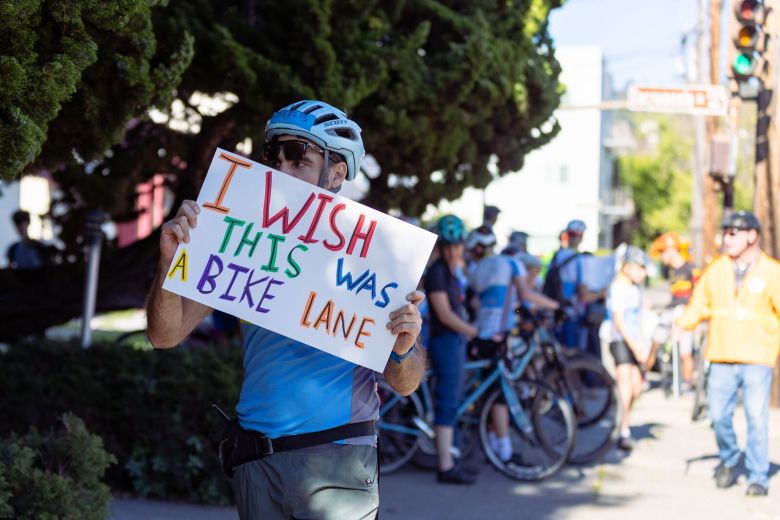 A protester holds a sign at the demonstration in support of protected bike lanes on Hopkins Street last month. Credit: Estefany Gonzalez for Berkeleyside
“I’m concerned about the oxygen that is being taken up by this street when there is so much more that we can do,” Kesarwani said. “I want to make sure we use our scarce resources and our scarce staff time to get as many miles of safe streets as possible.”
While DeDiemar’s group would be thrilled if the proposal from O’Keefe and Kesarwani is approved, she isn’t convinced that the idea is the white flag that it appears to be. DeDiemar said she remains concerned that it might prove to be a Trojan horse for reopening the bike lane discussion, and that the council will make a “last-minute amendment to include the cycle track.”
As his side of the debate rallies against the proposal, Gerhardstein of Walk Bike Berkeley argues advocates shouldn’t drop the Hopkins project because the corridor is a critical piece of the network of cycling-friendly routes the city has pledged to create in its Bicycle Plan. And he said Berkeley’s budget woes shouldn’t be an excuse to not build the lane, since officials are required to provide a minimum amount of street funding from the city’s general fund to access the money raised by Measure FF, which could insulate the project from cuts — if officials make it a priority.
“I don’t really care to guess at what’s going on politically,” Gerhardstein said. “I feel like there is room, and a willingness on the part of some of the members who are signed on to that item, to change their minds … and that’s where our focus is.”
Related stories
Berkeley public works director resigns in latest upheaval for key city department
November 9, 2023Nov. 13, 2023, 9:21 a.m.
Advocates push to extend planned Hopkins bike lanes, sparking another fierce debate
December 14, 2022Dec. 14, 2022, 3:31 p.m.
How did the Hopkins Street bike lane project turn into a ‘culture war’?
February 23, 2023Sept. 22, 2023, 10:14 a.m.
“*” indicates required fields