
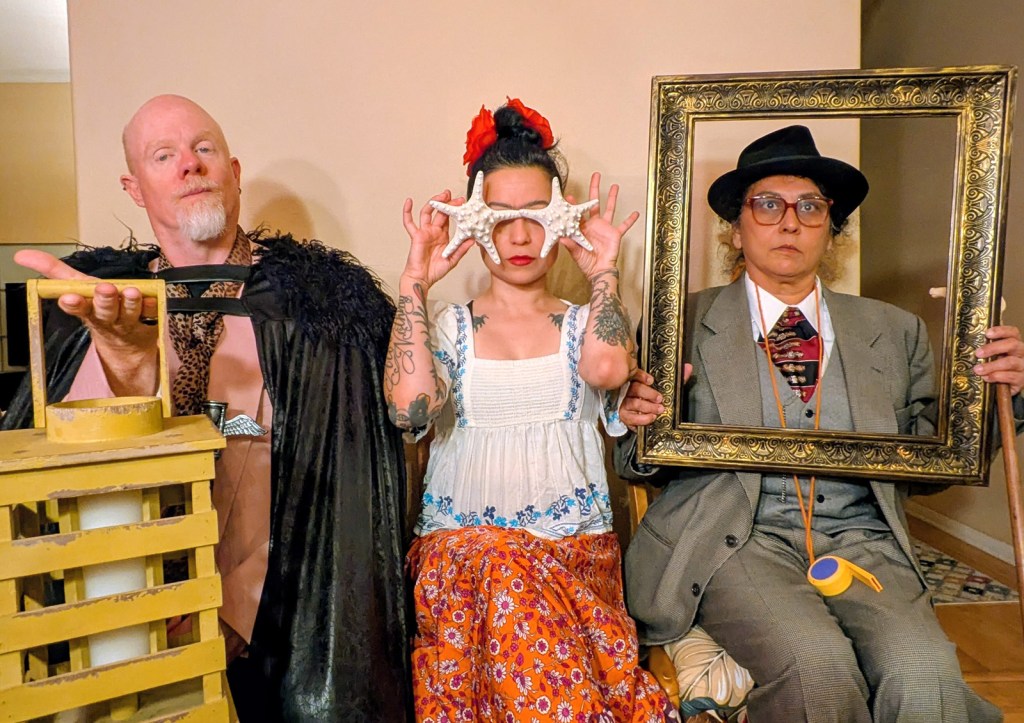
Immersive theater has been around for ages, but “Your Unconscious Mind” may be the first local production encouraging audience members to show up in their pajamas and help create the surrealist art of their dreams.
“The Unconscious Mind,” which opens Friday evening at the California Center for the Arts, Escondido, is the creation of Brilliant Spectrum Art owner Brenda Townsend, who wrote and produced the play.
Townsend is a professional artist, teacher and community theater director who is combining all of those skills in her world premiere show, which will have 10 performances in the arts center’s black box theater space.
The premiere of “Your Unsconscious Mind” celebrates Escondido’s Arts & Culture month. The play was funded with the help of a city arts grant.
“Your Unconscious Mind” will bring to life three famous figures of the 20th century: Austrian psychoanalyst Sigmund Freud, whose investigative work in exploring the unconscious mind inspired generations of authors, thinkers and artists; multimedia Spanish artist Salvador Dali, a leader in the surrealism art movement; and Mexican painter Frida Kahlo.
Audience members will enter a “dreamlike” classroom to meet Freud, Dali and Kahlo, and over the course of the show they will be encouraged to work with the trio to guide the creation of both collaborative surrealistic artworks and create their own, artworks to take home. Audience interaction is voluntary, so attendees can just sit and watch if they prefer.
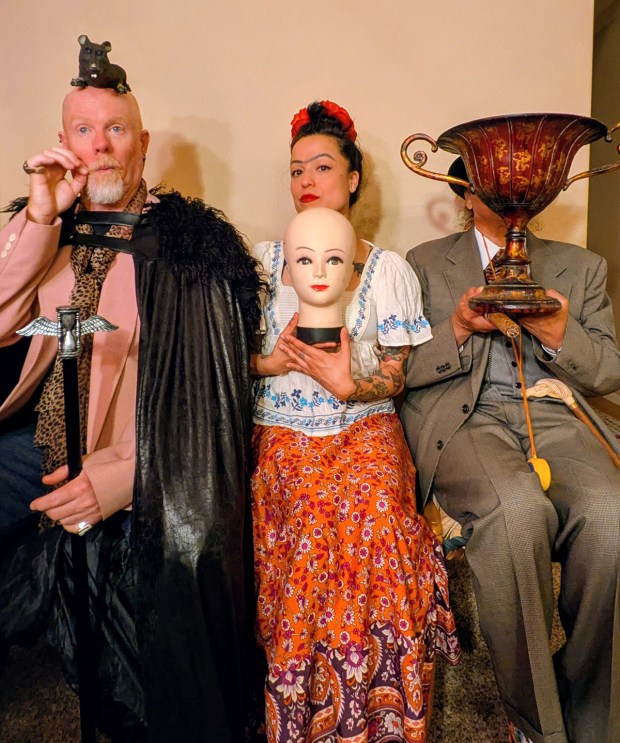 Phil Amer (Salvador Dali understudy), Ana dela Torre (Frida Kahlo) and Suchita Jhawar (Sigmund Freud) in costume for Brilliant Spectrum Art’s “Your Unconscious Mind.” (Brenda Townsend)
The show is directed by Steve Warrick and stars Suchita Jhawar as Freud, Ciara Atencio as Dali and Ana dela Torre as Kahlo. Phil Amer is the understudy for Dali.
Townsend said the show was inspired by her own studies of art and her global travels.
“As an artist and avid art history enthusiast, I have visited with my husbadn some of the most famous art museums in the world. When in Spain, we visited the Dali museum in Figueres, which Dali designed himself. I was able to spend more time with the work of this artist and to view Dali and his work through the lens of a native son, which is very different than he is regarded in the United States.
“Kahlo was also around at the time of the movement, but never identified as a Surrealist herself, although those involved were constantly trying to absorb her into their group. As I was reading more about the Surrealist movement, I learned that the artists considered Sigmund Freud their patron saint, and Freud and Dali even had one meeting together in the late 1930s.
“As I read more, my imagination took flight, and I began to get ideas about possible conversations about art and life that could have taken place between these three influential minds and voices of the 20th century,” Townsend said. “Most of the words in the show are the true voices of the people being portrayed.”
Freud, who died in 1939, pioneered the field of psychoanalysis and believed that the hidden depths of our unconscious minds could be accessed through both dream analysis and free association talking. Freud believed the unconscious mind harbors repressed memories, desires and fears that drive how we think and behave.
Following the publication of Freud’s books “The Interpretation of Dreams” in 1899 and “Unconscious Mind” in 1915, authors, philosophers and artists embraced the idea of exploring the unconscious mind in their work.
In 1916, the anti-war absurdist protest art movement Dadaism began in Europe during World War I, and from that grew Surrealism, which was born in 1924 with French writer André Breton’s book “Surrealist Manifesto.” He wrote that the goal of Surrealism was to bypass logical thought and find creative inspiration in the unconscious mind.
One of the leading Surrealist artists was Dali, who rose to fame in 1929 with the dreamlike film “Un Chien Andalou” (an Andalusion dog), which he co-created with Luis Buñuel. It featured a series of bizarre and disturbing scenes strung together with no clear storyline. His most famous work was the 1932 painting “The Persistence of Memory,” which depicted a trio of melting clocks on a mostly barren landscape. He passed away in 1989 at age 84.
Kahlo, who was active as an artist from the mid-1920s until her death in 1954 at age 47, didn’t identify as a Surrealist but her symbol-laden and often fantastical paintings often expressed her fears, losses and personal traumas. Many of her paintings feature dreamlike scenes, bleeding hearts and violence, inspired by the severe injuries she suffered in a bus accident in her teens, her unhappy marriage and her miscarriage.
The Surrealism art movement slowly declined in the 1950s and ’60s, giving way to the the rise of expressionism and pop art. But the unconscious mind continues to serve as inspiration for artists, writers and filmmakers.
Townsend said she envisions this play as “edutainment.”
“People will most likely come in knowing at least a little bit about the Surrealists, and how they came to be, and develop, as a major art movement in the early 20th century. We hope that this experience will make our audience laugh out loud, as well as have a blast, being guided to create impromptu works of art themselves with no fear,” she said. “Lastly, we also wish to inspire audiences to curiosity, so that they want to learn more about these artists and others, once they have experienced this show.”
‘Your Unconscious Mind’
When: 7:30 p.m. Friday, Saturday and April 9-12, 16-19
Where: Californina Center for the Arts, Escondido, 340 N. Escondido Blvd., Escondido
Tickets: $20
Online: yourunconsciousmind.square.site/