
Orange County Supervisors just uncovered the biggest problem fueling fraud, waste and inefficiency inside the county government.
It’s them.
Last week, auditors hired by the county to look into how much damage former County Supervisor Andrew Do was able to do inside the County of Orange came back with startling conclusions – echoing what I’ve been writing for years.
[Read: Audit Finds More Questionable Spending From Convicted Former OC Supervisor]
Orange County Supervisors are treated like Kings and Queens, not to be questioned by anyone and able to stick their hands directly into the bureaucracy of government.
Keep in mind that more than a hundred years ago around the turn of the last century, public bureaucracy was born in America to avoid the situation that became synonymous with government corruption, New York’s Tammany Hall, where politicians had a direct hand in government spending, contracts and hiring.
Reforms that followed those scandals largely set up the city manager form of government seen across most of America today.
The idea being that you don’t want elected leaders directly ordering public staff to do anything or getting involved with procurement or hiring.
That’s why – in theory – we have a county CEO, an Executive, not a CAO, an Administrator.
Except the Do scandal clearly shows how politicians in Orange County have been able over the past two decades to effectively short circuit the county CEO, turning the job into a bag man of sorts.
At the March 24 board meeting, auditors with Weaver unveiled the conclusions of looking into a series of contracts emanated from Do’s District 1 office, part of what auditors called “a culture where decisions related to District 1 contracts were not to be questioned.”
Yet what the auditors were too nervous to note, or didn’t see, is the structural problem that made Do possible.
County supervisors regularly work the CEO’s office and in many cases, county agencies.
Note that earlier this year, when South County residents started complaining about the expanding footprint of the local county landfill, Supervisor Katrina Foley announced to residents that she was able to get the head of OC Waste to immediately halt the project, illustrating a level of influence at the department level that even her colleagues called out publicly.
[Read: Expansion of County Landfill Turns Into Hot Button Campaign Issue]
Yet Supervisor Vicente Sarmiento really illustrated the power of county supervisors at the March 24 meeting when he publicly said that when he asked questions about Do’s contracts, former CEO Frank Kim verified that everything was ok.
With Do himself.
“I said, ‘Can you explain what happened with this inquiry?’“ Sarmiento said. “I remember the response graphically, which was ‘I (Frank) checked with the supervisor’s (Do’s) chief of staff and he said that it was.’”
“There were people trying to draw attention to this, and those in positions of more executive authority disregarded those,” he continued.
“That is a fatal flaw in our government.”
To Sarmiento’s credit, he finally exposed the big dirty secret at the County of Orange.
The question now is how can county supervisors ignore the implications of what Sarmiento clearly put out there?
Guardrailing Politicians
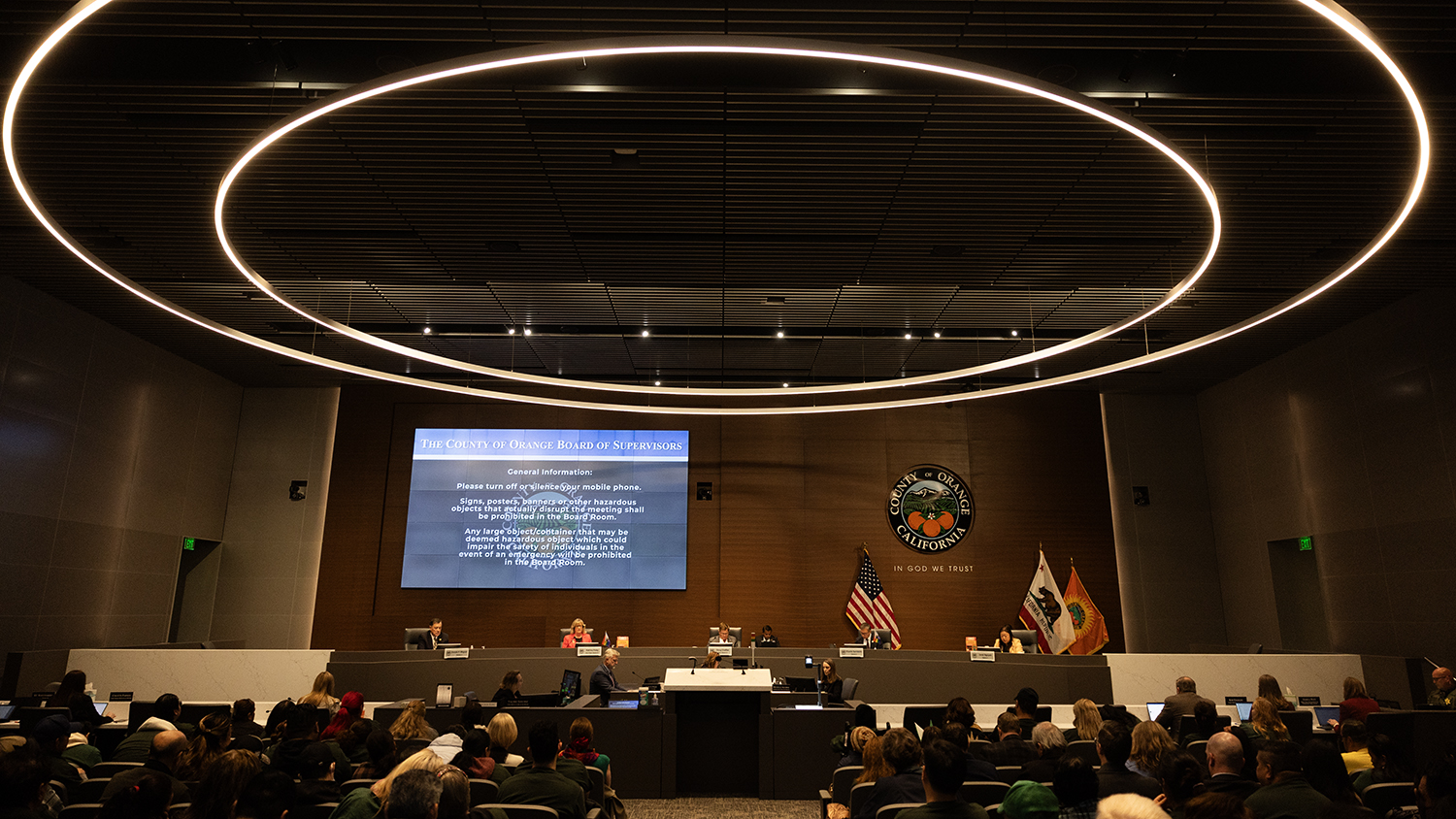
 The Orange County Board of Supervisors building in Santa Ana on Aug. 19, 2024. Credit: ERIKA TAYLOR, Voice of OC
I’ve written before on the weak CEO system in place in Orange County that county supervisors have historically encouraged and that was directly responsible for what Do was able to get away with.
Few insiders seem to like my idea of having an elected CEO – as they are currently experimenting with in LA County.
[Read: Santana: Time For an Elected Orange County CEO?]
Yet the fact that so many insiders are afraid of an elected CEO makes me even more confident in the notion.
When the county went bankrupt in 1994, Wall Street insisted on having a real chief executive that was accountable. But almost immediately, county supervisors short circuited that office and made sure to put weak executives in place.
Sarmiento noted publicly that he admires current CEO Michelle Aguirre because she’ll bite back against supervisors.
But Aguirre – the former head of the budget office – is ready for retirement, with just a few more months to go.
That kind of short timer is perfect for pushback.
But what happens when she leaves?
County supervisors have triggered another search for a weak CEO but have yet to find one despite several failed recruitments.
Could it be that any tough executive with vision is smart enough to not take a job where five supervisors get to run the county behind the scenes?
In addition to an elected CEO, there’s not enough county supervisors.
Five officials to oversee a county of three million people spread out over nearly 800 square miles of land and 34 cities is clearly not enough.
There’s been talk of expanding supervisors to seven or even nine in past years.
But again, the current Fab Five are unlikely to dilute their power.
That kind of sweeping reform may have to be imposed on them from the citizenry in the form of a ballot initiative.
Reining In Supervisors’ Discretionary Spending
 Disgraced Supervisor Andrew Do during a 2023 Orange County Board of Supervisor meeting. Credit: JULIE LEOPO, Voice of OC
There’s no area more in need of reform – or more like termination – than county supervisors discretionary spending, which was minimal for decades with traditional OC leaders having an aversion to what many call political slush funds.
Yet when the COVID bailout dollars arrived, county supervisors made sure to give themselves massive private spending accounts, totalling $10 million each.
[Read: Santana: Should Elected Officials Get To Spend Public Money Themselves?]
Most spent it right away. And many expenses had no relation to the pandemic.
Especially not now.
Most recently, Supervisor Katrina Foley doled out a bunch of discretionary dollars to a series of local groups and nonprofits – just ahead of her reelection campaign.
Supervisor Janet Nguyen is currently arguing that just under $4 million recovered from the Do scandal should go directly to her office as she didn’t get to direct spending any of the COVID money on her district.
That discretionary spending was key in Do’s bribery scheme.
[Read: Former OC Supervisor Sentenced to 5 Years in Federal Prison in Bribery Scheme]
Again, because no county executive can tell county supervisors the word, no.
Real Ethics Reform
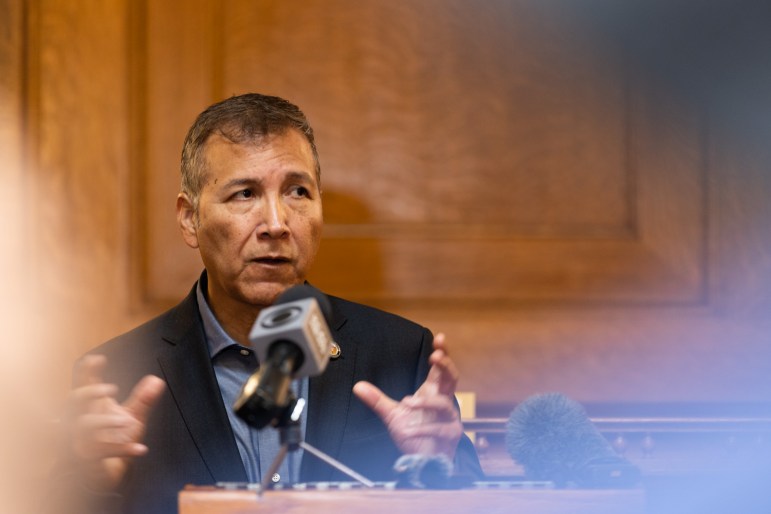 Orange County Supervisor Vicente Sarmiento speaks to reporters after the scheduled press conference on July 25, 2025. Credit: JULIE LEOPO, Voice of OC
Sarmiento was spot on to publicly point out that the county’s ethics commission is essentially “toothless.”
What he didn’t say is that the commission was designed to be toothless. That’s the only way that supervisors approved it.
To her credit, campaign finance activist Shirley Grindle – who has been tracking money and influence at the county since the 1970s – got supervisors to establish a commission.
But the commission can’t really look into any ethical issues and mainly acts as a coach to candidates and office holders on how to comply with campaign finance reporting requirements, which can be onerous and even confusing.
The challenge now for county supervisors like Sarmiento is to put their money where their mouth is and actually toughen up the county ethics commission, granting it investigative powers and also potentially tightening up oversight of OC’s lobbyist culture.
A Real Fraud Hotline
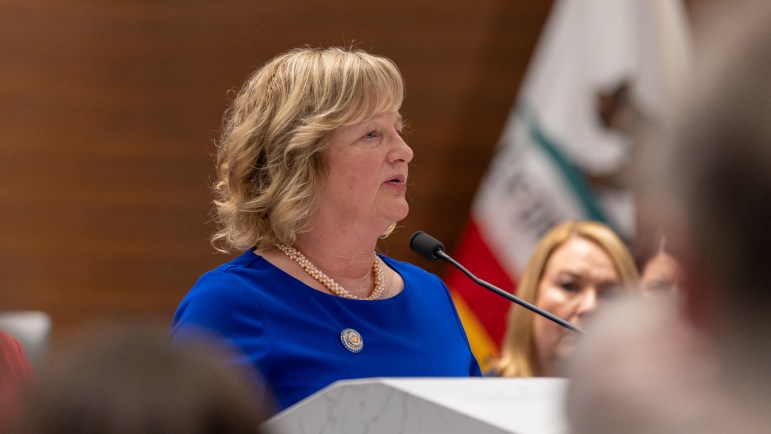 Supervisor Katrina Foley speaks at the podium during the OC Board of Supervisors meeting on May 20, 2025. Credit: ERIKA TAYLOR, Voice of OC
Supervisor Foley also mentioned at the March 24 meeting that the county’s fraud hotline – a favorite fake fix of supervisors – needs to be improved.
I’ve spoken with numerous employees and activists – like those working to improve the county animal shelter – who have consistently told me the hotline doesn’t work and nobody calls back when complaints are left on the line.
And again, that’s how it was designed to work – especially after county supervisors moved the hotline from the county Auditor Controller to their lawyers’ office, the County Counsel.
There’s rarely any kind of public listing of how many complaints were left on the hotline, how many were investigated and how many triggered sanctions.
Real Transparency
I got an even louder laugh when Sarmiento mentioned at the meeting that county supervisors calendars should be made public.
I’ve asked to see supervisors’ calendars many times in my more than 20 years of covering the County of Orange.
It’s a request that numerous county counsels have consistently refused.
After Anaheim’s City Hall corruption scandal kicked off in 2022, a new slate of council members eventually voted to regularly post their calendars online – detailing who’s lobbying them and who they’re meeting with.
[Read: Anaheim Officials to Publicly Post Online Who They Meet With]
Given Sarmiento’s idea, I’ll go ahead and ask again and see what I get back from the county.
I’ll make sure to share whatever I find out.
Stay tuned.
Related