
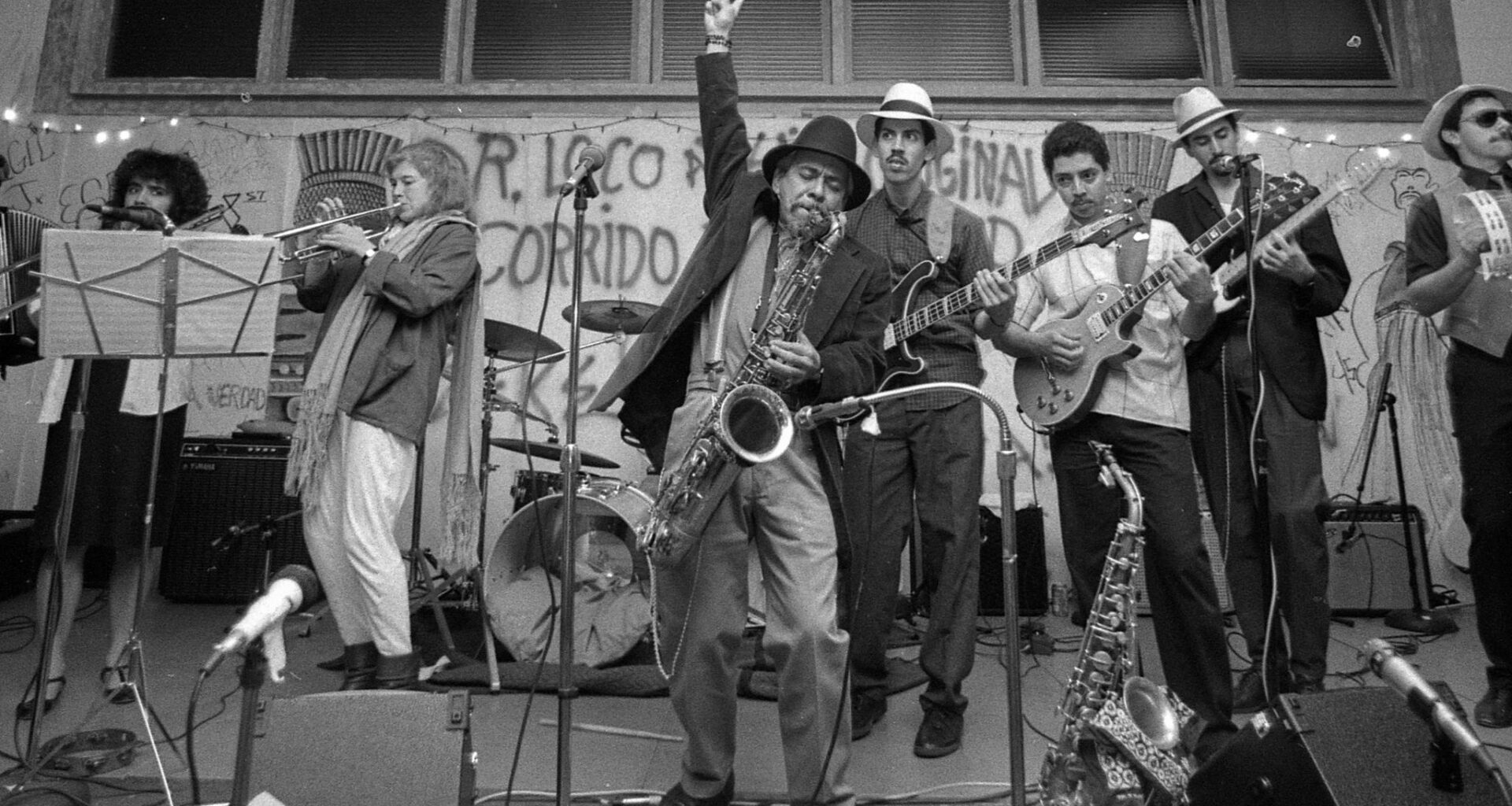
Dr. Loco & His Boogie Band performs at Stanford University in 1988, led by Jose Cuellar, the San Francisco State professor who built a following as his musical alter ego, Dr. Loco.
Deanne Fitzmaurice/S.F. Chronicle
Jose Cuellar, known onstage as Dr. Loco, performs with Dr. Loco & His Boogie Band at Stanford University in 1988, where the group first took shape among students and faculty in the early 1980s.
Deanne Fitzmaurice/S.F. Chronicle
Jose Cuellar aka Dr. Loco, in an undated publicity photo
Courtesy of Stacie Powers CuellarDr. Loco and His Rockin’ Jalapeno Band, founded and led by Cuellar, played up to 100 shows a year across the Bay Area and recorded four albums.Cuellar was a longtime San Francisco State professor and chair of the Raza Studies Department.A public memorial and concert honoring Cuellar will be held April 8 at a major San Francisco theater.
During his lectures in the Raza Studies Department at San Francisco State University in the 1990s, professor Jose Cuellar would mention that students could experience the pride and joy of being Latino by checking out the local Tex-Mex outfit Dr. Loco and His Rockin’ Jalapeno Band.
Students who followed this advice to a club or festival in the city’s Mission District would see their professor as his alter ego, Dr. Loco, wailing on the sax or squeezing an accordion while he sang in a blend of English and Spanish. Cuellar took the stage after making a Clark Kent transformation from his academic attire of subtle Pendleton shirt and Ben Davis jeans to his bright and shiny performance zoot suit. He was known universally as Dr. Loco, or just Loco, and he cultivated that image with his signature Ray-Bans and braided ponytail and beard.
Article continues below this ad
“He was a proud Tejano (Texan of Mexican descent), and because he was a professor he brought in a young audience,” said Bay Area radio host and Latin music historian Jesse “Chuy” Varela. “In his 40 years in the Bay Area performing and teaching, he touched generations with a style that was distinctly his own.”
Exuberant and charismatic, Cuellar kept his musical act going after he taught his last class and retired in 2020. He was still blowing on that sax and singing last July when he was diagnosed with incurable small cell lung cancer. Cuellar died at his home in the Bayview on Jan. 21, at age 84. But Dr. Loco was not the kind to go quietly.
His life will be honored by a free public memorial and concert April 8 at the Palace of Fine Arts Theater in San Francisco. The event will be hosted by his wife of 36 years, Stacie Powers Cuellar. Reservations are requested.
San Francisco Chronicle Logo
Make us a Preferred Source to get more of our news when you search.
Add Preferred Source
“Jose was always honest, earnest and humble and came from a place of real principal, committed to showing up in his authentic self in whatever context he found himself in,” said Powers, retired executive director of Brava Theater Center in the Mission District, and a 40-year fixture in Bay Area performing arts. “Both of us saw the power of performance as a place where people could be transformed, find connectivity, feel at peace with who they are and be energized to face another day of fighting the good fight.”
Article continues below this ad
As a more permanent memorial, Dr. Loco’s image is being painted on a home known as the House of Latin Rock at 25th and York in the Mission. He will join Carlos Santana, Pete Escovedo and other Bay Area Latino music stars on the mural by Carlos “Kookie” Gonzalez. Varela is paying the artist out of pocket for the tribute.
“Dr. Loco was very unique in the sense that in the Bay Area there were not a lot of Texas-oriented bands that played Chicano music,” said Varela, program/music director at KCSM Jazz 91 FM. “He’d take a song like ‘Shotgun’ by Junior Walker and the All Stars and rewrite it in this Spanglish language that would make it cool for the younger listeners.”
This unique blend was formed among Stanford graduate students when Cuellar was a teaching fellow in 1983. As it evolved, Dr. Loco and his Rockin’ Jalapeno Band was not a hobby band or novelty act. It was a nine-piece professional wall of sound with horns, percussion, drums and electric guitars. The set list was so broad that Cuellar often labeled it a “History of Chicano Music.”
José Cuellar performs as Dr. Loco at the Oakland Museum of California in 2006, leading the band that made him a fixture on Bay Area stages.
Carlos Avila Gonzalez/SFC
For 20 years, the Rockin’ Jalapenos were in demand as a dance band that played up to 100 engagements a year in the Bay Area and beyond.
Article continues below this ad
They appeared at San Francisco venues including Slim’s and the Great American Music Hall, at events like the Black & White Ball and the Stern Grove Festival, at winery concerts in Napa Valley and Sonoma, and festivals in Dolores Park and nationwide. The band also recorded four albums.
Cuellar had other musical projects all along: He played as a solo act on indigenous flutes, fronted a Tex-Mex trio, Los Tiburones, and recorded a soundtrack for the Hollywood feature film, “Alambrista (the Illegal)” directed by Robert Young and released in 1977.
“We’re just having a good time,” he told a Chronicle interviewer in 2000. “I’m lucky to be making the most of a modest talent.”
Cuellar was a working musician long before he was a working academic. Music was Plan A. He would never have found Plan B and his talent for teaching had he not been kicked out of a Los Angeles recording session because he could not read music, said his wife. This compelled him to enroll in community college to take an introductory class in music, which took him on a road that ended with a doctorate in anthropology from UCLA.
His academic specialty was cholos, part of a Chicano youth subculture along the U.S.-Mexico border, and he was in Tijuana conducting interviews when one of his young subjects asked if he was a doctor. He responded in Spanish that he was a doctor of anthropology, which sounded like “loco.” The kids started calling him Dr. Loco, and the nickname stuck.
Article continues below this ad
“He was pretty much crazy,” said Powers. “Crazy in a good way, doing a million things at once, all over the place. He was living in a duality all his life.”
The duality began in San Antonio, the historic South Texas city that was a battleground in the war for Texas independence from Mexico in 1836. He was born Jose Bernardo Cuellar on April 3, 1941, on the south side of town, where he grew up in an extended family that lived on the same street. They all played instruments and traditional Mexican music. His father, also Jose Cuellar, was a draftsmaker who made aerial maps of Europe for the military during World War II.
By the time he was 17, Jose was aiding his father as a draftsman in training while also playing clarinet in the marching band at Brackenridge High School. In his senior year he was promoted to drum major, leading the band in the Fiesta San Antonio parade.
After graduating in 1959, he was on his way to register for drafting classes at a technical college, when he walked by a music store and saw a tenor saxophone in the window. He walked into the store and came back out with that sax, using the $600 in cash he was carrying for tuition money for its purchase. That was the end of drafting school and the beginning of his life as a musician. By the end of that one day, he was in a band with high school friends.
After a four-year detour in the U.S. Air Force, stationed in Puerto Rico, he was discharged in 1964 and joined a San Antonio R&B band called the Dell Kings, which worked its way to Las Vegas and Los Angeles, where they lived in a hotel on the Sunset Strip, waiting for the big break that never arrived. Cuellar found work as a studio sax player, which brought him to the moment when it was discovered that he couldn’t read sheet music.
Article continues below this ad
“He was trying to fake it and didn’t make it,” said Powers. “He always said he was so embarrassed by that.” He enrolled in Golden West College in Huntington Beach and went on to earn his B.A. from Cal State Long Beach, followed by his master’s and Ph.D at UCLA, all on the G.I. Bill.
“Those were radical times,” he once told an interviewer from Latin Style magazine. “There were fewer than 100 Chicanos at UCLA total. There was a great deal of activism and a lot of tension.”
His first tenure track job was as an associate professor of Chicano studies at San Diego State. After attaining tenure, he took a leave to become a combination visiting fellow in Chicano studies and anthropology professor at Stanford University in 1983.
Jose Cuellar, performing as Dr. Loco, leads Dr. Loco & His Boogie Band at Stanford University in 1988, blending Chicano music and showmanship that would define his decades-long Bay Area career.
Deanne Fitzmaurice/S.F. Chronicle
His first band while at Stanford was a quartet of mixed ethnicities and genders that grew to a 12-piece band made up of undergraduates, grad students, staff and faculty. Called “Dr. Loco’s Original Corrido Boogie Band,” it played the college circuit and local festivals. Band membership was always in flux as members left for academic jobs. By attrition, the 12-piece boogie band was reduced to nine and renamed “Dr. Loco’s Rockin’ Jalapeno Band.”
“Dr. Loco was always encouraging about stuff we could do or try. He was good at coaxing talent and ideas out of everybody,” said Charlie Montoya, who was a resident assistant at the Casa Zapata, Stanford’s Chicano/Latino-themed house, when he met Dr. Loco after one of his dorm lectures. Montoya was recruited to play percussion in the Boogie Band and was promoted to bass in the Jalapeno Band as an undergraduate in 1989. He stayed with it for 12 years during through graduation and the early years of a civil service career in San Mateo County.
“We were touring and recording and I got to see a lot of the United States,” said Montoya. “Dr. Loco modeled how to be a professional,” he added. “He had a lot of energy even when he had a cold or the flu. The show must go on.”
Cuellar taught and did research at both UC Berkeley and Harvard before Stanford made what he liked to call “an offer that he couldn’t accept,” to join the permanent faculty. Instead, he accepted an offer from San Francisco State to become chair of the Raza Studies Department. The tenure-track position was prestigious: Raza Studies was one of the four founding departments in the first college of ethnic studies in the country when it opened in 1969, to meet a student demand for settling the high-profile student strike of 1967-68.
He was on the faculty from 1990 to 2009, after which he became emeritus and kept teaching until 2020. His classes were usually full, with a waiting list.
“He was an incredibly impactful professor. The same way he could move his concert audiences, he could move his students,” said Teresa Carrillo, who was mentored by Cuellar when she was a graduate student at Stanford and is now full professor in what is now called the Department of Latina/Latino Studies at San Francisco State. “In addition to giving his students material that centered Latinos and people of color, he gave them the confidence and the conviction that they could be agents of social change and justice.”
Cuellar had been married and divorced twice, with two kids from his first marriage, when the band played a New Year’s Eve show at Fort Mason in 1989. Powers, a stage manager for the San Francisco Mime Troupe and one-time Long Island springboard diving champion, was in the audience. Dr. Loco noticed her, and at the end of the set he stepped out from the stage to approach her.
“He came up to me and said, ‘Do you always look this good?” recalled Powers. She gave a flippant reply, but Cuellar persevered and talked her into attending a New Year Day’s brunch. “He seemed sincerely interested in who I was, and that was very appealing to me,” she said. They ended up moving in together at her place on 23rd Street in the Mission and were there through their wedding in 1992, at City Hall. By then she had become the band manager, so they both worked on their wedding night at a Dr. Loco show.
In 2000, they moved to a house they bought in the Bayview, where they raised a daughter, Ixchel Cuellar, who followed them into the arts. A graduate of the Ruth Asawa School of the Arts, she is now in her fourth show on Broadway, “Wicked,” at the Gershwin Theater. She alternates between 10 parts, eight shows a week. Her dad saw her perform in April.
Cuellar started smoking at age 16 and continued, mostly as a way to relax after shows, until age 48, when Powers “gave him an ultimatum to stop altogether.” He did, but he eventually developed lung cancer.
In December, Cuellar made his last stage appearance as Dr. Loco at a tribute reunion concert put on by the Rockin’ Jalapeno Band at the Brava Theater Center. With his oxygen tank in a backpack he took the stage backed by some 20 musicians who had all played in his band over the years.
He was seated stage right, next to Varela, but stood and sang lead on “Pledging My Love,” a 1950s ballad by Johnny Ace with lyrics rewritten by Cuellar.
“I’ll por siempre love you for the rest of mis dias,” he sang to his wife, who was also onstage. “I’ll never part from you and your homemade tortillas.”