
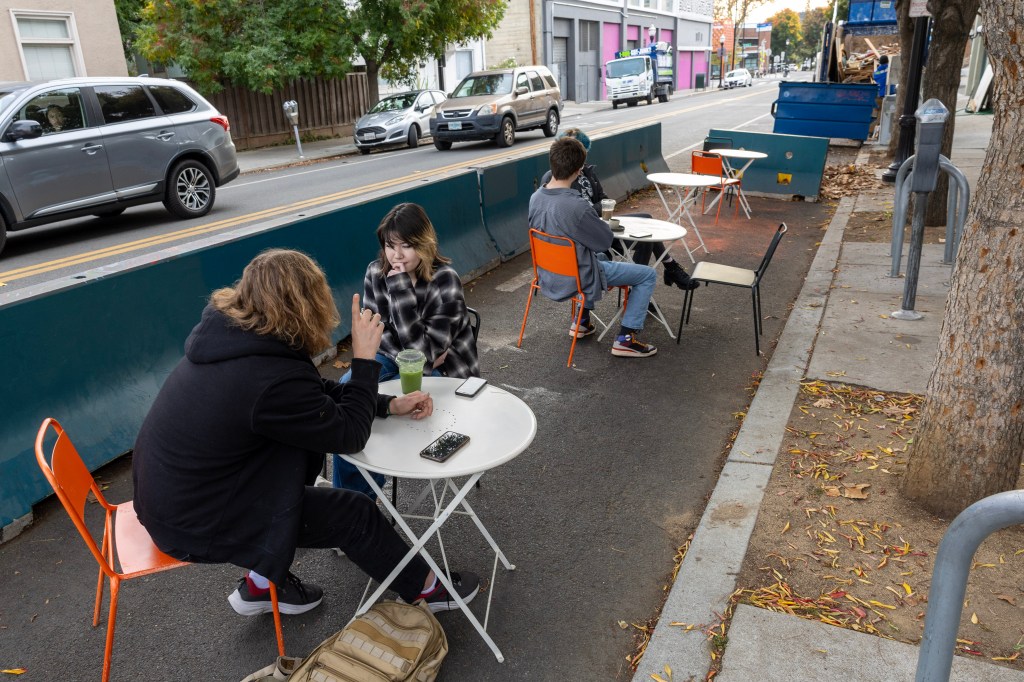
San Jose is exploring a plan to make outdoor dining permanent, six years after pandemic-era rules first opened sidewalks and parking spaces to restaurants and cafes.
The rules committee Wednesday directed the city manager to develop proposals to streamline and simplify the permitting process and design standards for outdoor dining — even as the city faces a projected $56 million budget shortfall and the federal funds that once supported the program have long dried up.
Co-sponsored by Councilmembers Peter Ortiz, Anthony Tordillos, David Cohen, Rosemary Kamei and Michael Mulcahy, the memo calls for the permanent expansion of “al fresco” dining to support small businesses and neighborhood vibrancy in downtown and the city’s “urban villages” — mixed-use neighborhoods near transit corridors planned for residential, retail and job growth, including Five Wounds, Eastside Alum Rock and the Alameda.
San Jose is not alone.
Cities across the Bay Area have either made parklets permanent, scaled them back or are still weighing how to address challenges including disability law compliance, complicated permit processes and community pushback over lost parking.
In 2020, the city relaxed its outdoor dining rules and helped install parklets — temporary outdoor dining structures — to keep local restaurants afloat when the county imposed strict limits on indoor dining. Nearly half a million dollars in federal pandemic funding helped cover installation and rental of the concrete barriers surrounding the structures.
But those funds are gone.
In 2023, San Jose began requiring business owners to either pay for their parklets or remove them — costs that could run as high as $50,000, an amount many business owners have said they could not afford.
The city said the new effort is about more than helping businesses. It is also aimed at restoring street life years after the pandemic emptied downtowns and as remote work trends persist.
“Small businesses, particularly restaurants and food-serving establishments, play a significant role in San Jose’s local economy, cultural vitality, and community identity,” the memo said. “These changes would help maintain the accessibility that defined al fresco’s success while providing businesses with a predictable, efficient pathway to invest in long-term outdoor dining improvements.”
The stakes are significant.
According to a 2023 report by urban planning nonprofit SPUR, San Jose’s restaurant and food service industry generated $1.5 billion in taxable revenue in 2022 and employed more than 25,000 workers. SPUR supports making al fresco dining permanent, arguing that expanding outdoor seating could double the number of jobs per shift.
The memo mirrors several of SPUR’s recommendations, calling for clearer processes, more sensible codes and a dedicated coordinator to ensure consistency. It also proposes a streamlined permitting pathway for complex outdoor dining configurations — patios, railings, pergolas and semi-permanent structures — while keeping a simpler process for basic installations, and directs staff to review best practices from peer cities, including San Francisco.
However, the memo does not address if the city would help defray the costs of building a code-compliant parklet outside of simplifying design and permit standards. Specifics are expected once a resolution is placed on the full City Council agenda, which has not yet happened.
Downtown resident Jordan Moldow pointed to San Francisco during public comment, noting the city has seen a resurgence in restaurant patronage with outdoor dining — an arrangement that also benefits pet owners who cannot dine inside.
“It would be great to see more of that in San Jose,” Moldow said. He also noted the memo did not mention parklets specifically and asked the council to remove costly requirements such as cinder block barriers for parklet protection. “There were none that I saw in San Francisco, just reflective poles so that cars could see them.”
Downtown currently has two permanent pedestrian malls on Post Street and San Pedro Square.
While the proposal does not include closing additional streets, the city has seen the potential of expanded outdoor dining firsthand — both the recent NVIDIA conference and Super Bowl packed businesses downtown.
But not all neighborhoods have benefited equally. According to SPUR, during the pandemic, participation in the al fresco program was lower in economically disadvantaged neighborhoods, largely because of its temporary nature.
Vice Mayor Pam Foley, who represents neighborhoods in southwestern San Jose, said she was concerned the memo’s scope was too narrow — limited to downtown and urban villages — and wanted any final directive to extend to businesses across the city.
“I hope that when it comes forward, we’ll be able to take this into consideration — because all businesses who have the physical capability should be able to have this opportunity to expand outdoors,” Foley said.