
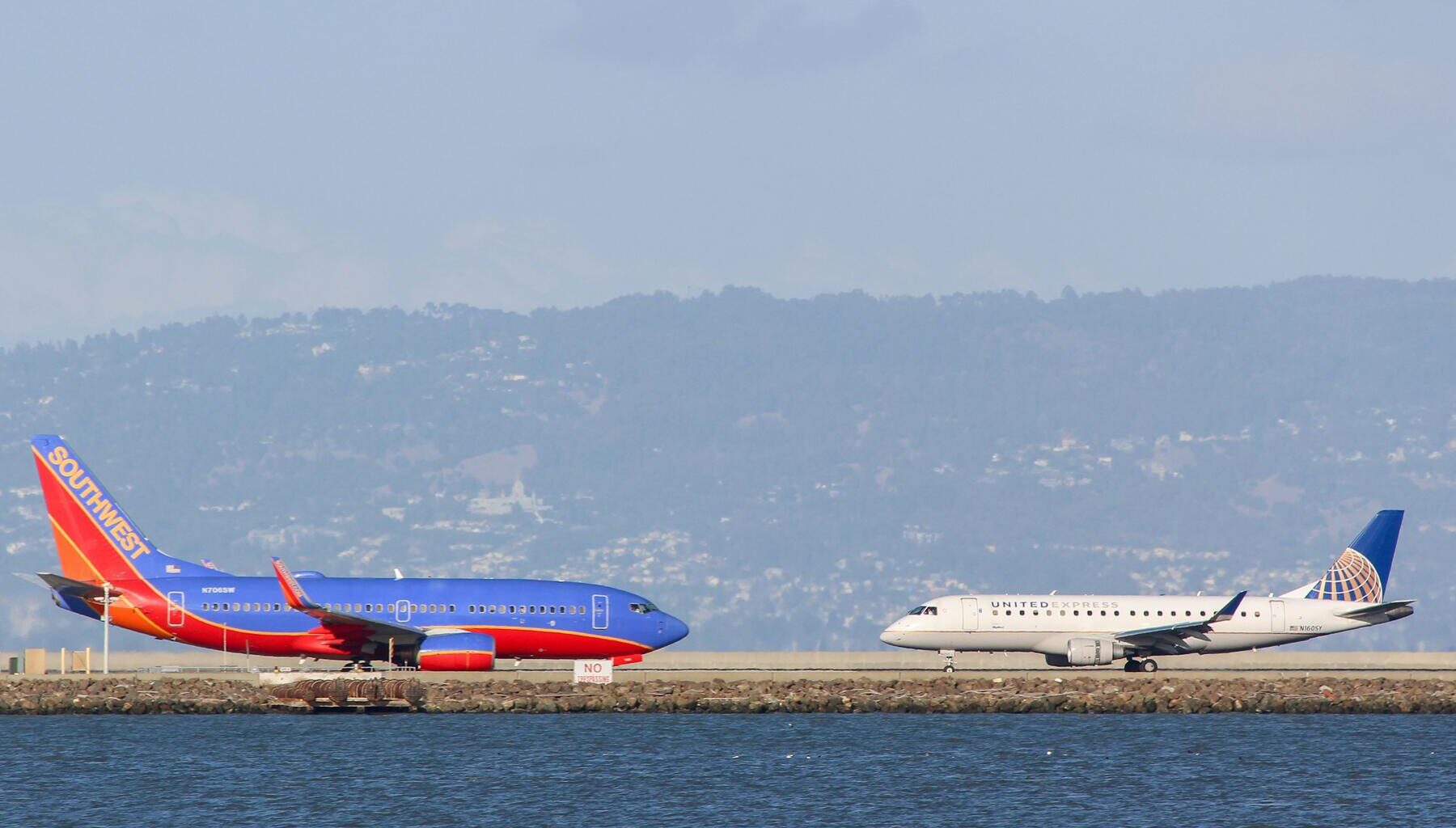
New FAA rules and runway construction at San Francisco International Airport will reduce arrivals from 54 to 36 per hour, increasing flight delays for travelers.
Fliers bound for San Francisco International Airport (SFO) can expect delays after an FAA rule change that will reduce the number of aircraft arrivals per hour.
Longtime travelers at SFO are familiar with a landing process that allows arriving airliners to approach and land on parallel runways at the same time in clear weather conditions. The result was a spectacular show for passengers on the common side for both aircraft—a thrilling look at another airliner in flight just a few hundred feet away.
The FAA rule change now disallows that practice, which had never been allowed in bad weather. Aircraft can still land on the parallel runways in relatively close proximity, but can no longer do so simultaneously and must stagger arrivals, which reduces the efficiency per hour.
An FAA spokesperson told Travel Weekly that simultaneous landings on the two runways—just 750 feet apart from center line to center line—is too dangerous, but could not explain why the practice had previously been allowed.
Continue Reading Article After Our Video
Recommended Fodor’s Video
In addition to the rule change, the number of landings per hour allowed at the airfield will be further limited by the closure of Runway 1R on March 30 for resurfacing, which is expected to last for six months. The adjacent Runway 1L will not be used for takeoffs and landings; it will instead be used as an additional taxiway to alleviate traffic congestion on the ground.
The runway closures will effectively reduce SFO to the two east-west parallel runways for arriving and departing flights. In a statement announcing the runway closure, but before the FAA rule change, the airport said it anticipated less than 15% of flights will be delayed as a result of the runway closure, and that most flights will be delayed less than 30 minutes. After the FAA rule change—which, unlike the runway closure, is permanent—the number of estimated delayed flights increased. The airport now expects 25% of arriving flights to be delayed more than 30 minutes.
Between the rule change and the runway resurfacing, the maximum number of aircraft arrivals per hour is reduced from 54 to 36. Nine of the 18 reductions are related to runway resurfacing and will snap back in October once that runway reopens. The other nine reductions are related to the rule change and represent a permanent reduction in flight throughput. Weather conditions impacting visibility on the airfield or airspace congestion could further reduce the number of allowed arrivals per hour. No airline has yet announced any plans to significantly change the number of scheduled flights at the airport.
Recent aircraft incursions at SFO were not related to the parallel approach. A 2013 Asiana Airlines crash was ultimately attributed to pilot error. An incident last year where two departing aircraft nearly collided is under investigation.
SFO was the nation’s 13th busiest airport in passenger traffic in 2024, a hub for United Airlines and Alaska Airlines. For international passenger traffic, SFO ranked 4th, behind New York JFK, Los Angeles, and Miami.
SFO is one of three major airports serving the San Francisco Bay Area. Oakland San Francisco Bay Airport is on the east side of San Francisco Bay, while Norman Y. Mineta San Jose International Airport lies to the south. Of the three airports, the lion’s share of international service is from SFO. The airport is a major gateway to Oceania and the Asia/Pacific region. The airport has nonstop flights to over 140 destinations around the world, including new flights to Adelaide, Australia, on United launched late last year. New nonstops to Warsaw on LOT Polish Airlines will begin in May 2025.