
DOWNTOWN SAN DIEGO
A husband and wife who operate at least two North County elder-care facilities are facing human trafficking and wage theft charges for allegedly forcing at least three employees to work around the clock with minimal pay, in part by threatening to use their immigration status against them, San Diego District Attorney Summer Stephan announced Thursday.
Rolando “Bobby” Solancho Corpuz, 57, and Maria Elsabel Sio Corpuz, 41, each pleaded not guilty Thursday in San Diego Superior Court to three charges of human trafficking and three charges of wage theft, Stephan said. The charges stem from their alleged exploitation of three employees at the residential care facilities Rose Garden in Vista and Rose Garden Capo in Escondido.
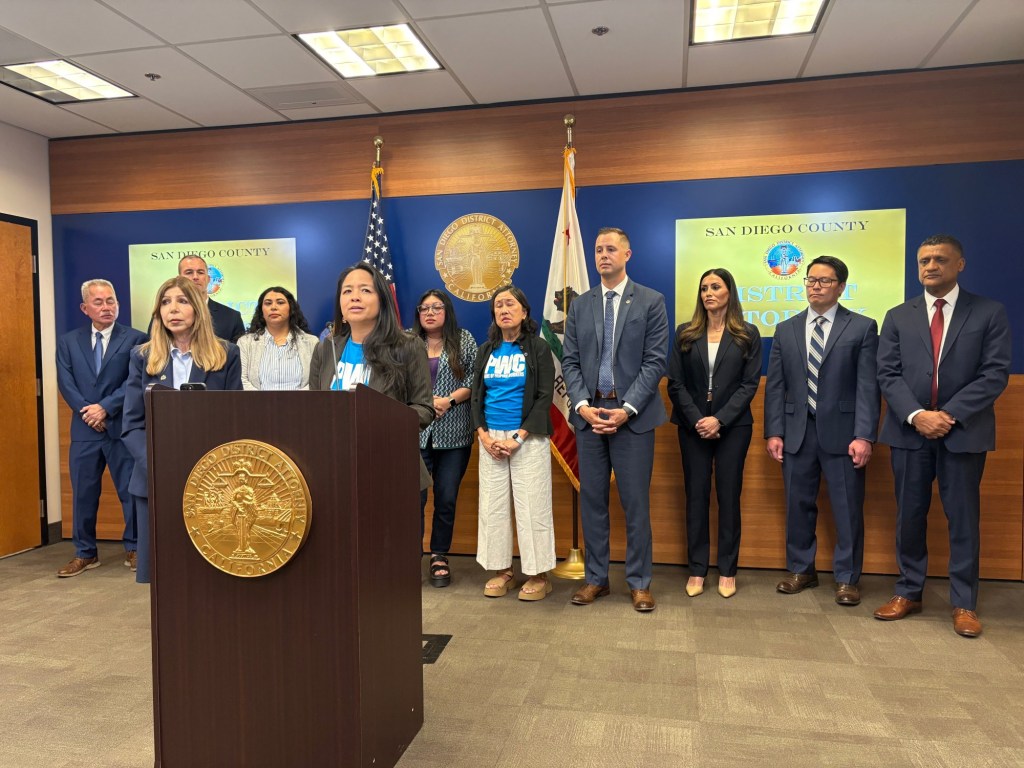
“These defendants didn’t just steal wages, they stripped away the dignity and human rights of vulnerable individuals, leveraging their immigration status as a weapon of exploitation,” the district attorney said at a Thursday morning news conference.
It was not immediately clear Thursday if the defendants had attorneys who could comment on their behalf.
Stephan said an investigation into the couple remains ongoing, and investigators believe there are likely more victims. She asked additional potential victims to come forward.
“It’s clear this is the tip of the iceberg,” Stephan said. “This case is a chilling example of human trafficking hiding in plain view.”
The alleged exploitation came to light, Stephan said, when one of the workers reported the abuse to the Pilipino Workers Center, a Los Angeles-based nonprofit that advocates for Filipino workers in the U.S. That group forwarded her complaints to county officials, and eventually Stephan’s workplace justice unit launched an investigation that identified at least two other alleged victims. Investigators arrested the couple on March 26 and served three search warrants that same day.
“What they uncovered was an orchestrated web of greed and exploitation,” Stephan said.
The three workers were allegedly promised jobs working 40 hours a week with good pay, but soon were coerced into working 24 hours a day for six to seven days a week for as little as $7 an hour, Stephan said. The workers were allegedly made to live inside bedrooms in the care facilities with their patients, some of whom were immobile and non-verbal; at least one of the victims was tasked with administering medication and insulin injections with no medical training or certification, according to the district attorney.
“One of the biggest red flags for labor trafficking is when a victim is made to live and work in the same place,” Stephan said. “This provides the traffickers even more control.”
Stephan said the fact that the defendants paid the victims some money “is a tool that traffickers use to keep people with the hope that they will be fully paid. But they didn’t even come close to California’s minimum wage laws or any other related labor laws.”
According to Stephan, the California Department of Industrial Relations performed an audit that determined the initial victim who came forward is owed more than $175,000 in unpaid wages.
Stephan said that same victim agreed to have a percentage of her earnings withheld on the promise that the money would be used to hire an immigration attorney to help her gain full legal status in the U.S. But the investigation revealed that of the $19,000 withheld from the victim, less than $4,000 was paid to the attorney, Stephan said.
“The evidence shows this was another deception to line the pockets of the defendants and support their lavish lifestyle and their fancy cars,” Stephan said. “These defendants used the immigration status of the victims to manipulate them. They used it to dehumanize them. They used it to extort free labor.”
Aquilina Soriano-Versoza, executive director of the Pilipino Workers Center, said the victims’ culture was also used against them. “In the case of Filipinos, our culture, our sense of real respect and love for our elders is used often to keep workers in situations where they’re experiencing wage theft and exploitation,” she said.
Stephan said the two facilities operated by Bobby and Maria Corpuz housed 20 total patients — 15 at one and five at the other. She said investigators are still working to determine how many caregivers may have been exploited, how far back the alleged exploitation stretches and whether the couple is involved with any other residential care facilities.
Stephan said her office will seek restitution from the defendants and back pay for the alleged victims. She urged any other potential victims in the case to come forward by contacting district attorney investigator Yvette Gaines at 619-531-3515 or yvette.gaines@sandiegoda.gov.