
This is the second article in a two-part story about Congressional candidate Saikat Chakrabarti’s ground game. Read part one here.
Very often, it’s at least 28 stairs to knock on one door in the Sunset, said two paid canvassers for Saikat Chakrabarti, one of the three leading candidates to succeed Rep. Nancy Pelosi.
They kept climbing and knocking on doors that were coded by the campaign as a likely Chinese-speaking household over the course of a few broiling hours during San Francisco’s winter heat wave.
This pair, however, are among the very few who are physically ready for this: They have day jobs as USPS letter-carriers.
They were among the 10 paid Cantonese canvassers gathered for a warm-up session on a recent Sunday at the Sunset Recreation Center.
The group — with long sleeves, long pants, sunglasses and more than a few wide-brimmed hats — stood in a circle. They practiced a conversation with faux voters, with some new members still getting comfortable reading from the script.
The group got feedback from Chakrabarti’s two Cantonese field organizers, Yan Liu and Albert Lam, on how they smiled or listened.
They were soon dispatched in pairs to the Sunset District to find actual voters. They were taught all the techniques: Wait a minute after buzzing the doorbell, strike up a conversation before handing out flyers, and make sure to ask clearly whether people are planning to vote for Chakrabarti in the June 2 primary.
Many doors went unanswered. One voter said their door had already been knocked on.
Because some households were labeled as both Chinese- and English-speaking, two of Chakrabarti’s teams overlapped in the Sunset that day, an inefficiency that the $1.77 million campaign, which has $1.47 million from the centimillionaire candidate, can afford.
Meanwhile, Liu and Lam tracked the canvassers’ locations on a mobile app from blocks away before heading out to check on each group.
They also served as a central hub for information: One canvasser called Lam to ask what to tell a voter who wanted to understand how Chakrabarti is going to “stop the authoritarian coup that’s happening right now with Trump,” Lam said.
That was not one of the prepared questions, so Lam urged his canvasser to listen and bring the information back.
The campaign will use the back-and-forth with voters to update its script — it is about to launch a new Chinese-language flier — and to tailor Chakrabarti’s message to voters.
It seems to be working: Chakrabarti got the loudest applause and cheers at a recent Chinatown forum, even though courting Chinese American voters is a novelty for him.
Thanks to input from Liu, Lam and his political director, Nadia Rahman, Chakrabarti appears to have a good sense of how to appeal to Asian voters.
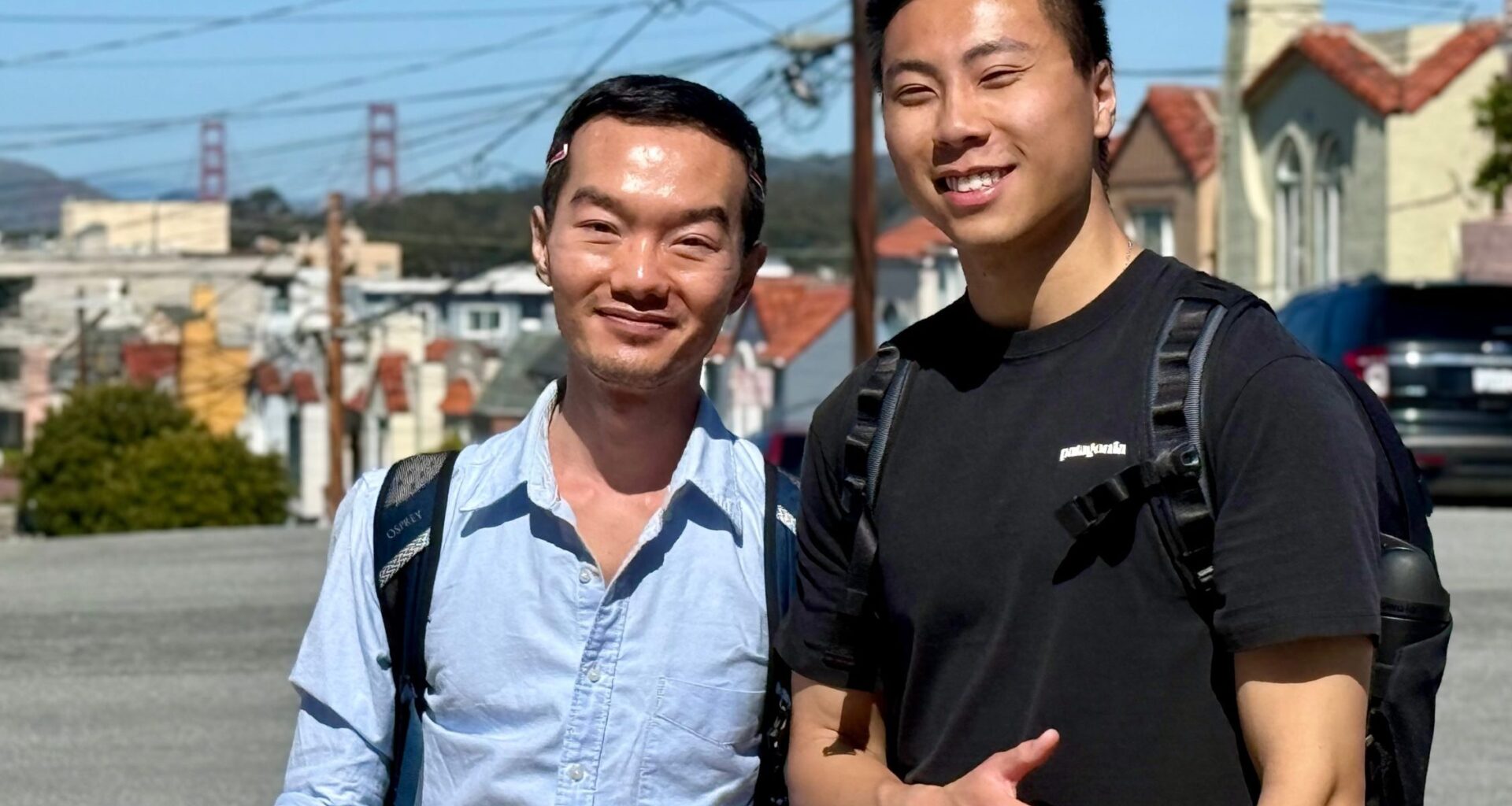
Liu and Lam also guided Chakrabarti around in Chinatown on the night of the Lunar New Year parade, taking selfies at the Chinatown-Rose Pak Station and eating an egg tart from AA Bakery. Supervisor Connie Chan and Sen. Scott Wiener both participated in the parade as elected officials.
Back in the Sunset during the recent heatwave, the Cantonese canvassers were equipped with the messages the campaign thought would resonate.
The crew practiced messages emphasizing Chakrabarti’s past at Harvard University and his experience in Silicon Valley, and emphasized that the former Rep. Alexandara Ocasio-Cortez staffer is the only major candidate who has actually worked in Congress.
Another message: Chakrabarti’s support for Medicare for All, universal childcare, and kicking PG&E out of San Francisco. In between, they mentioned the deteriorating economy, and alleged that the other two candidates won’t be able to change it.
They avoided giving a clear stance on the closure of the Upper Great Highway, which was opposed by the vast majority of Sunset voters but supported by a decent majority of citywide voters.
Lam’s sample answer, instead, focused on listening: The previous District 4 supervisor didn’t, but Chakrabarti will — and the other two candidates won’t (they are too busy with their full-time lawmaker jobs).
Liu, 40, who was first hired as a canvasser in November before getting promoted to a field organizer, worked under “door-knocking genius” Han Zou on both Lurie’s ground campaign and Matt Haney’s State Assembly campaign in 2022.
“He’s one of the best,” Liu said in a recent interview about his former boss, Zou, who helped secure victory for Lurie and Haney.
Zou, now working as Lurie’s head of communications, is someone with “high IQ, high [emotional intelligence],” very “data-driven” but also “intuitively understands the community and human nature,” Liu added. Liu has learned those lessons.
Zou also kept “a delicate balance of giving [canvassers] really good instruction, but also empowering them to absorb information in the field.”
That balance tends to be different for Chinese canvassers than other canvassers: They are often given more flexibility in how they go out and approach people.
For a community that has long felt disconnected from mainstream politics, “just having somebody who speaks their language at their door talking to them is, in itself, sometimes enough to convince them to vote for somebody,” said a former campaign operative.
After hearing first-hand about how popular Lurie is among voters, especially among the Chinese community, Liu said, “It’s only rational to think I want to learn from that campaign.”
In one “funny moment,” Liu said, he saw a Lurie window sign during a Chinatown merchant walk, and convinced the business owner to put a Chakrabarti sign next to it.
Nathan Allbee, a longtime Haney strategist and aide who trained Zou on field campaigning, is one of the consultants for Chakrabarti’s campaign. Chakrabarti’s field director, Alex Vanscoy, was a field organizer for Breed’s 2024 campaign.
Despite 23-year-old Lam’s street cred, he has not been particularly successful in convincing his dad, a leader in Chinatown’s Ying On Merchants & Labor Benevolent Association, to organize his own tight-knit community to support Chakrabarti.
“My dad said, ‘We don’t really do politics,’” said Lam. He knows it’s true; Ying On Association nowadays is “more like a hangout club” that is involved in the “commerce of mahjong,” the younger Lam grumbled. But he’ll keep trying.
Both Liu and Lam are passionate about Chakrabarti. Liu has long been a fan of Ocasio-Cortez.
For Lam, the appeal of Ocasio-Cortez and Chakrabarti gets down to economics.
“Capitalism has run its course, and a lot of the wealth has been removed from the middle class to the upper class,” says the econ grad, pointing to San Francisco as a case study of rising inequality.
Chakrabarti is the candidate for his generation, says the San Francisco native. It’s okay that Chakrabarti belongs to the upper class and can afford to fund his campaign with millions of his own dollars.
“People normally want to keep that kind of wealth,” said Lam. “But he wants to have taxes on him.”