
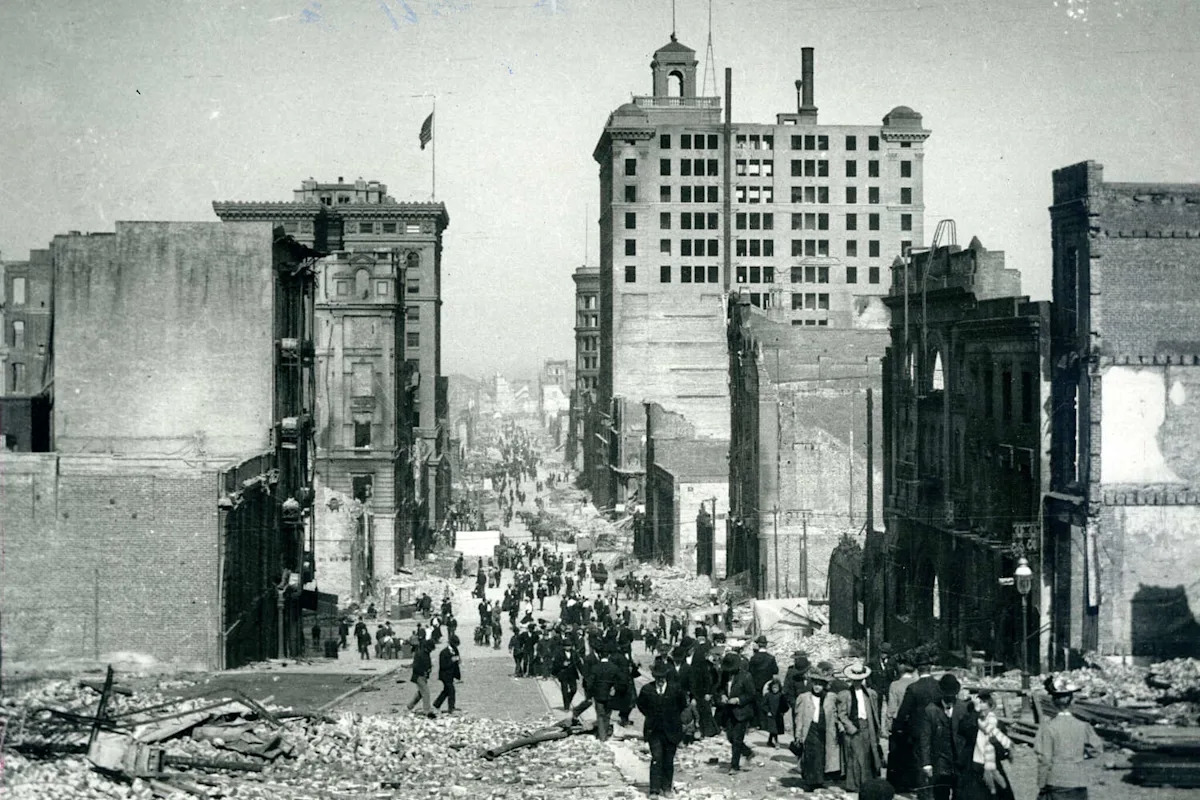
When the 7.9-magnitude San Francisco earthquake went off at 5:12 a.m. on April 18, 1906, earthquake alerts were more than 100 years in the future.
So what if that exact same earthquake – the Big One off the San Andreas Fault, epicentered in exactly the same place – happened today?
We asked a U.S. Geological Survey expert how much time people would have after their phone buzzed.
The answer is sobering.
The core population centers – not just San Francisco but also Oakland and Berkeley – would have no advance warning, according to Robert de Groot, the coordinator for ShakeAlert, the earthquake early warning system used in California. The shaking would start faster than the ShakeAlert system could transmit the message to them.
Even San Rafael and San Francisco International Airport would feel rumblings before a phone message appeared.
That’s because of how close those areas are to the epicenter, which in 1906 was off Daly City. Further out, Palo Alto could see anywhere from 5 to 10 seconds of warning time before shaking arrives, according to de Groot. In Santa Cruz, that stretches to 15 to 20 seconds.
It’s possible to extrapolate warning times via concentric circles radiating out from the 1906 epicenter, with locations across the Bay Area receiving anywhere from zero to approximately 20 seconds of alert time.
The same principle applies to the Hayward Fault in the East Bay. In the event of, say, a magnitude-7 quake there, cities about twenty-two miles away from the epicenter should begin to get some alert time before shaking begins, de Groot said.
Thus if, for example, a Big One on the Hayward Fault originated at California Memorial Stadium – the fault runs directly below the retrofitted stadium – then none of San Francisco would get advance warning, as the entire city is less than 22 miles away.
The primary waves of an earthquake travel at about 13,000 miles per hour, reaching nearby cities injust a few seconds. According to de Groot, earthquake processing stations need a few seconds to confirm the earthquake before sending information to delivery partners to distribute. So there is an inevitable lag, but messages can start moving before secondary, slower and more destructive waves hit.
Delivery times through the Apple and Android systems, the MyShake app and wireless emergency alert systems that disseminate Amber Alerts, vary depending on the carrier.
Early warning is critical: Even a fewseconds can allow trains to slow or stop or provide hospital staff time to pause procedures. For residents, those seconds can be enough to stop driving, move away from falling hazards or get under a desk or a table.
This article originally published at If the 1906 San Francisco earthquake struck today, these cities would get no advance warning.