
Six years ago, an assistant coach at Arizona Western College in Yuma got a text message from a friend back East who had helped them get players in the past.
Hey, 6-9 kid, New Jersey, looks intriguing. You guys interested?
The pandemic shutdowns had just started and society had lurched to a halt. Arizona Western already had most of its roster set for next season but it did have one scholarship left — unlike California JCs, those in Arizona can offer tuition, room and board to athletes — and figured it didn’t hurt to look.
They got some film.
“I don’t even know how long it was, maybe 70 to 80 seconds, maybe 90 seconds max,” says Kyle Isaacs, the AWC assistant who became head coach the following season. “It just was a scrawny young man going around. Nothing that we observed gave us any indication like, hey, this kid was going to be one of the best players in the NCAA six years later.”
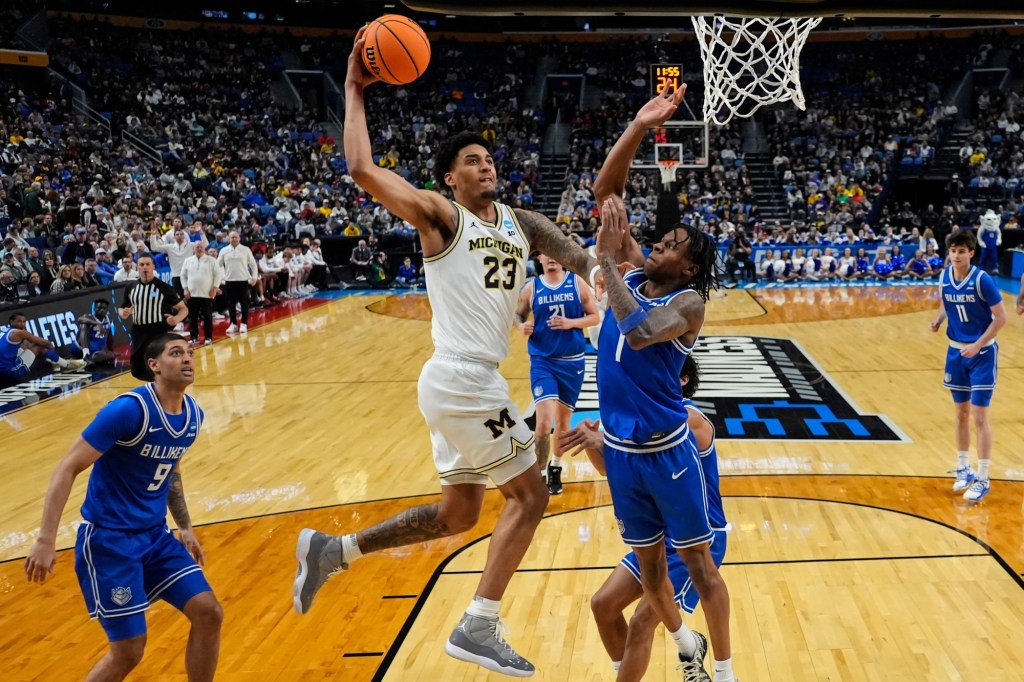
It was Yaxel Lendeborg, the Big Ten Player of the Year and a consensus All-American from Michigan. You can see him in the Final Four on Saturday when the Wolverines face Arizona in a battle of No. 1 seeds.
That he spent three years at a community college two hours east of San Diego merely adds to the improbable journey of a kid born in Puerto Rico to Dominican parents and raised in Ohio and New Jersey.
“It’s a heckuva story,” Michigan coach Dusty May says.
The film sent to Isaacs was from Lendeborg’s 11-game career at Pennsauken High in New Jersey, just across the Delaware River from Philadelphia. That’s it, 11 games.
He was cut from his middle school team. He made the freshman team but was quickly ruled academically ineligible, a theme that continued as a sophomore and junior. His mother, Yissel Raposo, tried repeatedly to change his life arc, once even removing everything from his room in a mother-knows-best attempt at shock therapy.
“All of it. Gone!” Lendeborg wrote in a thank-you ode to his mother published in The Players’ Tribune in February. “No TV. No game system. No lamp. No dresser. No clothes. No pictures. Nothing on the walls. Bro….
“No door.
“Like, she literally took the door off the hinges and put it somewhere else. That’s how bad it had gotten.”
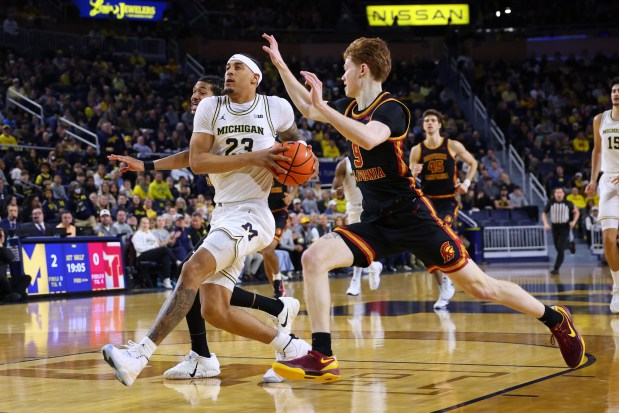 Michigan’s Yaxel Lendeborg drives past USC’s Ryan Cornish (right) during a Big Ten game on Jan. 2 in Ann Arbor, Mich. (Photo by Gregory Shamus/Getty Images)
The summer before his senior year, she tried one last time. She showed up a friend’s house where Yaxel was playing video games — his true passion – and honked the car horn for him to come outside. He got in their minivan and … they just sat there, tears rolling down her cheeks.
Soon he was crying, too, and reluctantly consenting to her plan: removing him from classes at Pennsauken High School and attending a mirror program at a local community college, where he could reset academically without the distraction of his friends while receiving high school credits.
It worked, and he regained athletic eligibility with 11 games left in his senior season. Pennsauken went 10-1.
The next step was getting him a spot in a basketball showcase in New York for kids of Dominican heritage (both his parents played for the DR’s national team). He took it so seriously that he stayed up until 4 a.m. the night before playing video games.
“I play in the camp,” Lendeborg wrote in The Players’ Tribune, “and when it ends, they make this announcement, the list of ‘top performers,’ and they call my name. I’m like: ‘Oh, cool. That’s great! Let’s get back home so I can get up on some Call of Duty.’ But mom … she’s not having it. She’s over on the bleachers meeting with these JUCO coaches, these NAIA dudes, anyone who was willing to talk to her, basically.
“Next thing I know, she comes into my room and is like, ‘You’re going to Arizona!’
“Whhhhhhhaaaaaaaaat?”
The next job was getting him on the plane. Yissel got him a part-time warehouse job alongside her at VoiceComm, a wholesale supplier of cell phone accessories. The message was simple: You can do this for the rest of your life, or you can go to Yuma and play basketball.
Lendeborg got on the plane.
He got off and didn’t see any trees.
“It’s the desert,” Isaacs says. “This kid lived in Ohio, he lived in Jersey and the Pennsylvania area, he lived on the island when he was a young kid. For sure, it was culture shock.”
“It was terrible,” Lendeborg says. “Brutal.”
His first season, in 2020-21, was abbreviated by pandemic restrictions and didn’t count toward his allotted two years of JC eligibility. AWC played only 14 games, Lendeborg starting four and averaging a modest 6.1 points and 7.1 rebounds.
“It really wasn’t that first year,” Isaacs says of when he knew he might have something special. “Anybody who says that is probably engaging in revisionist history. Obviously he had skills, but he had barely played any organized — organized — basketball at all. He had to realize there were more restrictions that go with playing at a more organized level.”
But Yuma grew on him, in part because he could speak his native Spanish, and he kept coming back each fall. By the time he left, he had gone from under 200 pounds on his 6-9 frame to 230 and was a two-time JC all-American.
His second year, he averaged 12.1 points and 11.0 rebounds while shooting 72.2%. His third year: 17.2 points, 13.0 rebounds, 2.6 assists and — perhaps the most intriguing part to Division I coaches — 43.8% on 3s. He also displayed uncanny ballhandling skills because Isaacs, as an incentive to keep rebounding, let him play point guard anytime he grabbed a defensive board.
San Diego State was among those pursuing him, given the Arizona JC ties of JD Pollock, the program’s director of player development and a former head coach at Central Arizona College. But the Aztecs didn’t have a pressing need at power forward with Jaedon LeDee and Keshad Johnson both having eligibility in 2023-24, and the recruitment, Pollock says, “never grew legs.”
Coach Andy Kennedy and Alabama-Birmingham ultimately landed him, sweetening the deal by offering AWC teammate and roommate Marquise Hargrove a scholarship as well.
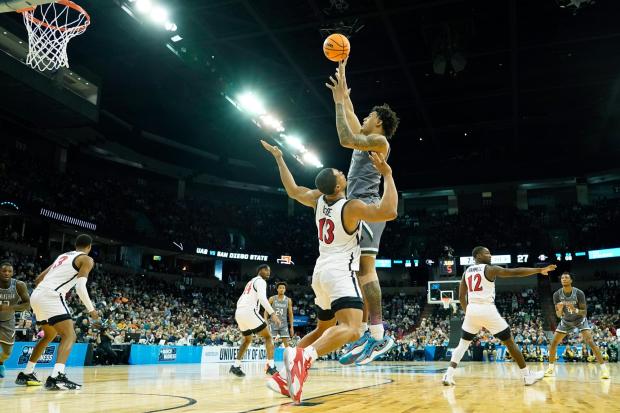 UAB forward Yaxel Lendeborg shoots over SDSU’s Jaedon LeDee in the first round of the 2024 NCAA Tournament in Spokane, Wash. (AP Photo/Ted S. Warren)
Lendeborg and SDSU would intersect again the following March, when they met in the first round of the NCAA Tournament in Spokane, Wash. Lendeborg was limited to 11 points by foul trouble while LeDee erupted for 32, a school record for an NCAA Tournament game, in a 69-65 win.
Lendeborg exacted a measure of retribution last November at the Players Era Festival in Las Vegas. Now 6-9, 240, he had 15 points, six rebounds and four assists in a 94-54 beatdown.
In his second season at UAB, he became only the second player in Division I history to record at least 600 points, 400 rebounds and 150 assists in a single season. The other: Larry Bird from Indiana State.
He also was one of two players across Division I to lead his team in points, rebounds, assists, steals and blocks. The other: No. 1 overall NBA Draft pick Cooper Flagg from Duke.
Lendeborg provisionally entered the draft last spring and attended the combine, measuring 6-8½ in bare feet with a 7-4 wingspan. He withdrew and instantly became the top prize in the transfer portal, opting to spend his sixth year of college basketball with May and Michigan for somewhere between $2.5 million and $5 million, depending on the source. Earlier this year, the ever-candid Lendeborg said he turned down $7 million-plus from Kentucky because he felt more comfortable with May, whose personality he equates to a “cool uncle.”
“He’s so unselfish,” May says. “He’s so, I don’t know how to say it: He wants to be one of the guys. They’ve encouraged him to be more aggressive, to shoot more, to hunt some more individual accolades all year, and he simply refused because he didn’t care about any of those things.
“It’s improved our environment because he’s been so unselfish. He still has no idea how good he is.”
May continues a serendipitous trend for Lendeborg, his third coach who served as a student manager under the late Bobby Knight. May did it at Indiana. Harral and Isaacs were student managers at different times when Knight coached at Texas Tech in the early 2000s.
Texas Tech’s motto is “From here, it’s possible,” and Isaacs has carried that with him to the desert. AWC has a rich basketball history, sending dozens of players to Division I and counting Nate “Tiny” Archibald — a skinny guard from the Bronx who would play 14 seasons in the NBA — among its alums.
Its mascot is a matador, which is fitting. It’s what Lendeborg, with a motherly nudge, did to life’s charging bull.
“I feel like I’m doing it for the people who didn’t believe in themselves,” the kid who got on the plane to Yuma told Hoops HQ last fall. “I want to be a role model for those people.
“Like, don’t doubt yourself.”