
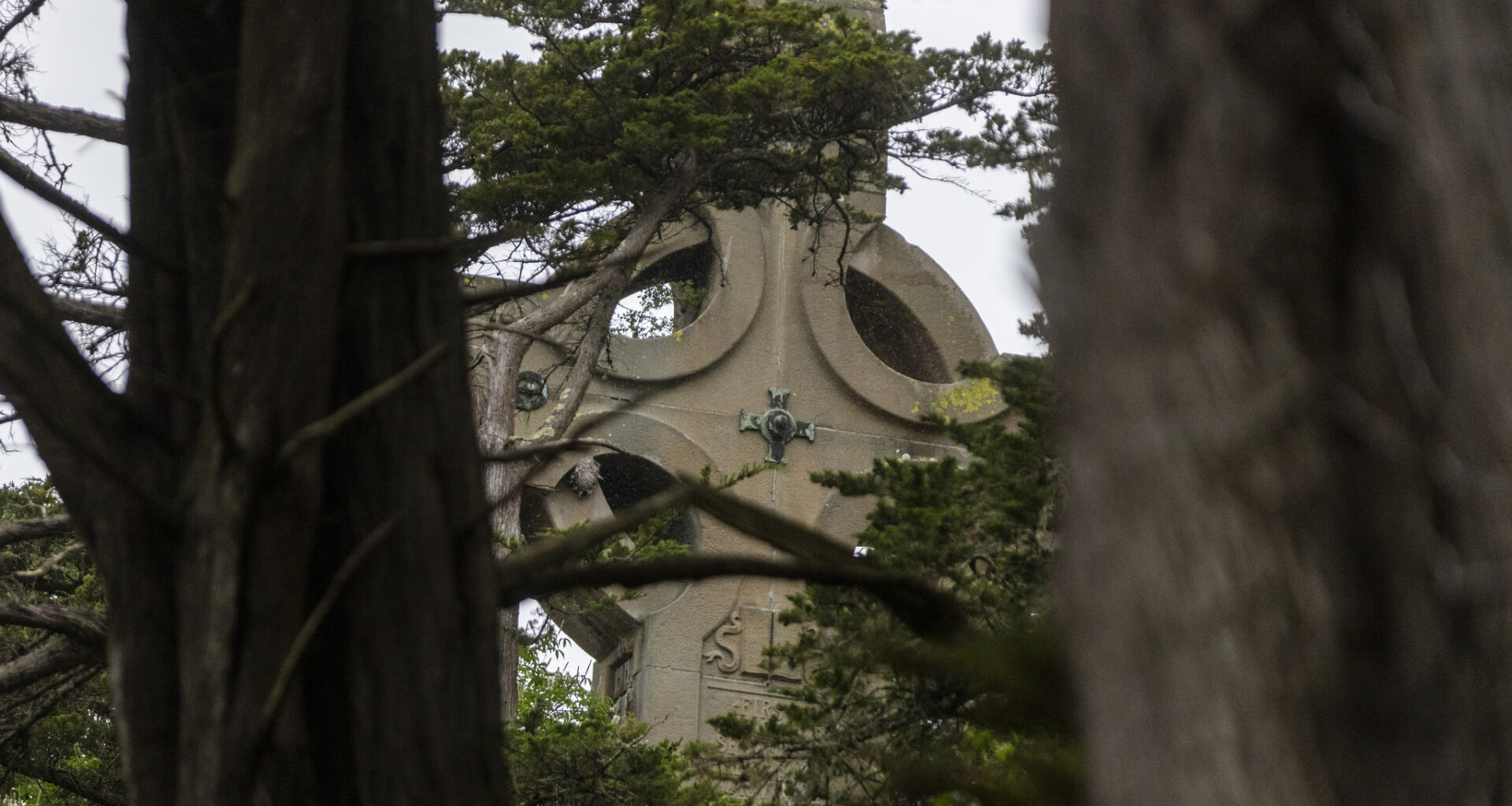
If you forget to look up, you’ll miss it. Most people do. Despite its towering figure, the 55-foot-high stone cross in Golden Gate Park evades notice. Standing atop the high hill over Rainbow Falls, it looms over JFK Promenade, the car-free thoroughfare popular among joggers and parents with strollers. Cyclists zip down the road without paying the cross any notice. Children don’t spot it, either. Instead, they glue their eyes to the 100-foot long serpent statue at the base of the waterfall, which blows bubbles out of its mouth.

Some call this landmark the Prayer Book Cross. Others call it Drake’s Cross. When it was unveiled in 1894, it was one of San Francisco’s most prominent landmarks. Newspapers claimed that the monument, built from 68 blocks of sandstone, was the largest cross in the world.
Back then, the cross was visible from Point Reyes. Today, the Prayer Book Cross is barely visible from within the park, let alone from across the bay. Tall trees partially block it from view.
Article continues below this ad
For those who do spot it, though, the cross stands out. “Looms” seems to be the right word. Tinted green with moss, the cross contrasts sharply with the colorful Adirondack chairs and murals lining the Golden Mile. Placed alongside Naga the sea serpent, it’s almost Gothic in tone.
The Prayer Book Cross in Golden Gate Park in San Francisco on March 31, 2026.
Douglas Zimmerman/SFGATE
A Celtic-inspired bolt is part of the Prayer Book Cross in Golden Gate Park in San Francisco, seen on March 31, 2026.
Douglas Zimmerman/SFGATE
Once you notice it, it’s hard to stop wondering: What is a giant cross doing in the middle of a public park?
Article continues below this ad
The Prayer Book Cross viewed through the foliage in Golden Gate Park in San Francisco on March 31, 2026.
Douglas Zimmerman/SFGATE
“The mystery to me is how something so big and that was supposed to be so prominent has gotten so forgotten,” Richard White, a Stanford professor emeritus of American history, told SFGATE.
An imperfect history
White has spent some time mulling this mystery over. Back in 2020, during the George Floyd protests, he penned a New York Times op-ed about the cross, titled “This Monument to White Supremacy Hides in Plain Sight.” The cross, White explained, pays tribute to Sir Francis Drake, the British explorer and privateer who circumnavigated the world in the 1570s.
Article continues below this ad
Make SFGATE a preferred source so your search results prioritize writing by actual people, not AI.
Add Preferred Source
During his journey, Drake briefly stopped on the West Coast of North America — possibly somewhere around Point Reyes, although the exact location is uncertain. There, his ship’s chaplain, Francis Fletcher, held the first known Protestant service in North America.
Visitors check out the Prayer Book Cross in Golden Gate Park in San Francisco on March 31, 2026.
Douglas Zimmerman/SFGATE
In her book “From Gold Rush to Millennium: 150 Years of Episcopal Diocese of California 1849-2000,” author Mary Judith Robinson summarizes the chaplain’s written account of the service:
Article continues below this ad
“Fletcher’s chronicle of the event related that the good chaplain read services and celebrated Holy Communion to the amazement of a large group of curious natives gathered at the scene, to whom he ‘preached the Gospel with much fervency.’”
The cross, which was built on the suggestion of California’s Episcopal bishop, memorializes this brief event.
“FIRST CHRISTIAN SERVICE IN THE ENGLISH TONGVE ON OUR COAST,” one of the panels of text carved into the cross reads.
“FIRST USE OF BOOK OF COMMON PRAYER IN OUR COVNTRY,” reads another. (Hence the name “Prayer Book Cross.” The figure of a book, presumably the Book of Common Prayer, is carved above.)
Article continues below this ad
A detail of some of the writing on the Prayer Book Cross in Golden Gate Park in San Francisco, seen on March 31, 2026.
Douglas Zimmerman/SFGATE
Drake Cross dedication in Golden Gate Park in San Francisco, 1894.
UC Berkeley Library/Calisphere
The Prayer Book Cross was officially unveiled on New Year’s Day, 1894, an event that coincided with the city’s Midwinter Fair event (a World’s Fair). A crowd of a few hundred people gathered around the monument, which was draped in an American flag, and a marching band played a few songs. The historian who had argued that Drake landed in Point Reyes gave a lengthy address, during which he again argued that Drake landed in Point Reyes, and not San Francisco.
When the flag covering the cross was pulled off, it brought “a rain of chips of stone upon the faces of those staring upward,” according to a San Francisco Examiner reporter in attendance. The paper, writing on the ceremony, declared it “the largest cross in the world and the most notable construction of stone in the United States.”
Article continues below this ad
Sir Francis Drake was also a slave trader. In 2020, as cities reevaluated the names of their streets and schools, the city of Larkspur removed a statue of Drake. In San Anselmo, Sir Francis Drake High School announced it would change its name. The Prayer Book Cross, meanwhile, seems to have gone unnoticed.
Drake’s entanglement in the slave trade and colonialism is part of the cross’s problem. But according to White, the issue runs deeper. “What makes it problematic now has actually very little to do with why it’s there,” he told SFGATE.
When it was first erected, the cross was an attempt to rewrite California’s history, according to White. California was first colonized by the Spanish, who converted Indigenous people to Catholicism under the violent mission system. The Prayer Book Cross, meanwhile, in its celebration of Drake’s brief, relatively insignificant stop on the coast, makes the case that from its initial “discovery,” California was Anglo-Saxon and Protestant.
Article continues below this ad
“So, what the Episcopalians try to do is say this is the beginning of white California,” White said. “This is the first white man to show up in California, and it’s the first time that Christianity comes to California, hence the cross.”
In the 1890s, San Francisco was already a city of immigrants. White said the cross is meant to argue San Francisco was white and Protestant, as opposed to Chinese, Irish, Catholic, Mexican or Indigenous.
Visitors check out the Prayer Book Cross in Golden Gate Park in San Francisco on March 31, 2026.
Douglas Zimmerman/SFGATE
A couple walks up a trail to view the Prayer Book Cross in Golden Gate Park in San Francisco on March 31, 2026.
Douglas Zimmerman/SFGATE
“‘We’re the Americans, these people aren’t.’ That’s what the cross is meant to commemorate,” White said. “That’s the simplest way I can put it.”
Article continues below this ad
Asked for a response to White’s article, Daniel Montes, communications manager for the San Francisco Recreation and Park Department, shared a statement via email.
“As stewards of our city’s parks and public spaces, we are committed to creating beautiful, inviting places that spark joy, strengthen connection, and foster civic pride,” Montes wrote. “Parks are living spaces that evolve over time. As our understanding and values grow, names and features may be updated to better reflect who we are today—as seen with Blue Heron Lake and Presidio Wall. Our ultimate goal is to ensure that everyone feels welcome in our parks.”
According to Christopher Pollock, the historian-in-residence for the department, the cross was a gift from George Childs, a Philadelphia philanthropist and newspaper publisher. Childs, a friend of California’s Episcopalian bishop, spent $10,000 on the cross.
The cross was originally planned to be placed in Drake’s Bay in Point Reyes, which is likely closer to the spot Drake actually landed. But according to an 1893 San Francisco Chronicle article, “a number of gentlemen” lobbied the city to find a place for it in Golden Gate Park.
Article continues below this ad
Fading from view
Episcopalians held services at the cross for a number of years afterward, Pollock noted. In the early 1950s, there was an annual pilgrimage to the cross, although it’s unclear when this celebration petered out. In his notes, Pollock mentioned a 1960 gathering that drew 200 to the cross.
The Prayer Book Cross viewed through the foliage in Golden Gate Park in San Francisco on March 31, 2026.
Douglas Zimmerman/SFGATE
A nest of hornets is visible on a piece of the Prayer Book Cross in Golden Gate Park in San Francisco on March 31, 2026.
Douglas Zimmerman/SFGATE
To fully appreciate the strangeness of the Prayer Book Cross, consider the story of San Francisco’s other landmark cross, the Mount Davidson Cross. Like the Prayer Book Cross, the Mount Davidson Cross is tall, standing at 103 feet. And like the Prayer Book Cross, it sits on public land.
Article continues below this ad
Or it used to, anyway. In 1990, the American Civil Liberties Union and the American Jewish Congress, among others, sued the city over the Mount Davidson Cross. The groups argued that the cross’s presence on public land was unconstitutional, and after a lengthy legal battle, San Francisco was forced to sell the 0.38-acre parcel of land on which the cross stands. In 1997, an Armenian American group purchased the cross for $26,000, and rededicated it to memorialize the Armenian genocide.
In light of this series of events, some have wondered why the Prayer Book Cross eludes the same scrutiny. Unlike the Mount Davidson Cross, the Prayer Book Cross remains uncontroversial. After all, how can a landmark be controversial if barely anybody looks at it?
“You know, millions of people go past it every year and never even see it,” White said. “And when they do see it, they have no idea what it’s about.”
Article continues below this ad