
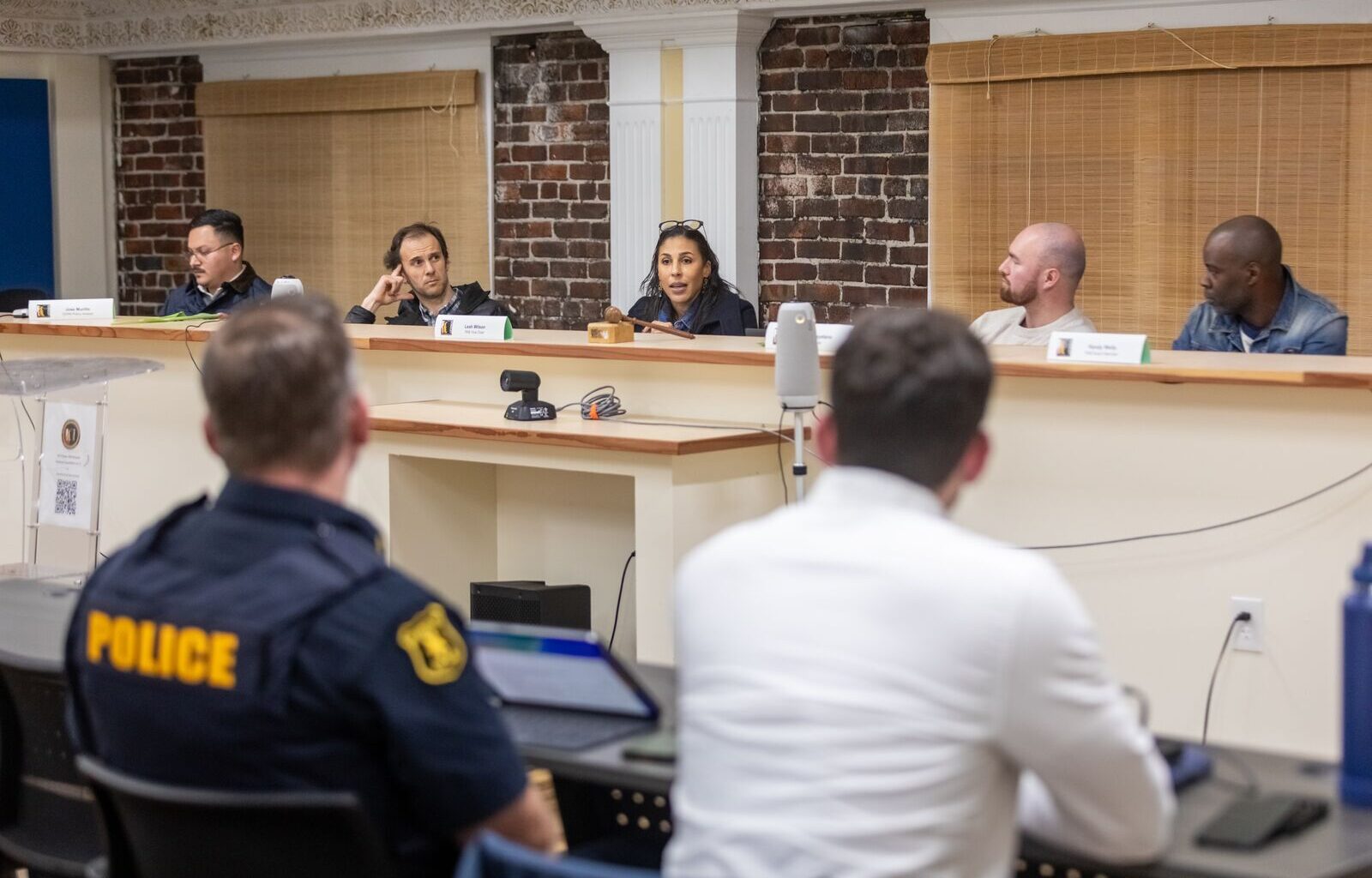
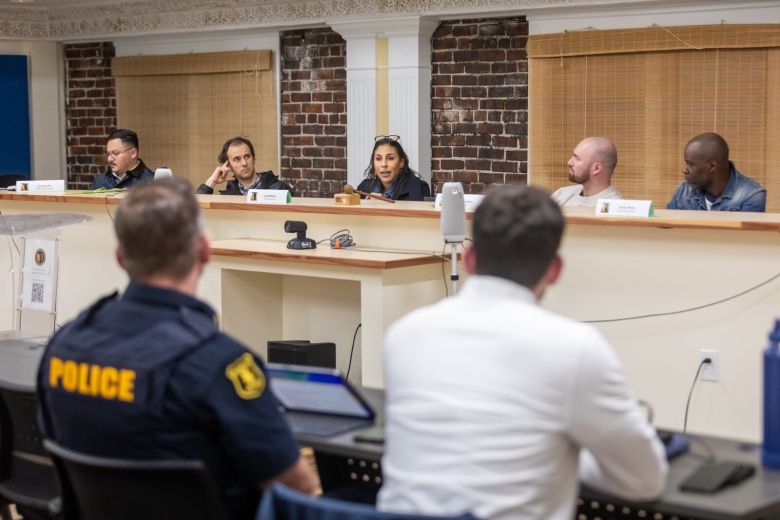
 The Police Accountability Board meeting on Feb. 11. The board said BPD had improperly updated its use-of-force policy by implementing it without City Council approval. The city’s top attorney ended up agreeing. Credit: Kelly Sullivan for Berkeleyside
The Berkeley Police Department’s leaders began loosening restrictions last month on how and when officers may use physical force.
The rewritten policies also removed language on BPD’s core values from the department’s use-of-force policy and eased reporting requirements for some police equipment.
But after objections from Berkeley’s civilian police oversight board, City Attorney Farimah Brown said that BPD cannot alter the policy without the signoff of the City Council.
BPD’s current policy on using force was finalized and approved by the City Council in July 2020, in the wake of the murder of George Floyd.
This past December, BPD leaders presented a draft of updates to the policy to the Police Accountability Board (PAB) that they said would bring it into compliance with state law, modernize the policy, remove outdated language and clarify reporting and supervisory responsibilities.
Current, former and recently departed PAB members have criticized the proposed new policy as giving individual officers too much leeway in the use of force, calling the changes “draconian” and “part of a full-scale attack” on civilian oversight.
PAB Chair Josh Cayetano told BPD leaders in December that the board believed the proposed updates needed to go before the council.
Police Chief Jen Louis disagreed, saying there was nothing in the city code, charter or other guiding documents that compelled BPD to seek council approval first. BPD leaders issued the proposed new policy to the rank and file March 6.
Soon afterward, the department “paused implementation” of the policy while the City Attorney’s Office — responding to a request from Cayetano — reviewed the process for updating the policy, according to an email from Louis to City Manager Paul Buddenhagen.
Brown said on Tuesday that BPD would need approval from the council to change the policy, without sharing details of how she made the determination.
The skirmish over the use-of-force policy is the latest in a series of battles between Berkeley’s civilian police oversight apparatus and the police department, which has largely had the support of city officials and elected leaders.
After BPD stonewalling forced the PAB to subpoena records related to racist, anti-homeless texts between some officers, the PAB issued a slew of policy reform recommendations last April, which BPD said were unnecessary and the council opted not to force. Hansel Aguilar, the director of police accountability, who had challenged the city in court over records, was fired by the council in February, nine days after the two most senior members of the PAB, Kitty Calavita and Julie Lefwich, resigned in protest of what they saw as citywide resistance to police reform and reversals of what reforms the PAB and its predecessor had accomplished.
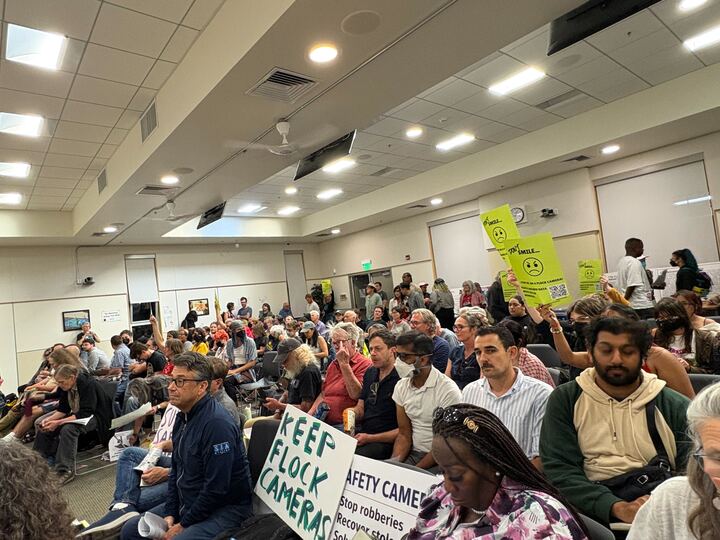 Berkeley’s City Council postponed a vote on new surveillance hardware for BPD after hours of public comment in March 2026. Credit: Alex N. Gecan/Berkeleyside
Outside of its own internal policies, BPD has recently sought to loosen restrictions on how and when officers can use weapons and other hardware. A reduction in reporting requirements for pepper spray has already passed the council. BPD has also asked for new surveillance tech, greater access to other agencies’ helicopters and canine units, and wider latitude to use tear gas. Those requests have passed the committee level but the full council has not yet signed off on them.
How proposed use-of-force policy differs from previous policy
The 2020 policy demanded force be used under an “objectively reasonable” standard, and added provisions that “Officers shall use only 1) minimum force that is 2) objectively necessary, and 3) proportional to the situation,” Calavita, who at the time served on the Police Review Commission, the predecessor of the PAB, wrote to the council in 2020.
“Because the proposed standard is one viewed from an objective perspective it does not rely purely on the subjective belief of an officer,” Calavita wrote at the time. “The officer must be able to articulate the specific facts that will demonstrate that his actions were in fact ‘reasonable.’”
The new language softens that standard, allowing officers to “use a level of force that they reasonably believe is proportional to the seriousness of the suspected offense or the reasonably perceived level of actual or threatened resistance,” the same language used in the Government Code.
A prohibition on the use of lethal force “if it reasonably appears that doing so would unnecessarily endanger innocent people” was excised entirely, without any language that clearly replaced it.
The proposed new policy also has softer language on neck holds. It bans holds that compress the trachea or blood vessels in the neck, but the older version also banned any sort of hold “that applies pressure to the front, side or back of the neck.”
The PAB has asked that BPD leadership restore several components of the 2020 version that are not overtly spelled out in the proposed new one. Among them:
Explicit prioritization of the “sanctity of life”
A mandate, rather than a recommendation, to “use alternatives to physical force whenever reasonably possible,” and never to use more than the minimum force required
Firmer mandate on de-escalation
A framework defining strata of resistance by suspects
Reporting requirements for restraint devices like spit hoods and body wraps
Why police oversight board members object to changes
On Dec. 17, BPD Deputy Chief Jen Tate and Sgt. Darrin Rafferty presented a working draft of a new use-of-force policy.
Tate offered to meet with a PAB policy subcommittee, though given the PAB’s staffing challenges, there is only one board member and one member of the public assigned to it, and Cayetano said no such meetings ended up taking place to his knowledge.
When Calavita and Leftwich announced their resignations, they called out the rewrite as just the latest example of BPD undoing reforms that the PAB’s predecessor painstakingly undertook, along with support from the previous police chief, Andrew Greenwood, and his subordinates. (They also called out the council for siding with BPD over the PAB on regulatory issues.)
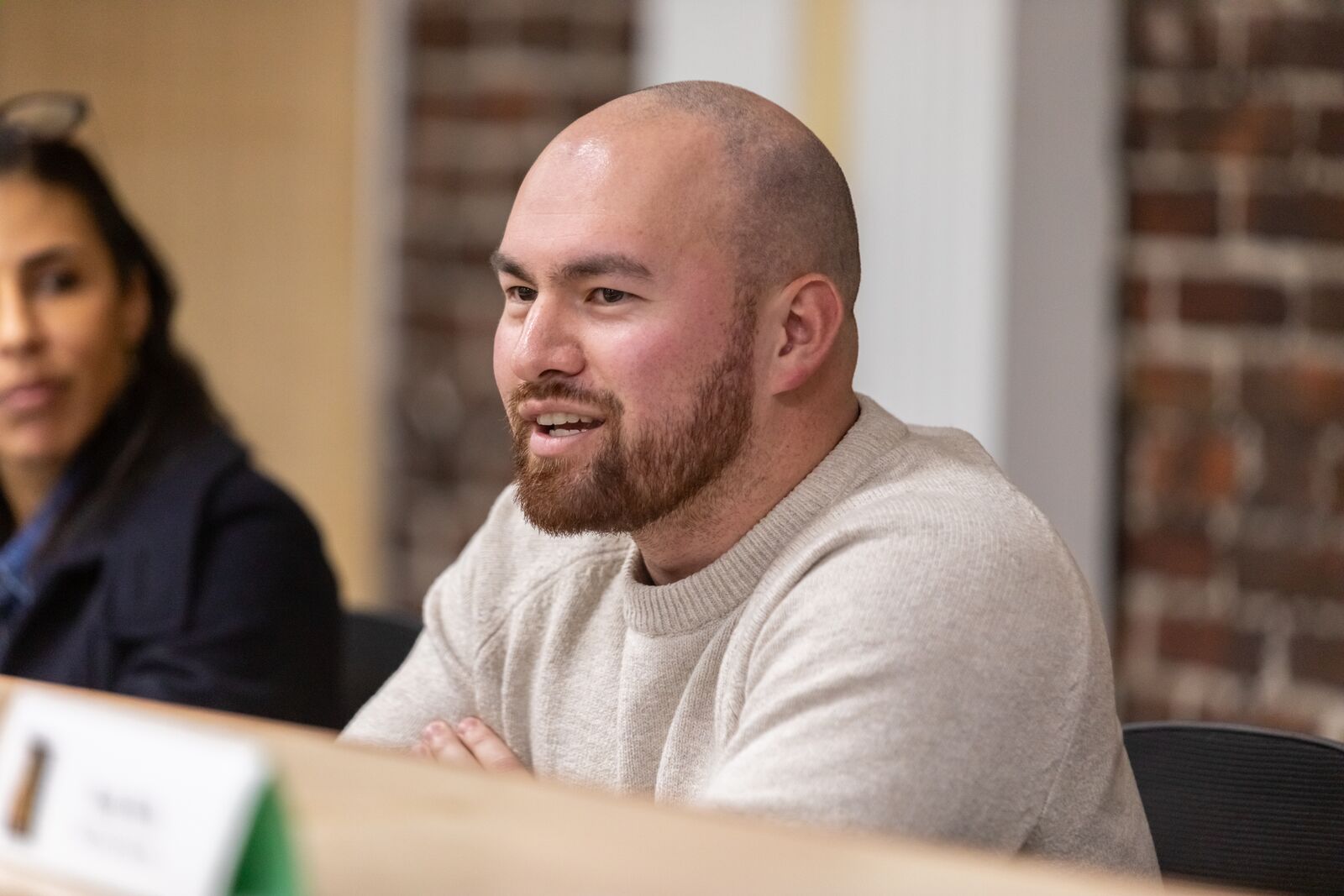 Police Accountability Board Chair Joshua Cayetano at the Feb. 11 meeting. “I do not understand why there is a pressing need to reevaluate the use of force policy,” he said. Credit: Kelly Sullivan for Berkeleyside
“Although purportedly intended to ‘streamline’ the policy, the redlines completely eviscerated the document,” Calavita and Leftwich wrote in their joint departure letter. Tate’s earlier promises of a “deeper conversation” notwithstanding, “It’s doubtful that any real collaboration is possible given how radical the changes are and how abruptly the PAB was informed of them,” Calavita and Leftwich wrote.
Their departures, followed nine days later by the Aguilar’s firing, hamstrung the city’s civilian police oversight, with no chief executive and only four members on a board meant to have nine regular members and an alternate. (There are three PAB nominees in the works and Aguilar has been replaced with a new acting director.)
The remaining members of the PAB were taken by surprise when Tate told them on March 6 that the new “policy has been issued to department personnel.”
The PAB approved a letter from Cayetano to Buddenhagen and the City Council March 11, asking that they step in and order BPD to set aside the new policy. Operating under the assumption that the council would have to approve any policy change, Cayetano asked that they not even consider one unless and until the PAB had vetted it first.
BPD use-of-force policy has been updated twice since 2020
Louis laid out her reasoning for going ahead with the policy update on her own in a March 12 email to Buddenhagen. She acknowledged that the council had signed off on the 2020 rewrite, but “as we reviewed the legislative history, nowhere in these materials could we find any resolution or indication that these actions established an ongoing requirement that every future revision … must return to council for approval.”
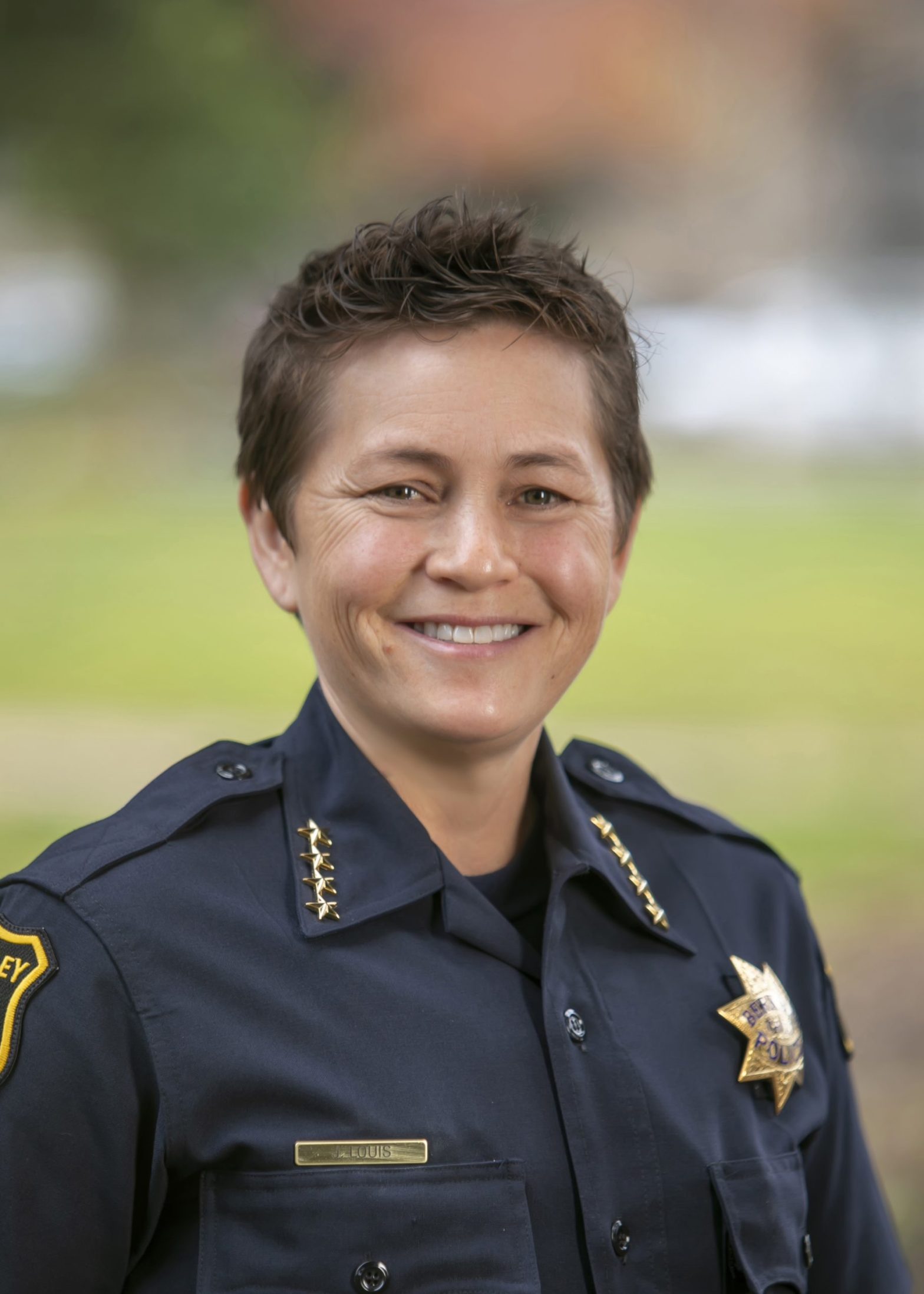 Police Chief Jen Louis. Courtesy: City of Berkeley
Louis pointed out that the use-of-force policy has already been updated two times since the 2020 rewrite. City and police officials did not immediately respond to requests for information on those updates; Cayetano said they were before his time on the PAB and he did not know the specifics of either one but that they were relatively minor compared to the wholesale overhaul presently at issue.
“In any event, just because someone unlawfully reverses council policy one time undetected, doesn’t give license to do it a second time when confronted,” Cayetano told Berkeleyside.
Louis took the position that the use-of-force policy itself empowered BPD to make changes “through the administrative process” to keep up with state statutes, case law, policing requirements and “best practices.” The proposed rewrite would broaden BPD’s purported authority even further; instead of annual meetings between BPD leadership and the PAB, the police chief alone (or a proxy) could review the use-of-force policy for possible updates.
The proposed new policy still appeared in the department’s online policy manual as of Thursday.
Police supervisors and the PAB will begin talks on the new rewrites this month, and some version of the rewrites may go before the City Council as soon as May, Cayetano said.
“At the moment, I do not understand why there is a pressing need to reevaluate the use of force policy. Over the last three years, the department has prided itself on its relatively low use of force numbers and a very small amount of sustained complaints over their use of force,” Cayetano told Berkeleyside. “That said, there may be some ambiguities in the current policy and I am looking forward to meeting with the department to discuss those ambiguities and how they can be clarified.”
Related stories
From drones to video cameras, Berkeley police ask for more Flock surveillance tools
March 19, 2026March 19, 2026, 3:23 p.m.
What future does police accountability have in Berkeley?
February 25, 2026Feb. 25, 2026, 7:31 a.m.
Berkeley police watchdog considers subpoena of BPD for ‘stonewalling’ routine info requests
May 22, 2025May 22, 2025, 5:12 p.m.
“*” indicates required fields