
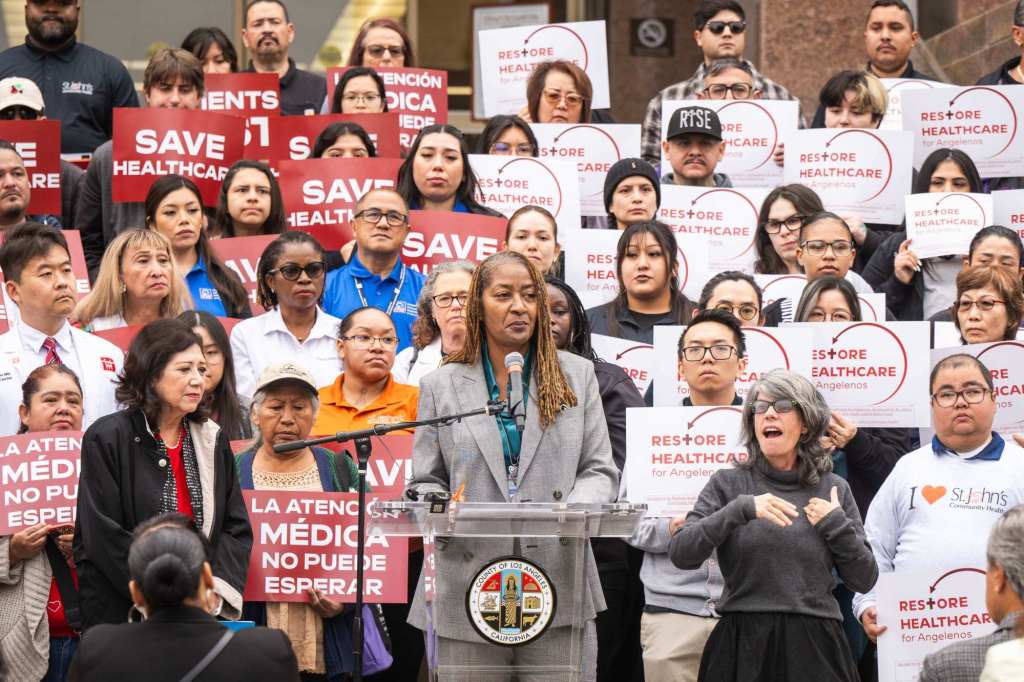
A countywide, half-cent sales tax ballot measure that will help plug gaps in federal health care coverage provided by the county is losing among Los Angeles city voters, according to a new poll.
Measure ER on the June 2 ballot trails among Los Angeles city voters, with 47% opposed. About 45% were in support of the tax increase, poll results found. The measure needs 50% + 1 to pass.
Los Angeles County voters, including voters in all 88 cities, will decide the fate of the half‑cent sales tax increase intended to prop up slashed health care services and insurance coverage caused by Medi‑Cal cuts enacted by Congress and President Donald Trump as part of H.R. 1, “The Big, Beautiful Bill” approved in July. The cuts will have a direct impact on 3.3 million low-income LA county residents, according to the county.
Potentially losing support from a large chunk of voters within the city of Los Angeles, who many say are more likely to vote for tax increases then voters in the county as a whole, could portend a negative outcome for the measure, say pollsters and others pundits.
There are about 5.8 million registered voters in LA County. Of those, about 2.2 million live in the city of L.A., records show.
In addition, the poll found just 53% supported an LA city measure to increase the transient occupancy tax (a tax on hotel rooms and short-term rentals) that will help pay for local services and would not impact many Angelenos.
The poll was conducted by Sextant Strategies & Research out of Claremont. Using telephone calls and emailed questions, it received 824 responses, some from interviews done in Spanish, of likely LA city primary voters. The poll was taken between March 10 and March 15, the firm reported. It was commissioned by Working Californians, a nonprofit group affiliated with the International Brotherhood of Electrical Workers (IBEW), according to Jonathan Brown, president of Sextant.
Brown said the poll focused on LA city issues, new taxes, homelessness and housing and included questions on Measure ER. The issues of housing and homelessness were key, but affordability and the cost of living in the city and county, including rising prices for groceries, gasoline and insurance came into play in the responses, he added.
“The poll also finds that voters are increasingly cautious about new taxes as they continue to feel financial strain,” the polling group said in a statement. “These results show that voters are feeling squeezed and are hesitant to support new taxes without a clear case for how the money will be used or belief that they will see tangible results,” said Brown.
Measure ER, the Essential Services Restoration Act for Los Angeles County General Sales Tax Measure, is supported by a coalition of labor, clinic operators and county workers and was placed on the ballot by the LA County Board of Supervisors on Feb. 10. The effort was led by Second District Supervisor Holly Mitchell and First District Supervisor and board chair Hilda Solis. The two were joined by Third District’s Lindsey Horvath and Fourth District’s Janice Hahn in a 4-1 vote. Fifth District Supervisor Kathryn Barger was the lone no vote.
Barger is listed on the ballot measure as an opponent, which also includes LA Taxpayers Association, Arcadia City Councilmember Paul Cheng, Rosemead Mayor Sandra Armenta and Temple City Mayor Cynthia Sternquist.
Mitchell and Solis have said approval of the ballot measure is a way for voters in the county, including its cities, to ensure health care access for those cut-off, plus continuation of countywide vaccines and other public health services, while preserving an estimated 64,000 jobs that would otherwise be lost.
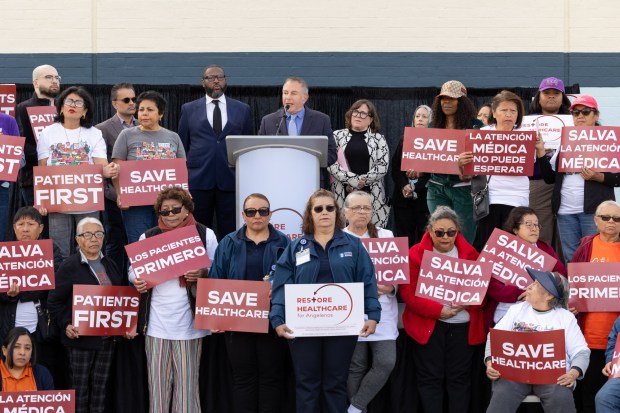 Jim Mangia, president and CEO of St. John’s Community Health, leads a group of clinics and healthcare workers called the Restore Healthcare for Angelenos coalition at a rally in Venice for a sales tax measure that would raise backfill dollars in LA County cut by H.R. 1. (image courtesy of Restore Healthcare for Angelenos)
The Restore Healthcare for Angelenos coalition has rallied in support, initially to place the measure on the ballot, and the group has continued to campaign for it. The group disagrees with the Sextant poll results.
“Every poll we’ve taken has shown a clear majority in favor,” said Jim Mangia, CEO and president of St. John’s Community Health, a leader of the coalition.
Mangia said once their supporters explain the measure, people respond positively. He also recognizes that affordability is an issue in the county, but he says so is healthcare.
“Measure ER will keep healthcare affordable. We think that is a message that will resonate,” he said in an interview on Thursday, April 2, two months before election day.
“Healthcare is on the minds of most people these days. People are very worried about their healthcare and are concerned about healthcare costs, especially when you talk about affordability,” Mangia added.
Cuts enacted by the new law will reduce county health care funding by $2.4 billion over the next three years, removing hundreds of thousands of low-income residents from federal health care coverage while stripping funds from the county Department of Health Services and the Department of Public Health for medical services provided by 24 clinics, numerous county hospitals and prevention services such as vaccines and ocean water testing.
Measure ER would raise about $1 billion per year for county health care services. The tax would sunset Oct. 1, 2031.
Hundreds of thousands are losing Medi-Cal coverage as a result of cuts and from new rules that include renewing coverage every six months rather than each year, work requirements and reductions in how much will be covered for noncitizens, according to CalMatters.
Mangia said 200,000 LA County residents already have been disenrolled from full-scope Medi-Cal coverage, roughly 1,100 people per day. One out of the five people who lost coverage is a child, including 787 infants, 4,000 toddlers, and over 15,000 school-age children.
“This is not a warning; this healthcare crisis is happening now. Hundreds of thousands of Angelenos have already been impacted by federal funding cuts, and this number will only continue to grow if we don’t take action immediately,” he said.
In addition, the county would experience reductions in health care services provided to its residents due to cuts in federal funding. And those who lose benefits would flood both county and private hospital emergency departments, Mitchell said.
The federal cuts will result in losses of $750 million over the next three years from the county’s Department of Health Services. About 70% of the department’s budget comes from federal funding, and federal cuts would be “catastrophic,” Dr. Christina Ghaly, the department’s director, said.
Unless the gap is filled, the county will experience reduced services in emergency rooms and at 24 county clinics, including possible clinic closures. The hospitals that would be hit hardest without stopgap funds are Los Angeles General Medical Center, Olive View Medical Center, Rancho Los Amigos and Harbor-UCLA Medical Center, the authors have stated.
Brown said explaining the complicated facts behind Measure ER may help convince voters to support it. He said a key selling point is that the tax is temporary, lasting five years.
But he said getting past the affordability issue will be tough, as evidence by further polling data.
The poll found 55% of Democrats would vote yes, a low amount of support in L.A. Also, 37% said they’d vote no. “That is a key issue for supporters,” Brown said. “Democrats are feeling the pain of the cost-of-living like everybody else. They are not overwhelmingly in favor of this measure.”
About 81% of Republican likely voters in L.A. surveyed said they would vote no, while 14% said yes. A majority of independents — those not registered Republican or Democrat — are opposed. About 51% were opposed, while 39% favored the measure, Brown said.
Jon Coupal, president of the Howard Jarvis Taxpayers Association, said not a lot of LA County voters know about this proposed sales tax hike.
“People haven’t been subjected to arguments for or against,” he said. “The more people know about it, the less likely they will support it.”
State funding reductions in health care also are exacerbating health care in LA County. Due to budget constraints, California rolled back health care coverage for undocumented immigrants and reduced funding for other initiatives.
In January, the California Department of Health Care Services stopped enrolling new adult patients without legal status in its state-funded health care program, Medi-Cal. The state is expected to cut nonemergency dental care for immigrants here illegally who are already enrolled in the program.
State officials agreed to enact a $30 monthly premium starting in July 2027 for immigrants who remain on the program, including those with legal status.