
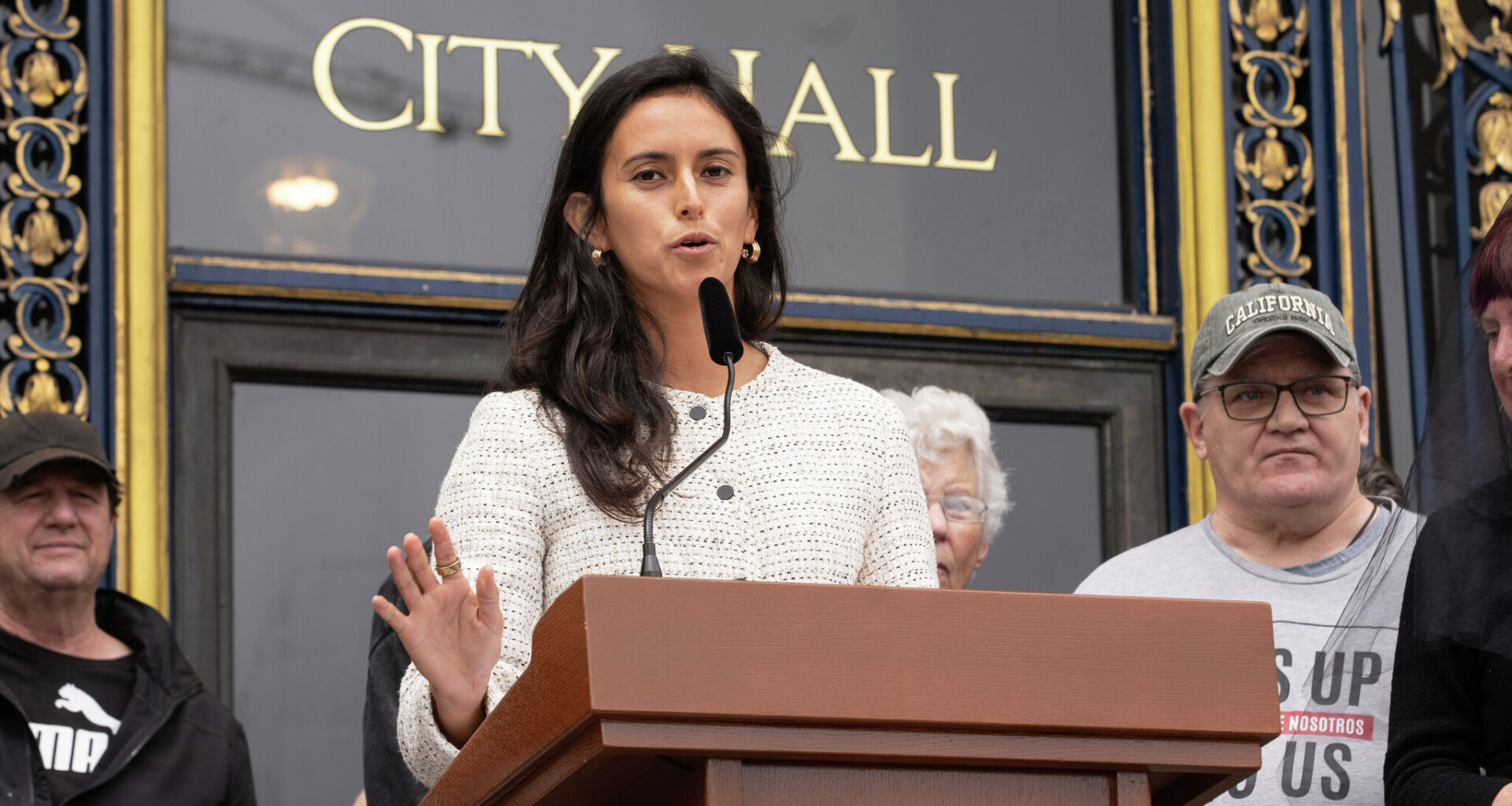
Supervisor Jackie Fielder speaks at a rally hosted by the Coalition on Homelessness and allied organizations outside City Hall in July.
Anna Connors/S.F. Chronicle
San Francisco Mayor Daniel Lurie talks with Supervisor Jackie Fielder in the Board of Supervisors Chamber at City Hall in January
Lea Suzuki/S.F. Chronicle
Before San Francisco Supervisor Jackie Fielder stopped attending meetings and said from a hospital last week that she was considering resigning, her office had become the focus of a city investigation into the leak of a confidential memo, according to a person familiar with the matter.
Fielder stepped back from her duties March 17 and was seeking treatment in a hospital as of 10 days later. Since then, she and her aides have declined to share details about what they identified as a “mental health condition” and requested privacy, saying the supervisor needed time to recover before deciding whether to resign.
But on Friday, Fielder’s chief of staff directly denied that the office leaked the memo, which concerned a new strategy for deterring open-air drug use called the “RESET Center,” to the news outlet Mission Local. Sasha Gaona released a written statement after learning the Chronicle planned to report that the city attorney’s leak investigation had closed in on Fielder’s office.
Article continues below this ad
“The District 9 office did not provide the city attorney’s memo related to the RESET Center to the press, and we have also informed the mayor’s office of this,” Gaona said. “As has been reported, the City Attorney’s Office is currently conducting an investigation and we are unable to provide further comment at this time.”
Amid the city attorney’s investigation, one of Fielder’s four aides, Feng Han, departed her office. It is not known whether Han resigned or was fired, and whether the separation was linked to the leak probe. Han, who uses they/them pronouns and served in an at-will position, told the Chronicle they left for “personal reasons.”
Feng Han, left, an aide to Supervisor Jackie Fielder, departed the office recently amid a city attorney’s investigation into a leaked memo. Han told the Chronicle they left for “personal reasons.”
Gabrielle Lurie/S.F. Chronicle
News outlets have mentioned the leak investigation in stories about Fielder’s leave. The Chronicle is the first to confirm her office had become its focus, and the first to report a denial of responsibility by Fielder’s office. Asked whether the investigation played a role in her health issue, the office pointed to an earlier statement that asked the press “not to report on unsubstantiated rumors.”
San Francisco Chronicle Logo
Make us a Preferred Source to get more of our news when you search.
Add Preferred Source
The person who provided new details about the investigation was granted anonymity under the newspaper’s confidential sources policy.
Article continues below this ad
The Feb. 9 memo that was leaked contained advice on the “very high” legal risks posed by Mayor Daniel Lurie’s plans to open the RESET Center, a facility on Sixth Street where police can bring intoxicated people as an alternative to jail. Mission Local reported that it had obtained a copy of the memo on Feb. 10, the same day Fielder voted against the center.
In opening a leak investigation, City Attorney David Chiu warned that disclosing his office’s confidential legal advice could make it harder for the city to defend itself against lawsuits. Chiu wrote in a letter to the board that whoever leaked the memo could face significant penalties, “including discipline or termination for an employee and removal from office for an elected official.”
David Campos, one of Fielder’s predecessors and supporters, said he “wouldn’t be surprised” if the leak investigation affected Fielder’s state of mind. “I could see that being an added source of stress,” he said. He questioned whether the probe could be politically motivated — a suggestion the city attorney’s office denied.
“A lot of different offices over the years have been linked to the potential leaking of confidential information from all sides,” Campos said. “It’s not something that should be done for the protection of the city. But if there is going to be enforcement of it, let’s make sure there is uniform enforcement of it.”
Article continues below this ad
Fielder, 31, is the lone democratic socialist on the Board of Supervisors and represents District 9, a progressive stronghold that includes the Mission District. Since taking office 15 months ago, she has been one of the few supervisors willing to challenge Lurie and his moderate allies who dominate the board.
Supervisor Matt Dorsey, who frequently clashes with Fielder politically, has been the most vocal supporter of the leak investigation. “Attorney-client privilege is sacrosanct,” Dorsey said. “If a single supervisor or staffer leaked it, it is serious and it has to be taken seriously.”
Supervisor Matt Dorsey, center, has threatened repercussions for the person responsible for leaking a memo to the Board of Supervisors from the City Attorney’s Office.
Lea Suzuki/S.F. Chronicle
Jen Kwart, a spokesperson for Chiu, said the investigation was ongoing.
“We initiated an investigation into the unlawful disclosure of our privileged legal advice, not an investigation into any specific member of the Board of Supervisors or their staff,” Kwart said in a statement. “We always follow the facts wherever they lead us.”
Article continues below this ad
Kwart said the probe was “by no means the first investigation of its kind.”
“City officials generally respect attorney-client privilege, and they very rarely disclose a sensitive confidential memo in its entirety,” she wrote. “Happily, there aren’t that many instances to investigate, and thus, we have infrequently needed to investigate a breach of privilege. But, it has happened before.”
The leak investigation traces back to the Board of Supervisors’ Feb. 10 vote on a proposal to fund Lurie’s sobering center.
Shortly before the vote, Mission Local reported that it had obtained a memo, written by Deputy City Attorney Brianna Voss, that was sent to the board the day earlier. Voss had warned the facility could create “very high legal risk” for the city in the event of a lawsuit and potentially run afoul of state law.
Fielder and Supervisor Connie Chan cast the only dissenting votes.
Article continues below this ad
“I have concerns about this contract, as I understand the RESET Center may or may not be subject to state standards around these kinds of facilities, and we don’t actually know the answer to that at the moment,” Fielder said at the meeting.
Roughly an hour after the vote, Dorsey first raised the specter of a leak investigation and threatened repercussions for the person responsible.
“When the investigation identifies who unlawfully disclosed confidential (city attorney) advice, I’ll introduce a censure motion against the (Board of Supervisors) member involved,” Dorsey wrote in a post on X. “City officials who violate these laws are subject to penalties and ‘removal from office due to official misconduct.’”
When the investigation identifies who unlawfully disclosed confidential @SFCityAttorney advice, I’ll introduce a censure motion against the @SFBOS member involved. City officials who violate these laws are subject to penalties and “removal from office due to official misconduct.” pic.twitter.com/0Z2p5YNJHc
— Matt Dorsey (@mattdorsey) February 11, 2026
Dorsey was citing the potential penalties outlined by the city attorney’s office in 2009, after the Chronicle obtained a confidential memo — similar to the one recently leaked — about sanctuary city legislation that Campos had proposed during his time as a supervisor.
Campos said he had no recollection of the city attorney investigating the leak at the time, “which is why I’m surprised they did one here,” he texted Friday.
It’s unclear whether the city attorney investigated that leak.
Kwart said her office conducts all sorts of investigations that are confidential, “so it is unlikely people in and around City Hall would know about them.”
Three days after the most recent confidential memo hit the news, Chiu told the Board of Supervisors in a letter that his office had launched a leak investigation. Only the entire board can waive attorney-client privilege, Chiu wrote, and it must do so in a public vote.
Chiu said that whoever leaked the memo had either provided a copy to Mission Local or “allowed the reporter to take photos of every page.”
City Attorney of San Francisco David Chiu told the Board of Supervisors in a letter that his office had launched an investigation into the leak of a memo his office had written for the board.
Benjamin Fanjoy/For the S.F. Chronicle
It’s unclear how the city attorney proceeded with its leak investigation.
It wasn’t until March 12, almost a month after Chiu launched the probe, that Han, Fielder’s aide, separated from the city, records show. Han had been hired after serving as a key campaign worker for Fielder. Their departure shocked political insiders, who said Han was among Fielder’s few confidantes in City Hall and a close friend outside work.
The following day, Fielder faced added pressure when Sheriff Paul Miyamoto sent her a letter criticizing her decision to share an audit request with the media without first alerting him. The letter was published by the San Francisco Standard.
On March 17, Fielder informed the Board of Supervisors clerk that she would miss the board meeting that day and the following week. She did not state a reason. Fielder was in the hospital as of March 27, seeking treatment for what her aides described as an “acute personal health crisis.” She told Mission Local that she was unwell and planned to resign.
Her aides released a statement on social media two days later that said Fielder was “navigating a mental health condition and needs time and space to recover before making any major decisions.” The aides said they would run the supervisor’s office in her absence.
“We urge everyone to treat this situation with the same respect and sensitivity as they would if she were recovering from any other medical emergency,” her office wrote.
While it’s not unheard of for confidential information about a city’s business to leak to the media, such instances can violate the trust between a city attorney and the lawmakers they advise, said Dan Lindheim, an attorney and former city manager of Oakland who teaches at UC Berkeley.
An investigation to identify the source of the leak could be an opportunity to educate a lawmaker rather than to punish them, he said.
If Fielder was found to have leaked the memo, Lurie would decide whether to initiate official misconduct proceedings against her to remove her from office. Doing so over an alleged leak would be unprecedented in modern city history.
As of Friday, Lurie had not had any conversations about initiating misconduct proceedings against Fielder because the investigation had not concluded, according to a person close to the mayor who insisted on anonymity.