
San Diego Mayor Todd Gloria is urging City Council members to avoid deep cuts to homelessness funding this spring despite the need to close a looming $120 million budget deficit for the fiscal year that starts July 1.
In a nine-page memo sent to council members Friday afternoon, Gloria says substantial funding cuts could devastate what he characterizes as notable recent success in reducing street homelessness.
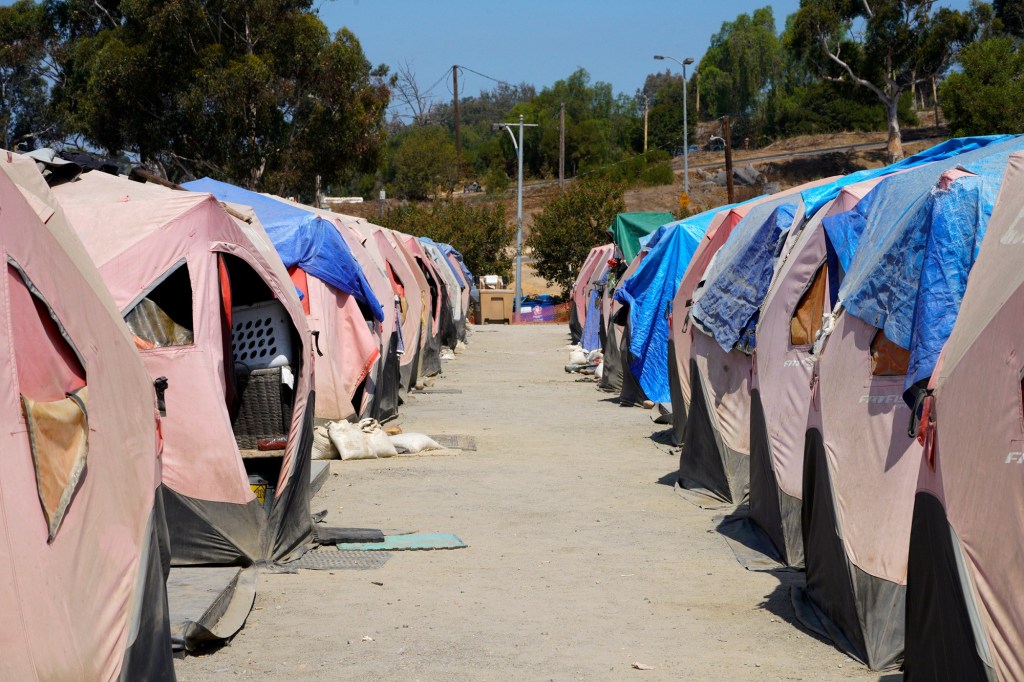
The mayor also says the city could need to stop enforcing laws against street camping and vehicle habitation if there are major cuts to city-run lots for people living in vehicles or tents.
Courts have ruled that the city can’t force people off the streets if it can’t offer a safe place for them to go — either shelter beds or designated sleeping areas.
The memo comes less than two weeks before the mayor is scheduled to release his proposed budget for the new fiscal year on April 15. It doesn’t say how the mayor plans to close the $120 million gap without cutting homelessness spending.
But the memo indicates homelessness spending might not be as vulnerable to cuts as other programs because the city now has roughly $33 million in hotel tax revenue to spend each year on homelessness.
That money is thanks to Measure C, a 2020 ballot measure that increased the city’s hotel tax to pay for homelessness programs, street repairs and an expansion of the waterfront convention center.
The measure was tied up in court for many years but got final validation last year. It’s projected to cover $32.6 million of the city’s $87.9 million in homelessness spending during the ongoing fiscal year.
And much of the remaining $55 million is covered by grants and other funding sources, shrinking the amount of general fund money the city is projected to spend on homelessness this fiscal year to $1.2 million.
That total is a sharp drop from the $25.2 million in general fund money the city spent in fiscal year 2023, Gloria notes in the memo.
But there is some risk the city will need to increase its general fund contribution in the new fiscal year because there are expected to be cuts to state funding.
In addition, some state funding is now dependent on cities showing evidence to Sacramento that they’re using the money to successfully get homeless people off the streets.
Gloria tells council members in the memo that deep cuts would be a mistake.
“The city is beginning to see measurable progress as targeted investments in outreach, shelter and housing programs help reduce homelessness and connect individuals and families to long-term stability,” Gloria says in the memo. “These results demonstrate that our approach is working and underscore the importance of continuing to invest in proven strategies that deliver both compassionate support and tangible improvements for neighborhoods across the city.”
The mayor cites recent data to support his arguments.
He notes that the annual winter count by the Regional Task Force on the Homeless found a 13.5% year-over-year drop in the overall homelessness population, including a 4% drop in the unsheltered homeless population.
The mayor says there has also been progress within specific subgroups. Compared to 2024 levels, he says unsheltered veteran homelessness fell by 22%, unsheltered youth homelessness by 23% and unsheltered family homelessness by two-thirds.
“These reductions follow continued investment by the city and our partners to expand services specifically designed to support these subpopulations,” Gloria says in the memo.
There’s also been progress in targeted areas, Gloria says. Homelessness along the San Diego River is down 50% year-over-year, and homelessness in downtown is down 62% since 2023 — the year the city enacted its controversial encampment ban.
On the safe parking and safe sleeping sites, Gloria stresses that they are cost-effective options.
The memo says the city-run tent sites cost the city $48 per person each night to run and the parking sites $26 per person each night, while the weighted average for shelter beds is $68 per bed night.
Last year, the city’s designated lots for tent camping served 1,854 people, of whom 207 successfully exited to long-term housing, the memo says. And of the 1,105 people who parked their vehicles in city-run lots, 240 exited to long-term housing.
The mayor concluded the memo with a plea to the council.
“Together we must make thoughtful decisions that allow the city to maintain a balanced budget, continue providing critical services to those who need them most, and do so in a way that reflects San Diego’s commitment to compassion, accountability and results,” he says.