
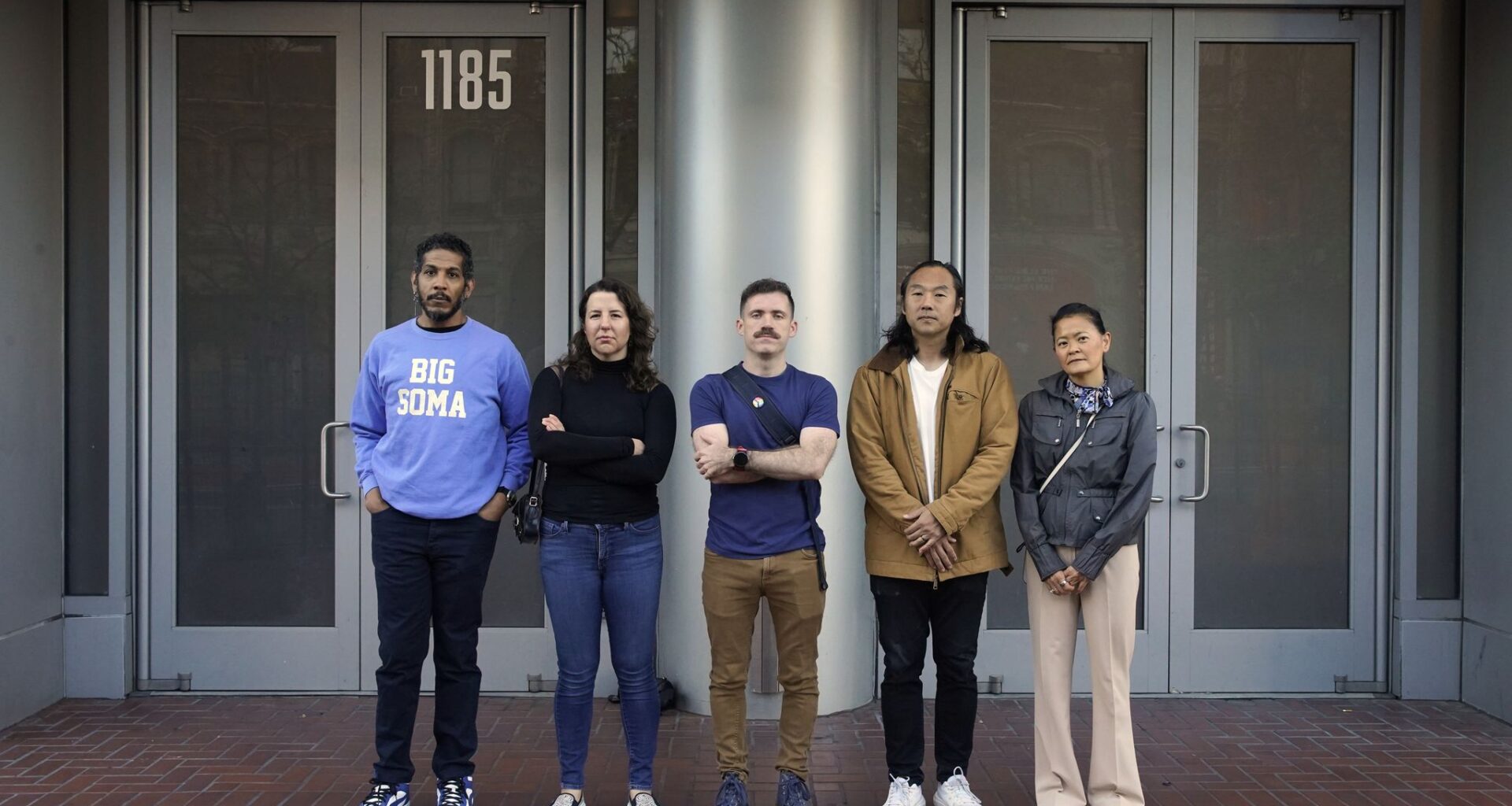
From left: Fernando Senegal, Leah Edwards, Shaun Aukland, Adam Hong and Lara Hashimoto are members of the SOMA West Neighborhood Association. The group filed a formal complaint with state authorities, alleging that San Francisco is unlawfully concentrating homelessness and mental health services in the neighborhood.
Giselle Garza Lerma/S.F. Chronicle
Whenever dystopian images of San Francisco flash across your social-media feed — of tent encampments, naked people in the throes of a mental-health crisis, piles of needles or human waste — there’s a good chance they were taken in the Tenderloin or South of Market neighborhoods.
For decades, these two areas have served as de facto containment zones for San Francisco’s most pervasive social woes; they account for 60% of the city’s homeless shelters and transitional housing facilities.
Pretty much everyone agrees this isn’t fair. But there’s far less consensus about how to fix it.
Article continues below this ad
Residents and business owners have repeatedly sued the city over street conditions in the Tenderloin, with limited legal success. Last year, Supervisor Bilal Mahmood, who represents the Tenderloin, introduced a bill to spread homelessness and mental health services across the city. The law, which went into effect in January, prioritizes funding shelters in neighborhoods with a higher percentage of homeless people than beds — largely affluent, development-resistant communities on the west side — and requires additional review before new shelters can be put in the Tenderloin and SoMa.
Supervisor Bilal Mahmood, who represents the Tenderloin, wrote a law that prioritizes funding shelters in neighborhoods with a higher percentage of homeless people than beds, with the goal of spreading services throughout the city.
Lea Suzuki/S.F. Chronicle
For one group of SoMa residents, however, Mahmood’s legislation didn’t go nearly far enough.
San Francisco Chronicle Logo
Make us a Preferred Source to get more of our news when you search.
Add Preferred Source
On Friday, the SOMA West Neighborhood Association filed a formal complaint with state authorities, alleging that San Francisco has used a “deliberate, legislated containment strategy” to create a “segregated … impact zone” in SoMa. The complaint, shared exclusively with me, argues that SoMa’s “hyper-concentration of poverty” is an intentional policy choice — reflected not only in the high volume of homelessness and behavioral-health services but also poor public sanitation, dearth of trees and parks, slow police response times and zoning restrictions that limit market-rate housing and retail. These accusations are not necessarily new. But the association’s proposed remedy is.
Article continues below this ad
It wants the state Department of Housing and Community Development to decertify the city’s “housing element” — its state-mandated blueprint to accommodate 82,000 new homes by 2031 — and unleash the “builder’s remedy,” which essentially gives developers free rein to ignore local zoning rules so long as their projects contain affordable units.
It also wants the Office of the Attorney General’s Housing Justice Team to “pursue maximum civil penalties” against the city until its “arbitrary, capricious, and exclusionary practices are completely dismantled.”
These demands turn San Francisco’s typical housing debate on its head. Often, community members oppose market-rate housing. The SOMA West Neighborhood Association, by contrast, is asking for more.
“We want more people to come live in our neighborhood, and we want economic revival,” Shaun Aukland, the complaint’s principal author, told me.
The complaint traces a trend line of office tenants and businesses fleeing from SoMa as shelters and behavioral health centers proliferated.
Article continues below this ad
For Alex Ludlum, executive director of the SOMA West Community Benefit District, this is evidence that “San Francisco spends tons of money on SoMa West, and nearly all of it is spent to make the neighborhood worse for businesses and residents.”
After 17 years living in SoMa West, neighborhood association member Lara Hashimoto told me she’s fed up with the urine sprayed against the corners of her building, street harassment and open abuse of fentanyl. Just last week, she said, a clearly mentally unwell woman threw gravel at her face.
“How are things going to improve when you have the government that’s so hell-bent on putting everything in terms of the housing and services all in this neighborhood?” Hashimoto asked me.
The complaint argues that San Francisco’s concentration of services in SoMa violates California’s law requiring local governments to “affirmatively further fair housing” or integrate historically segregated areas.
The Attorney General’s Office didn’t respond to a request for comment. A state housing department spokesperson told me the agency “reviews all complaints received and cannot comment on open matters.”
Article continues below this ad
Chris Elmendorf, a UC Davis law professor and state housing law expert, told me the state will “almost certainly not” revoke San Francisco’s housing element approval based on this complaint — because California’s fair housing law is so broad and so vague that cities can argue pretty much anything fulfills the requirement.
What the state might be more willing to investigate, Elmendorf said, is the complaint’s request to block San Francisco from implementing its plan to comply with Senate Bill 79, a state law going into effect on July 1 that makes it easier to build dense housing near transit.
SB79 allows local governments to exempt “industrial employment hubs” from upzoning, which San Francisco has proposed to do for three parcels in SoMa West. But, as the complaint notes, those parcels are also zoned for 100% affordable housing and homeless shelters.
The city can’t have it both ways, the complaint argues: You can’t block a parcel from being zoned for mixed-income housing by calling it industrial while simultaneously allowing shelters and low-income housing.
A small homeless encampment is pictured in 2024 at 598 Brannan St. in the South of Market neighborhood. A complaint to the state alleges the city is intentionally creating a “hyper-concentration of poverty” in the area.
Lea Suzuki/The Chronicle
Dan Sider, chief of staff for the San Francisco Planning Department, told me that western SoMa “has had zoning intended to preserve the city’s industrial base” since the 1990s, a “direction” that came “directly from community planning processes relying on input from Western SoMa community members.” A carve out was added for 100% affordable housing, which, like industrial uses, couldn’t financially compete with offices or market-rate housing, Sider said.
Article continues below this ad
Protecting blue-collar industry is a laudable goal. But if there’s no industry to occupy spaces, it can merely lead to the preservation of blight, as Sausalito demonstrated with its decaying Marinship neighborhood.
San Francisco Mayor Daniel Lurie told me in a statement that “tent encampments are at a record low for the third time, more people on our streets are getting connected to treatment and recovery resources, and San Franciscans feel overwhelmingly like our city is moving in the right direction for the first time in years.”
But, he added, “I see every day that we have so much more work to do.”
Supervisor Matt Dorsey, who represents SoMa, said, “The city has a moral obligation to this neighborhood,” adding that he sees the recent prioritization of drug-free and abstinence-based shelters as a long-overdue step in improving street conditions.
Residents like Aukland have heard such proclamations before, and they are — rightfully — skeptical. The complaint is filled with quotes from city officials bemoaning the concentration of facilities in SoMa — only to keep placing them there.
Guest opinions in Open Forum and Insight are produced by writers with expertise, personal experience or original insights on a subject of interest to our readers. Their views do not necessarily reflect the opinion of The Chronicle editorial board, which is committed to providing a diversity of ideas to our readership.
Read more about our transparency and ethics policies
Indeed, Lurie’s controversial RESET Center, where police can drop off intoxicated people as an alternative to jail, will soon be joining the neighborhood.
If the complaint does nothing else, it should galvanize city officials to work harder than ever to do right by the residents who, for decades, have confronted the social woes other San Franciscans have the luxury to ignore.
Emily Hoeven is a columnist and editorial writer for the Opinion section.