
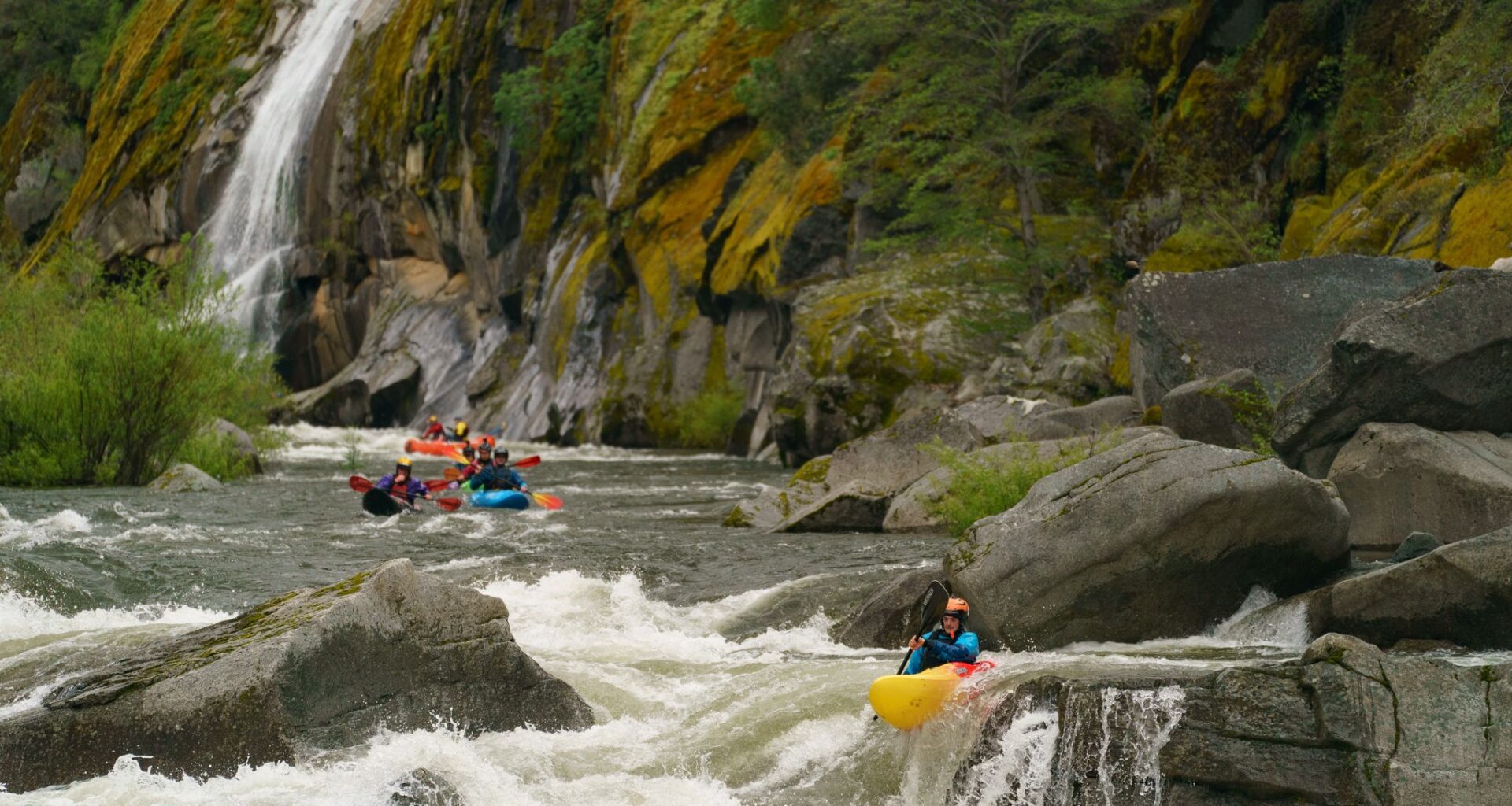
The Slab Creek run on the South Fork American River passes through scenic granite canyons in the western slopes of the Sierra.
Darin McQuoid Photography
The disappointing news came last week: A whitewater trip I’d been looking forward to — that winds through gorgeous and seldom-paddled granite canyons in the Sierra foothills — had been abruptly canceled.
Dozens of kayakers and rafters like me had been eager to get on the South Fork American River’s Slab Creek run, a remote stretch of water north of Placerville that’s only recently become a viable paddling destination. Last Sunday was supposed to be one of the few days of the year when a reservoir there releases flows that transform the mellow river corridor into a 5-mile whitewater party of huge rapids that attract paddlers from around the state.
Article continues below this ad
“When it goes off, it’s a really special, spectacular run,” said Trevor Croft, the editor of Rafting Magazine who grew up paddling the Sierra and has run Slab Creek many times. “It’s a harder section of whitewater with bigger rapids than what you find in other places around here.”
I’ve had to cancel or postpone outdoor trips for a lot of reasons, usually having to do with weather or wildfire. But the reason this time surprised me: The record-setting March heat wave that obliterated the Sierra snowpack also triggered an early mating season for the foothill yellow-legged frog, an endemic species of cute amphibian with olive coloring and nubbly skin that emerges each spring to breed along the riverbanks when it warms up.
San Francisco Chronicle Logo
Make us a Preferred Source to get more of our news when you search.
Add Preferred Source
The frog is found in mountain ranges across the state but is listed as endangered or threatened in several regions. Discharging torrents of whitewater out of the Slab Creek Reservoir dam would risk blasting the frogs and their egg masses downstream.
I assumed we’d have to delay the trip for a few weeks, but a representative from the national nonprofit advocacy group American Whitewater corrected me: The frogs’ larvae need months to mature. The whole Slab Creek season was kaput, over before it began.
Article continues below this ad
Balancing the sometimes competing priorities of wildlife protection and public recreation — and in this instance, water storage and hydropower as well — is part of California’s endless effort to appropriately manage its most precious natural resource. This situation was a small case study: The South Fork American holds some of the best whitewater runs in the country, and they in turn support the tourism economies of rural mountain communities. Also, like a lot of the Sierra’s dammed and altered waterways, the river props up a massive hydropower system engineered to serve 900 square miles of the Greater Sacramento area. And then it’s the home turf of threatened species of frogs, turtles, and other creatures and plants.
I called Scott Harding, American Whitewater’s stewardship associate and an expert on Northern California river politics and paddling. The organization was key in advocating for recreational flow releases out of the Slab Creek Reservoir, which began a decade ago under a 50-year license order between the Federal Energy Regulatory Commission and the dam operator, the Sacramento Municipal Utilities District.
“We’ve been engaged in that process for 20 years and then bird-dogging the implementation of the whitewater releases,” Harding said. “Now there’s an opportunity for people to go and enjoy that stretch of river, and it’s starting to gain popularity.”
For a long time, the Slab Creek run only got going periodically during big storm surges when the dam cut water from its spillway. It was kind of a local secret, enjoyed by a cohort of expert paddlers who monitor Sierra river flows the way most people check the weather forecast.
American Whitewater sought to carve out a schedule of reliable releases so more paddlers could enjoy it. Per a settlement agreement, SMUD is obligated to issue up to 12 releases for paddlers in spring during a typical water year. But many years since have been anything but typical — with seasons of heavy precipitation intermixed with extremely dry periods — so paddling opportunities at Slab Creek have proved to be infrequent and elusive. Recreational flows have been released in only five of the past 11 years.
Article continues below this ad
Paddlers, including Croft, had planned to take advantage of the flow initially scheduled for last Sunday — which was to be the second release of the season ahead of several more in April. But amid one of the hottest March months on record, frog mating season came early.
A foothill yellow-legged frog is seen along the banks of the Feather River in Northern California.
Rebecca Fabbri / U.S. Fish and Wildlife Service
The foothill yellow-legged frog “has disappeared from more than 50% of its historic habitat” here, a fate attributed to a slew of forces including “dams, water diversions, logging, mining, livestock grazing, climate change, pesticides, off-road vehicles, disease, urban and agricultural expansion and marijuana cultivation,” according to the Center for Biological Diversity.
The creatures need warmer, slow-moving water to thrive. Their “breeding stream habitat is typically shallow, rocky and at least partially exposed to direct sunlight,” according to the U.S. Fish and Wildlife Service.
The frog’s needs are reflected in the Slab Creek Reservoir license order. The 241-page document stipulates that, once water temperatures in the Slab Creek area reach 53.6 degrees Fahrenheit for a week straight, the dam operator “shall cancel the pulse and recreational flow events” to spare the frog and its larvae the risk of getting washed away. This same criteria also applies to a nearby whitewater run on the South Fork American at Silver Creek, which is also now closed for the season.
Article continues below this ad
Harding called the Slab Creek closure a “disappointing outcome” for paddlers but said it’s an acceptable toll of responsibly managing California’s waterways. “We don’t want a release for the purpose of whitewater recreation to cause ecological harm,” he said. “We want to have healthy rivers, and this is a component of that.”
Shutting down Slab Creek for the year isn’t harming the commercial rafting industry, since it’s a pretty niche run and the release schedule is relatively new; no guide companies offer trips there, Croft said. There’s a ton of excellent guided whitewater trips for novice rafters to sink their paddles into this time of year, including classics like the South Fork American’s 6-mile Chili Bar run downstream of Slab Creek.
A lost paddling season on one stretch of river seemed to me like a reasonable trade-off to help bolster an ailing species. I pulled up the newest wildlife monitoring report from the Sacramento Municipal Utilities District, anxious to learn how many frogs might be saved.
“Surveyors did not observe foothill yellow-legged frogs or California red-legged frogs in 2025,” it read.
Article continues below this ad
Harding confirmed this surprising finding, clarifying in an email that annual surveys going back more than a decade have found no foothill yellow-legged frogs at Slab Creek. “The frogs are not known to be present,” he wrote, “although suitable habitat exists.”
I called Harding to make sure I was understanding things correctly: Paddling season was canceled to make room for frogs that haven’t been found in this area for at least the last 10 years?
“Seems paradoxical, doesn’t it?” he said.
Yes, it did, I replied. I wasn’t upset, just perplexed.
Then I thought about the whole situation more — how the frogs, the paddlers and Sacramento’s hydropowered households are all nourished by and dependent on the downhill flow of this vital but limited resource. I marveled at how those sometimes-competing interests have found ways to share it — contentious as those negotiations can be — and how the tiny creature’s prospects were being represented.
Even though the terms of the license order ultimately canceled some good paddling this year, they felt like a nod toward optimism: Maybe this will be the year the frogs return.
When I’m finally able to get out to Slab Creek and experience the place at peak fun, hopefully next year, I’ll have a much greater appreciation for it.