
For years, I had been looking for a real-life version of “The Man Who Planted Trees,” a short story authored by Jean Giono, one of the greatest French writers of the 20th century. This story is widely available on the Internet (search “The Man Who Planted Trees PDF”), and I urge you to read it; no story, I venture to say, is more inspiring.
In brief, it describes the transformation of a vast, barren expanse of land at the foot of the French Alps into a lush ecosystem, entirely through the efforts of a single individual who planted more than 100,000 oaks, as well as a significant number of beech and birch trees, in the span of three decades.
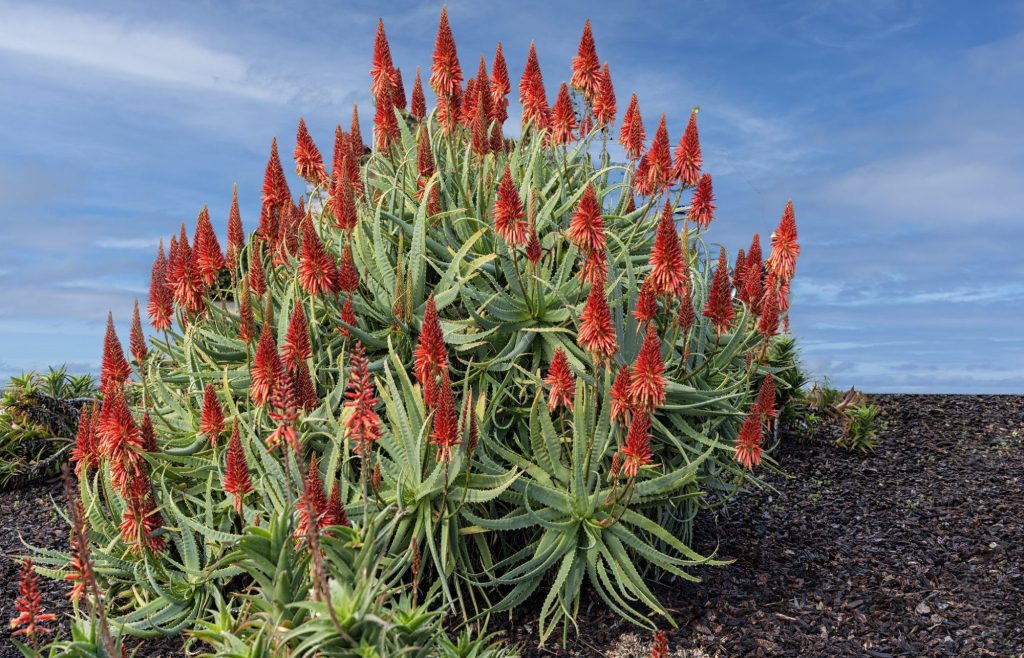
In Sunset Beach, a coastal neighborhood of Huntington Beach, there is “the man who planted aloes,” who, over a period of many years, has created and continues to maintain a large planting of these well-known succulents. “I planted the beginnings of this aloe garden 40 years ago,” Jim Hoyland wrote, “and still maintain it for the current owners. During the holidays, we call it the Christmas Garden; over 300 spikes were in bloom this year.” The spikes to which Hoyland refers are conical racemes, up to 16 inches long, each of which may bear between 100 and 300 tubular, orange-red blooms.
The plant in question is torch aloe (Aloe arborescens). It is rare among aloe species due to its exceptionally diverse habitat, which ranges from sea level to an elevation of 6,000 feet in its native South Africa. It is among the hardiest aloes, having survived winter cold down to 20 degrees. Although it may reach ten feet in height, it often grows no more than four feet tall at maturity. It is especially effective when grown as a dense, impenetrable hedge due to its deeply toothed or dentate leave margins. While not thorns, these foliar teeth can take a bite out of those who attempt to cross a thicket of torch aloes.
Propagation of this plant is easy. “I just detach some of the pups (offsets at the base of succulent plants) and set them on the sand,” Hoyland explained.
Nothing else is required for the plants to take root, although there is a sprinkler system in the area for irrigation purposes. Other plants on the property that have been grown in sand include gladiolus, lily-of-the-Nile (Agapanthus), and a hedge of geraniums. In truth, as long as water is available, plants of every description thrive in sand since it provides their roots with maximum oxygen, the most important element in their development.
Aeroponics proves the singular importance of oxygen in plant growth. In this technique, plants are suspended in air with a spray of water mixed with minerals applied to their roots every few seconds. Dozens of vegetable and herb varieties, in addition to strawberries, demonstrate explosive growth when cultivated aeroponically.
• • •
Although aloe sap is recommended for treating skin conditions, whether acne or psoriasis or sun burn or eczema, it is not the cure-all that you might think. Evidence of this was provided in an email sent to me by Maria Leano as follows: “A few years ago, I struggled with eczema. I was pretty desperate, and so one day I plucked an aloe leaf, sliced it open, and spread the oozy stuff on my neck. I felt a burning sensation and thought I had made the problem worse. While at the dermatologist, I mentioned the incident and that I was sort of puzzled since Aloe vera has such a great reputation for skin problems.”
Her doctor said that while aloe sap applied directly to the skin was effective in previous times, this was not necessarily the case today, since our skin may be more sensitive than it was back then. However, it could also be that Leano experienced a dermatitic response to the sap to which some people are allergic. Ironically enough, one of the allergens in Aloe vera that can cause burning is salicylate, the same compound in willow trees (Salix spp.) from which aspirin is made.
• • •
Peggy Neiman, who gardens in Rosemead, sent me a photo of a snowbush (Breynia disticha) with this note: “You asked for ‘a tale to tell regarding a plant with multicolored foliage.’ My very favorite multicolored foliage is found on snowbush. My plants are about 5 feet tall and grow in morning sun.” If you are seeking a moderately sized hedge for morning sun exposure, nothing tops snowbush. Foliage is every shade of pink, green, and white.
• • •
I received an email with photos of a St. Augustine lawn that was full of dead spots. Upon learning that dogs were allowed to roam on the lawn, the reason for its decimation became clear, since this grass, although touted for its shade and drought tolerance, is highly sensitive to dog urine and dog digging. Where it is allowed to grow freely, St. Augustine spreads rapidly due to its stolons (runners) that help it to create a thick carpet through which weeds cannot grow. However, it is shallow-rooted and easily deracinated by dogs in addition to the urine damage.
Bermuda grass is a better alternative where dogs need to roam; in addition to stolons, it also possesses rhizomes that can grow as deep as three feet, while roots growing off of these rhizomes can extend to a ten-foot depth. Kikuyu, however, is the ultimate in dog-tolerant grasses with its indefatigable, ropy stolons and rhizomes. It is tough enough to warrant planting on golf course fairways throughout Southern California.
While Bermuda and Kikuyu are weedy if allowed to expand into adjacent planter beds, these are your best choices for areas meant exclusively for grass, at least where water conservation is concerned. Although both of these grasses can survive in the absence of water and will go dormant when subjected to extreme drought, they need to be watered 2-3 times a week in extremely hot weather to remain green.
California native of the week: California native milkweed plants are recommended for spring planting. While seeds are recommended for fall planting, live plants are best planted in the garden at this time of year. The only nursery I found with a stock of native milkweed — 300 plants, in fact — is Santa Barbara Natives (sbnatives.com), located 20 miles west of Santa Barbara in Gaviota. Visits to the nursery are by appointment only.
The species available there is narrow-leaf milkweed (Asclepius fascicularis), the most important native milkweed when it comes to attracting monarch butterflies. Once summer comes, native milkweeds are covered with monarch larvae that will pupate before the adults emerge in all their glory. Narrow-leaf milkweed grows three feet tall and will experience winter dormancy when it completely disappears. However, all milkweeds are perennial and those that go dormant come to life again the following spring. Plant in full sun and mulch heavily. Water during the first month and sparingly, if at all, after that. Flowers, button-shaped in lavender or pale pink, appear in clusters. If you know of other milkweed sources, please advise.
Do you have an experience expanding the presence of a particular plant in your garden through propagation? If so, please send your story to joshua@perfectplants.com. Your questions and comments, as well as gardening conundrums and successes, are always welcome.