
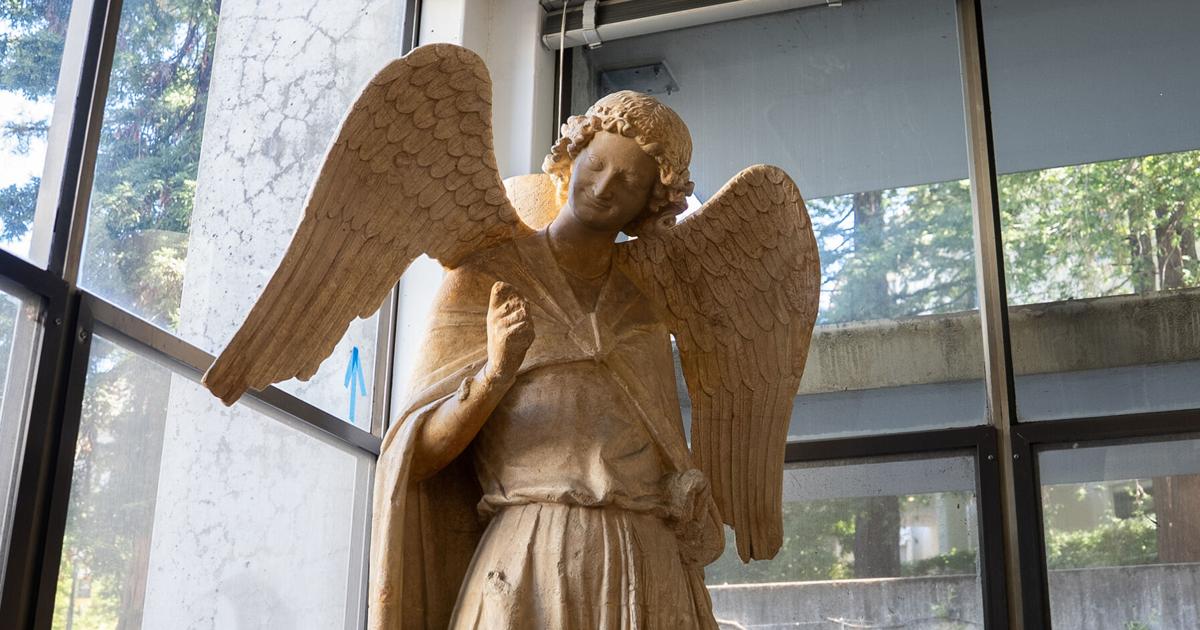
There’s a plaque on the wall next to the angel statue in Wurster Hall — the one in the far corner of the Environmental Design Library against windows that look out on ivy and concrete. “Plaque” is perhaps too grand of a word for what I’m attempting to describe, which is really a badly scanned image of a Daily Californian article from 1965, embossed on a sheet of printing paper and affixed to the wall in a plastic casing. One gets the impression that this clumsy acrylic frame was the culmination of a long chain of orders — the result of someone telling somebody to do something with this newspaper clipping. “Wurster Library Gets Arch-Angel” was written by Nancy Turpin back in 1965, and her words are still hanging on our walls (albeit rather haphazardly) more than 60 years later.
It’s been about six months since I first noticed Turpin’s article. Ever since, it’s been floating around in my mind. No undue attention had been granted to this piece of college journalism in its installation, but for some reason, it was all I could think about. I needed to know more.
As Turpin tells us, our angel is a plaster of paris cast of the Smiling Angel sculpture on the Reims Cathedral in France. Turpin wrote that, according to emeritus professor of architecture Raymond Jeans, the angel now residing over the Environmental Design Library was originally part of a 1915 French Exposition in San Francisco. The UC Berkeley Department of Architecture’s adoption of the angel likely saved it from destruction.
Slipped in at the end of Turpin’s article is a mention of the World War I bombings that damaged the original Smiling Angel in France. When the cathedral was bombed by the Germans in 1914, the angel’s head and outstretched arm were broken off and shattered. Thanks to a restoration led by Henri Deneux and Max Sainsaulieu, completed in 1926, the angel was mostly reassembled using found fragments, the rest filled in with a cast made before its destruction.
While much of this was mildly interesting, I was no closer to pinpointing why I felt so committed to my descent into this rabbit hole of Roman Catholic angel statuary. The intertwined histories of these two plaster angels — decapitated, lost, restored, copied, supplemented and saved — blurred in my mind. I had engaged myself in a struggle to locate the original, to uncover the origin of the serene smiling form, but little was solid or stable behind the facade. My research hadn’t gotten me any closer to identifying why I had been so touched by the experience of finding and reading Turpin’s article. It took me a long time to realize that what had resonated was not the angel itself but that writing on the wall.
During the first semester of my freshman year in a class on the Russian literary master, I read “The Student,” a short story by Anton Chekhov. In the story, a seminary student walks home from the hunt and meets two widows, a mother and daughter. The student tells these women the story of the Apostle Peter before Jesus’ crucifixion, bringing the mother to tears and inspiring intense, painful emotion in the daughter.
At the story’s opening, the student is hungry and cold, his mind filled with images of unending historical pain and ignorance. When he leaves the women, the night is just as cold and bitter, but a marked change has occurred in the student. He reflects on the effect that the Bible story had on these women, and the evident relation between the ancient narrative and the present. “The past, (the student) thought, is linked with the present by an unbroken chain of events flowing one out of another. And it seemed to him that he had just seen both ends of that chain: he touched one end, and the other moved.”
In the lecture, my professor told us that whenever we read, thought, talked and wrote about literature, this is what was happening: We were touching that chain.
I left class that day and cried outside of Dwinelle Hall because, for the first time in a while, I knew what I was doing. I had just come back to Berkeley after a weekend trip home to Los Angeles, and once I was back in my bedroom, sitting at my dining room table and lying on the couch, I realized that I couldn’t tell exactly why I was at school. In high school, things had been much simpler, my plan clearly outlined — go to school, do work, get good grades, get into a good college — but here, the openness of the future and the present was disorienting. A few months had passed since graduation, and there I was, in classes that I had picked nearly at random, where no one was terribly interested in whether I attended them or did any work. As an undeclared humanities major, I was writing essays in pursuit of a degree in something that led to no concrete job that anyone seemed to be aware of.
“I’m guessing you never talked to an academic adviser,” responded a family friend when I told him what classes I was taking that fall — and he was right. I felt that I had been going through the motions of this new fake life miles away from my friends and family, and that I had been able to go on with it until I returned to reality, where my cats were rubbing against my legs and my parents were reading the newspaper at the table. The illusion began to crumble. I’m sure that this isn’t a unique phenomenon by any means, but that didn’t make my crisis feel any less serious.
So, when I read Chekhov’s “The Student,” when my professor spoke those words about “touching the chain,” and I got that funny feeling in my chest, I remembered what I was doing. I remembered why. Writing has always been for me about adding, in whatever small way I can, to a chain: one extending further back in time than I can really visualize. In classes I take at UC Berkeley, words written thousands of years ago bring me to tears. With friends I’ve grown up beside, I talk about ideas originally expressed in languages. Human life and artistic activity seem, to me, to be based on this interaction. Relation to that which is outside of myself, to the foreign, the removed, the unimaginable. Attention to something (a plaster of paris angel, for example), that for whatever reason, moves me, that I am able to share with others.
I had been focusing on the wrong part of my infatuation with our plaster angel: What I was really interested in was Turpin’s decision, back in 1965, to write an article about the appearance of this statue in our library. I was interested in the fact that she had written about it for her college newspaper, that the paper had existed long before her and had continued to exist long after her time at the campus. I was excited by the idea that through her writing and its preservation, I was able, so many years later, to engage in some kind of dialogue with her.
Looking once again at the angel of the library, at Turpin’s endearing depiction of the angel come “to stop traffic” and her description of “overly-familiar” students sticking found objects (a leaf, a gum wrapper) to the angel’s thumb, I was reminded of Chekhov’s student. Like his student, I found myself thinking about storytelling. I find humanity’s unceasing, irrational commitment to look for and fabricate stories out of the world around us, and to continue to share those stories, a beautiful thing. Storytelling doesn’t erase darkness, but it reminds us of something outside of ourselves, of our place within a larger tradition. This is what I find so attractive about college journalism and, really, about any kind of published writing in general. Small contributions to a larger project are no less valuable in their minuteness.
Turpin’s article has lived quietly in my brain for a while now. For whatever reason, her writing has stayed with me, and kept me thinking about angels, the ’60s, college journalism and the value of record. I like that I can see it whenever I want to, and I like that I am now writing for the same publication that published her work so many years ago. The chain extends. I write this article, and I feel an answering tremor: just the slightest bit of movement as history settles itself down again.