
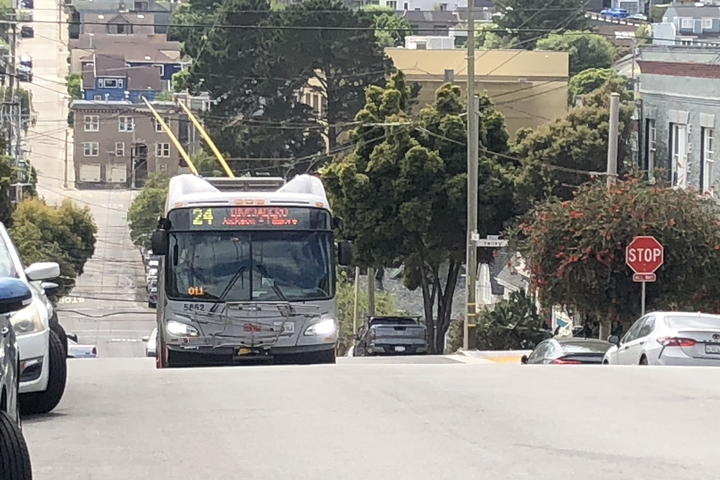
The 24-Divisadero, shown making its way up the steep portion of Noe Street, offers a snapshot of seven distinct San Francisco neighborhoods, complete with views of the city’s striking architecture and easy access to a variety of restaurants and bars.
Carl Nolte/S.F. Chronicle
Strollers often jam up the aisles on the 24-Divisadero, a clean bus that runs on electricity.
Carl Nolte/S.F. Chronicle
I was on a panel discussion the other day, and someone asked an intriguing question: Where would you go if you had only a single day to see San Francisco? At first I gave the Herb Caen answer: I’d sit down and weep, because you can’t see San Francisco in a single day.
There’s the Tony Bennett answer: Take a cable car halfway to the stars. Or maybe the tourist idea: Take one of those pricey hop-on, hop-off buses and see the usual sights explained in six or seven languages. Or maybe ride a tour boat from Fisherman’s Wharf around Alcatraz and under the Golden Gate Bridge. Or go to Pier 39 with everybody else from out of town.
But then you really wouldn’t see the city, see San Franciscans in their native habitat, or step off the beaten path into the real San Francisco.
Article continues below this ad
My own idea is different. I’d ride the 24-Divisadero bus from one end to the other, see the richest and poorest parts of town, ride over more hills than any cable car line, see amazing views, hop off in any neighborhood that interests you, check out any of dozens of bars and restaurants, get back aboard, no extra charge within two hours. It’s cheap. The top Muni fare is only $3, but kids ride free. So does everybody else, apparently: Paying the bus fare seems to be voluntary these days.
Baby buggies are a common sight on the 24-Divisadero, a bus that offers a cross-section of San Franciscans in their element.
Carl Nolte/S.F. Chronicle
I know what you are going to say: Muni is unsafe, it’s full of unsavory riders, the buses are unreliable and always crowded. It’s Muniserable.
San Francisco Chronicle Logo
Make us a Preferred Source to get more of our news when you search.
Add Preferred Source
Well, you have to pick your Muni lines. I try to avoid the Mission Street buses, and dislike the always packed Geary lines. But I’ve come to like the 24-Divisadero.
Article continues below this ad
For one thing, it goes through seven distinct neighborhoods: Pacific Heights, the Western Addition, NoPa, the Castro, Noe Valley, Bernal Heights and the Bayview. Not counting the gritty warehouse and factory area along a short strip of Industrial Street.
For another thing, the buses are electric and clean, and run fairly often. The passengers are the usual San Francisco mix, all kinds, all races. There seems to be a baby boom in this part of the city, so the biggest problem on the 24 line is large baby buggies that jam up the aisles. I saw a threepeat last week: three strollers, four babies. Nobody could move.
The 24-Divisadero rolls through Fillmore and Washington streets, a good spot for exploring Pacific Heights.
Carl Nolte/S.F. Chronicle
I’d start my sightseeing trip in the middle of the 24 line, at Castro and Market streets in the heart of the Castro, a world-famous neighborhood that needs no introduction. The Muni Metro subway station is right there, and so is the terminal of the F-Market historic streetcar line. I’d take whatever 24 bus comes first. So let’s head north, across Market and up the hill, weaving around past the Davies Campus of the Sutter Health hospital system. The 24 then rolls down Divisadero Street, which has changed a lot in the past few years.
Divisadero used to be a kind of neighborhood shopping street, a bit tough around the edges. Now it’s hip, lined with restaurants and institutions like the Bi-Rite Market and Nopa, a restaurant that’s organic and wood-fired. NoPa stands for North of the Panhandle, and Divisadero is the main street. Not long ago, New York magazine called Divisadero “San Francisco’s epicenter of cool.’’
Article continues below this ad
Moving on, the neighborhood gradually becomes the Western Addition, one of the city’s classic districts. The street is lined with apartments and flats, many of them Victorians. The trolley wires that power the bus head up the hill and right on Jackson Street, the home of handsome mansions, rich but not cool. Down the side streets a glimpse of the bay, ships, sailboats, Alcatraz.
The end of the line is Fillmore and Jackson, a good place to get off to explore the classy upper Fillmore neighborhood.
The 24-Divisadero passes Calvary Presbyterian Church at Jackson and Fillmore streets, a landmark on the National Register of Historic Places.
Carl Nolte/S.F. Chronicle
Get back on and head back, seeing Divisadero from the other side of the bus. Back to Castro and Market, get off to check out the Castro, or just ride through and head south.
Now it’s up Castro Street over the hill that forms the south side of Eureka Valley. The grade is so steep here that for 54 years starting in 1887, it was climbed by cable cars.
Article continues below this ad
This part of the 24 line comes with a kind of tour of San Francisco architectural styles right out the bus window. The crown jewel, you might say, is a blue and red Queen Anne-style Victorian house at 20th and Castro streets. It was built in 1897 as the home of Fernando Nelson, a master builder who designed and built 4,000 San Francisco houses, from Noe Valley to West Portal, the Sunset and Richmond. He used all kinds of styles, but he started with Victorians in Noe Valley.
There’s a row of three of his elegant houses right out the bus window on the west side of Castro near 25th. Nelson was no architect; he carried his building plans in his coat pocket. He built homes for working families, he said, but now his surviving homes are worth a fortune. Welcome to San Francisco.
The 24-Divisadero reaches the end of the line at Palou Avenue and Third Street.
Carl Nolte/S.F. Chronicle
The bus turns left here, then up Noe Street. The recorded announcement says “Hang on” — good advice because Noe is really steep. Up and down and around, a brush with a bit of wild San Francisco at 30th Street just down from Billy Goat Hill. Then east along 30th, a dogleg on Mission, then up Cortland Avenue through the main shopping area of Bernal Heights. Lots of good restaurants and shops.
Article continues below this ad
Down the hill, a dogleg again, this time on Bayshore and then left on Industrial to Palou Avenue to Third Street in the heart of the Bayview with its murals of Black city life. The end of the line is a surprise, the Bayview Opera House, a landmark that dates from 1888. If you are tired of buses, you can catch the T-Third Street train that will take you back to the city everybody knows: Oracle Park, Union Square and Chinatown, back on the beaten tourist path.