
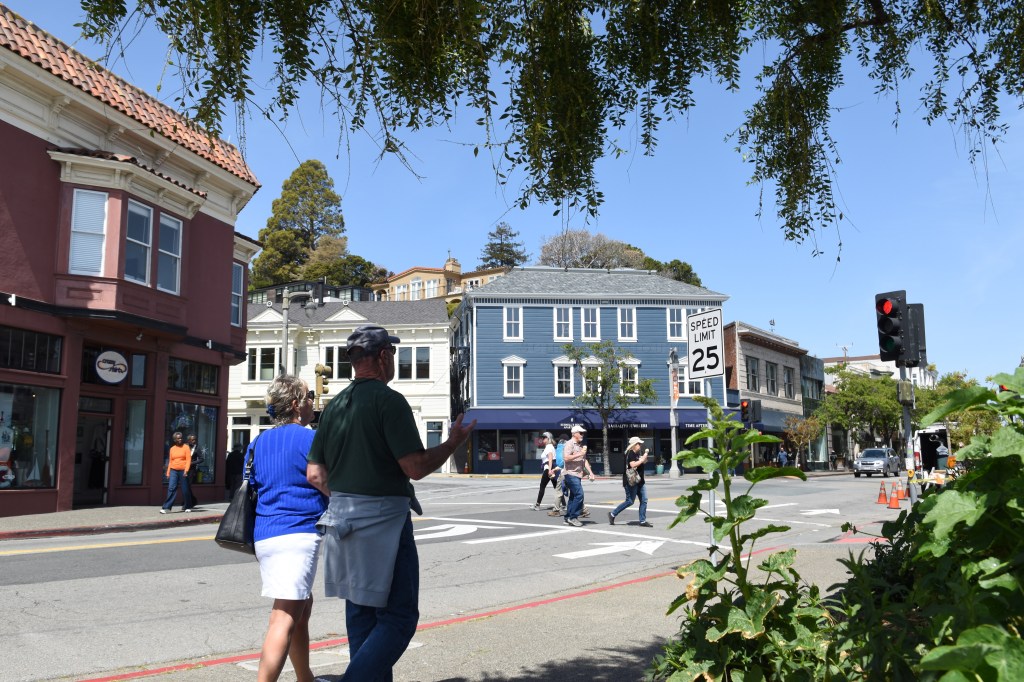
A developer wants to build 39 condominiums on less than a half-acre in Sausalito’s downtown historic district.
The developer, Matthew Shroder, a cryptocurrency executive, bought 83 Princess St. last year for $2.2 million. He asserts that the plan is entitled to special treatment because it qualifies as a so-called “builder’s remedy” project.
The builder’s remedy, which was established by a provision of the Housing Accountability Act, mandates that if a city or county lacks a “substantially compliant” housing element, the jurisdiction is precluded from using its zoning or general plan standards to reject any housing project that meets certain affordability requirements.
Shroder contends that when he submitted his preliminary application for the project on May 28, 2025, Sausalito was not in substantial compliance with state housing element law. The city disputes that.
Matthew Mandich, a city planner, said the state has considered the city in compliance since April 28, 2023.
Shroder did not respond to requests for comment. His attorney, Brian O’Neill, laid out Shroder’s argument in a Sept. 30, 2025, letter to the city.
O’Neill wrote that when Sausalito adopted an amended housing element on May 27, it “simultaneously rescinded its earlier housing element.”
“However, the city’s amended housing element was not certified by HCD as in substantial compliance until July 1, 2025,” O’Neill wrote, referring to the California Department of Housing and Community Development. “This means that the city did not have a housing element in effect that was in substantial compliance with the housing element law between the dates of May 27, 2025 and July 1, 2025.”
While the state originally certified Sausalito’s housing element on April 28, 2023, the city amended the document after YIMBY Law filed a lawsuit in Marin County Superior Court. The suit objected to Sausalito certifying its housing element without first doing an environmental impact report.
Judge Sheila Shah Lichtblau denied YIMBY Law’s challenge in February of this year, ruling that the lawsuit was moot because during the course of the case Sausalito completed an environmental review.
In her decision, Lichtblau stated that Sausalito rescinded its original housing element and adopted the amended housing element on May 27, 2025. She also wrote that on July 1, 2025, the state housing department issued its determination that the amended housing element was in substantial compliance.
Jack Farrell, a YIMBY Law attorney, said his organization plans to appeal the decision because the question of whether housing elements must undergo environmental review under state law remains undecided.
Farrell declined to render an opinion on whether he thinks the Princess Street project should be granted builder’s remedy status.
“We’re not interested in the complexities of the amendment of the housing element and how that impacts legality afterwards,” he said.
The city’s housing element includes 83 Princess St. on its list of sites appropriate for housing development, but lists the site’s realistic capacity as eight dwellings. The city’s zoning would allow 13 dwellings.
In his application, however, Shroder has indicated that under Assembly Bill 1893, which became effective in September 2024, he is entitled to 39. AB 1893 placed some limits on the size of builder’s remedy projects, which previously were virtually unbounded.
Shroder proposes to make four of the condominiums affordable to households with very low incomes. Doing so is one of the options required to qualify for AB 1893 eligibility.
It appears that Shroder is also counting on the builder’s remedy to avoid having to comply with Sausalito’s inclusionary housing ordinance, which requires projects involving four or more residences to have at least 15% that are affordable.
Shroder intends to use a historic house built in 1895, which the condos will stand next to, as a “resident clubhouse.” “It will host wine tastings, chef-led dinners, fireside conversations, and milestone celebrations,” the project narrative says.
Counting the proposed garage, the project would consist of six floors and stand nearly 66 feet tall.
The community group Save Our Sausalito has a number of objections to the project.
“In order to build this project, they are proposing to cut into the hill and put in a 40-foot retaining wall,” said Sophia Collier, founder of Save Our Sausalito. “They would have to remove something like 7,000 yards of material.”
“This is in an area that has had landslides within the last 15 years,” she said. “It’s too dangerous to build.”
Collier said the project would result in the cutting of 33 trees and disrupt habitat that supports 62 wildlife species, including at least 20 special-status species.
She said there are also economic and aesthetic considerations. She said the city’s historic district is one of only 12 in the state, and it is world famous.
“It’s an economic engine for Sausalito,” Collier said. “ A million people per year visit the historic district. We don’t want to have it taken over by large new structures.”
Collier said the site could probably accommodate some additional cottages.
“It’s just this out of scale, destructive project that we oppose,” she said.