
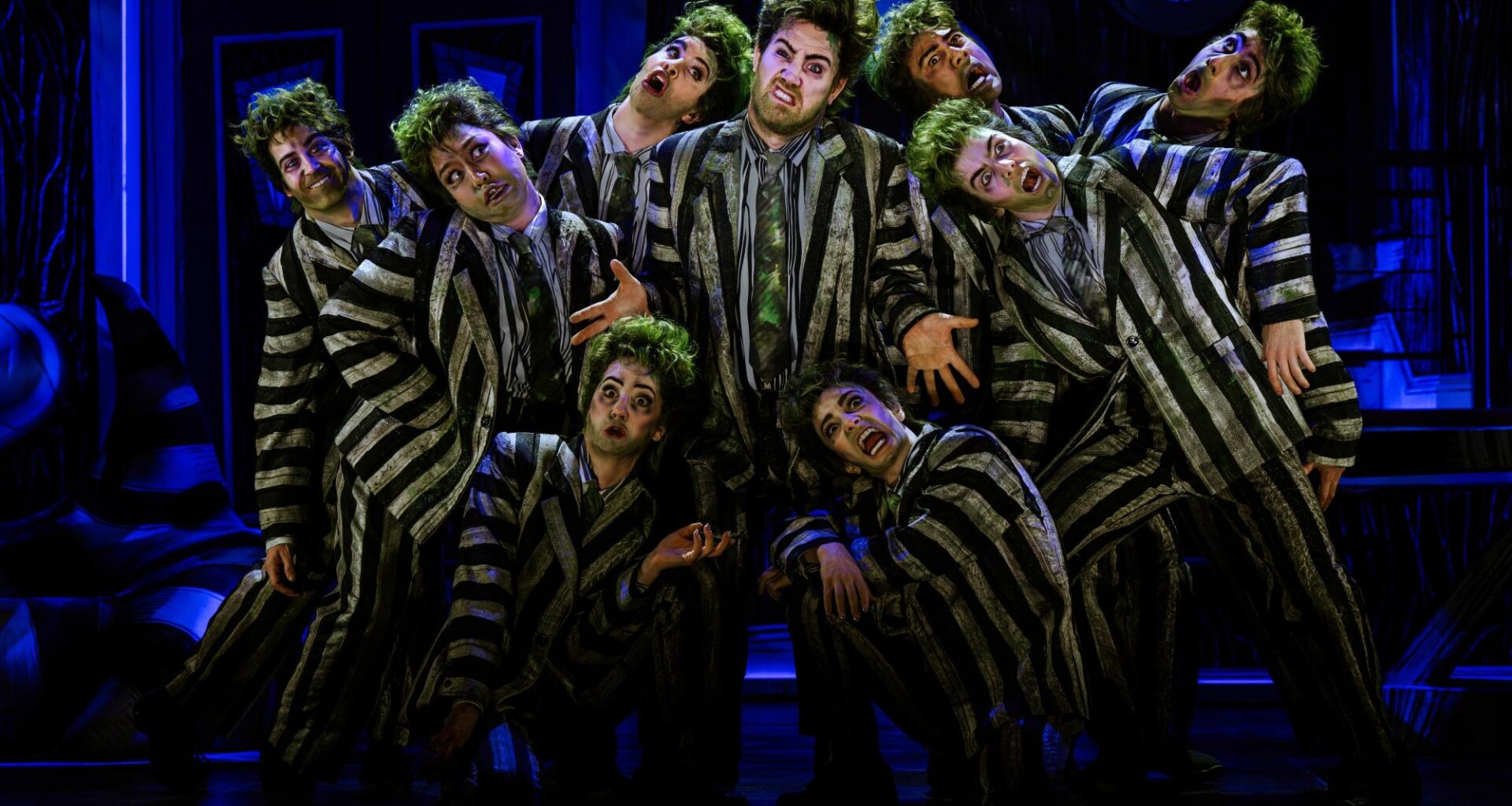
A sea of black-and-white pinstripes accented with green filled the San Diego Civic Theatre on Feb. 26. Older guests held bright green cocktails, and fans of all ages donned the iconic look for the special occasion: “Beetlejuice” was in town.
Based on Tim Burton’s atmospheric feature film of the same name, “Beetlejuice” the musical opened in 2019 and is currently on a national tour. Seeing this crowd transform the theater space told me I was not just attending a showing, but an interactive experience where the audience goes all out in support of our favorite dead guy.
Filing into my seat, I looked up to the iconic “Betelgeuse, Betelgeuse” sign donning the curtains in homage to the film’s “netherworld” attic sign. As they opened, the story began.
A young Lydia Deetz (Leianna Weaver) is grieving her recently deceased mother. Lydia navigates a changing family dynamic, a new home, and a world of ghosts only she can see, all while trying to bring a piece of her mother back. The cast’s effortless onstage harmony eased the weight of an otherwise intense story about dealing with grief, loneliness, and dysfunction.
The stars of this show, Lydia and Beetlejuice (Ryan Stajmiger), are at the forefront of this chaos. Weaver, a San Diego native, perfectly embodied Lydia’s teenage angst and rebellion, presenting a headstrong character determined to make her presence known, despite the neglect she faces from her father.
Stajmiger was equally incredible as Beetlejuice; his raspy singing that honored the original performer Alex Brightman. Weaver’s higher melodic tones meshed well with Stajmiger’s growls in songs like “That Beautiful Sound” and “Say My Name.” Their onstage chemistry drove home the complexity of the relationships between their characters and the rest of the ensemble.
Adam (David Wilson) and Barbara (Kaitlin Feely) — a painfully boring couple and the attic ghosts that once owned the Deetz home — were unexpected favorites. Their interactions were hilarious, particularly in tracks like “Barbara 2.0” and “Ready Set, Not Yet.” As Adam and Barbara develop confidence, they effortlessly play off each other’s energy and break free from the “Pottery Barn and dry white wine” stereotype that Beetlejuice imparts on them. Despite the couple’s sad backstory, the actors brought great comedic relief to the stage, balancing out the more serious themes.
“Dead Mom” was as much of a tearjerker on stage as it is in my headphones. Illustrating Lydia’s turmoil over losing her mom and feeling abandoned by her father, the song is heavy and emotionally charged. Weaver expressed these fears and feelings with her impressive vocal prowess. Even through long runs, difficult belts, and sustained high notes, her voice remained steady — a difficult feat given the high tonality of her range. It was an impressive sight to see her claim the stage and make the track her own.
Equally impressive was fan-favorite “Say My Name,” which is performed by Beetlejuice, Lydia, Barbara, and Adam when Lydia and Beetlejuice first meet. The song is a turning point; Lydia decides to scare her new stepmom Delia away and ventures to bring her mother back from the dead. It’s an iconic piece that showcases various character traits: Adam and Barbara’s apprehension toward Beetlejuice, Lydia’s initial excitement and subsequent wariness, and Beetlejuice’s confidence.
By far, my favorite aspect of the show was the set design. The Deetz’s family home transforms physically from Adam and Barbara’s forever home, to Charles Deetz’s modern renovation, and then to Beetlejuice and Lydia’s pinstripe chaos. The set changes not only represent the passage of time, but also exemplify the transformations Lydia experiences in her journey of self-acceptance and discovery. Her initial grunginess transitions into a perfect-daughter facade, which then becomes her chaotic and rebellious self with Beetlejuice by her side. As she learns to accept her circumstances and find solace in her father again, Lydia and the home return to their starting points.
My one critique of the show is the explicitness of some of the jokes and innuendos. Broadway recommends viewers of “Beetlejuice” to be at least 13 years old, but there were many kids younger than that in the audience. Many lines were directly sexual or strongly suggestive, accompanied by numerous political and self-deprecating jokes. Though not unexpected, I was uncomfortable knowing young children were hearing it too, and I felt the tension linger.
For anyone who is a fan of the original movie, I would recommend giving the musical a chance. While there are some subtle differences in plotline, it successfully encapsulates the comedy, grief, and adolescent uncertainty reminiscent of the film.