
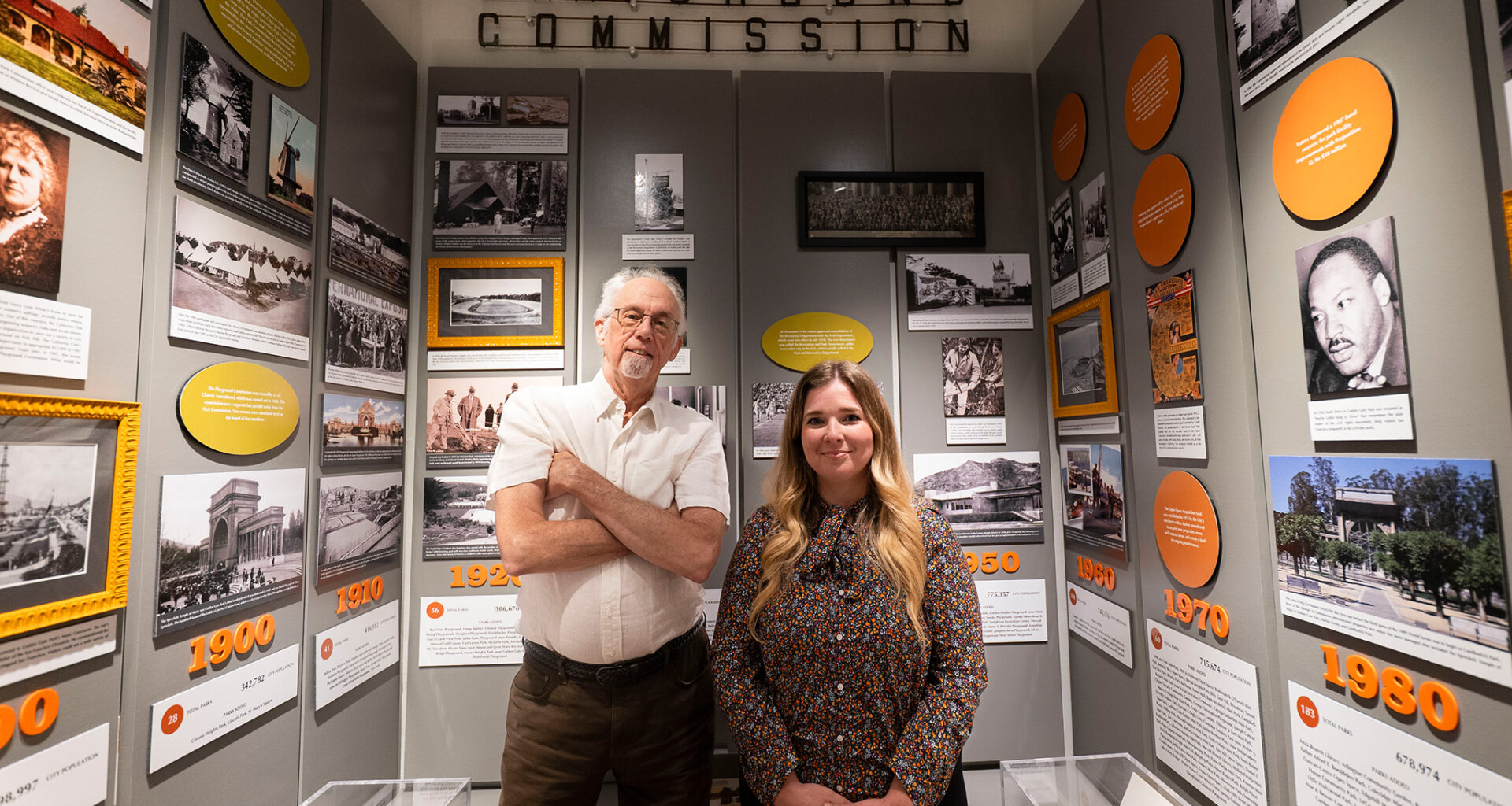
San Francisco’s newest museum is the size of a closet, and guests are making appointments months in advance to visit.

The Commission Vault Museum, which sits inside an old vault in McLaren Lodge, pays tribute to the history of San Francisco’s Recreation and Park Department. Since the exhibit quietly opened in December, between 75 and 100 visitors have filtered through the room.
On a recent Thursday, an SFGATE reporter and photographer joined the short list of vault visitors.
Article continues below this ad
Christopher Pollock, the department’s historian-in-residence, pointed to a colorized photo of MacLaren Lodge from 1896. “Here’s the lodge we’re in. It looks exactly like that,” he said.
He’s right. The only difference is the palm tree standing in front of the lodge. In the old photo, it looks like a shrub with overgrown fronds. Today, more than a century later, it towers over the building.
McLaren Lodge in Golden Gate Park, headquarters of San Francisco’s Recreation and Park Department.
Theo LaBrusciano-Carris/For SFGATE
The museum offers a decade-by-decade history of the park department, from the construction of Portsmouth Square Park in the 1850s to the recent establishment of Sunset Dunes on a former stretch of the Great Highway. Its walls, 6 feet by 10 feet, are crammed with archival photos and plaques. On one wall, you can see a photo of tents in Golden Gate Park, where the city’s refugees flocked after the 1906 earthquake; turn to the right, and you can see an old photograph of Monarch, the grizzly bear that lived in captivity in the park until his death in 1911.
Article continues below this ad
Make SFGATE a preferred source so your search results prioritize writing by actual people, not AI.
Add Preferred Source
The name Commission Vault Museum is literal. The exhibit is located inside an actual vault, the kind built to store money. It’s attached to an old meeting room in McLaren Lodge, the building that serves as the Recreation and Park Department’s headquarters. It has a mechanical lock on its door; decades ago, the vault stored whatever cash the department collected from carousel rides and boat rentals.
In a more recent and less glamorous past life, the vault served as a records room, crammed wall-to-wall with beige filing cabinets. In total, those cabinets stored 2,500 old documents, said Ashley Summers, the commission liaison. Those included scrapbooks, photos, letters and handwritten parks commission meeting notes dating back to the 1870s.
Ashley Summers points to a flyer advertising an old Golden Gate Park concert series.
Theo LaBrusciano-Carris/For SFGATE
Summers came up with the idea for the museum while digitizing these documents, a process that freed up the vault for other uses. Park Commission President Kat Anderson approved the project. Summers and Pollock began meeting weekly to plan and design the museum.
Article continues below this ad
They sifted through the documents in the filing cabinets and exhumed artifacts stashed away in the basement, like the antique bronze letters that spell “San Francisco Playground Commission” mounted on the back wall. (Before Rec and Park merged into a single entity in 1949, its duties were split across two departments, the Playground Commission and the Park Commission.)
The vault was completely transformed. The materials cost less than $10,000, excluding the cost of staff time. “We’re super fortunate at Rec and Park, too, because we have carpenters and painters and electricians,” Summers remarked.
An 1899 photo of the Sharon Building in Golden Gate Park. Today the building serves as an art studio.
San Francisco Recreation and Park Department
Hard plastic cases hold treasures of special interest. There are 1960s brochures for Camp Mather, and a printed program for a free concert in Golden Gate Park, dating from 1932.
Article continues below this ad
Pollock pointed out a seal press, which looked to be made of iron, used in the early 1900s to stamp automobile permits. When Golden Gate Park first opened to cars in 1901, San Francisco was home to only a small handful of registered vehicles. The Park Commission granted licenses to allow drivers to cruise through the park, and stamped each permit’s seal by hand.
Visitors can also view a topographic map of Golden Gate Park, a reproduction of the original drawn by engineer William Hammond Hall. Hall designed Golden Gate Park when he was just 24 years old, and went on to become the park’s first superintendent.
An aerial photograph of the Conservatory of Flowers in Golden Gate Park from 2000, one of many photographs reproduced in the Commission Vault Museum.
Theo LaBrusciano-Carris/For SFGATE
Beneath the photos and plaques, markers on the wall track the city’s population from one decade to the next. San Francisco grows from a city of 35,000, with just 14 parks, to a city of 808,000, with 230 parks.
Article continues below this ad
The decade that ushered in the most new parks was the 1960s. In 1968, San Francisco received federal funding for a mini park program; between 1960 and 1970, the city built 52 new parks. Now, these tiny parks dot street corners: 24th and York, Fillmore and Turk, 18th and Utah.
Summers and Pollock give tours on a weekly basis, more or less, depending on their availability. Visits are by appointment only; Summers has tours scheduled through July.
Christopher Pollock, historian-in-residence, points to information posted on the door of the museum room.
Theo LaBrusciano-Carris/For SFGATE
They observe visitors’ reactions firsthand. Summers recalls one guest’s excitement upon seeing a photograph of Laura Lyon White, a late 1800s and early 1900s activist who helmed pushes for public playgrounds and women’s suffrage. The guest was apparently a member of a club that once counted White among its rolls, and the activist’s legacy came up often in discussions.
Article continues below this ad
“She was like, ‘She looks so casual in this picture,’” Summers recalled the woman saying. “‘She usually looks much more put together. I’m going to have to show the ladies this picture.’”
Everybody, it seems, has their own tie to the history of San Francisco’s parks.
“I have been delighted with how delighted people are,” Summers told SFGATE.
Article continues below this ad
To schedule a free tour of the museum, visitors can email recpark.commission@sfgov.org.