
Recently, Los Angeles Times Reporter Melody Gutierrez asked me a simple question while she was writing her piece on Sacramento’s granting of generous unused vacation and leave time payouts (“Former Newsom advisor received $50,000 payout after leaving state job amid federal probe,” March 16, 2026).
I gave her an answer that was not too dissimilar to the one she provided in a previous piece on the subject (“Banked vacation leads to a $1.2-million payday: How state workers cash in on days off,” April 20, 2025):
[Budget Director for former Gov. Arnold Schwarzenegger Mike] Genest said while the current system is “fiscally irresponsible,” attempts to overhaul how vacation is earned or paid out would be “extremely unpopular.” Any changes would have to be negotiated with the state’s powerful and deep-pocketed public-sector unions, which are among the top donors to Democratic lawmakers and Gov. Gavin Newsom.
“That’s theoretically possible. It’s not politically possible,” he said.
It started me thinking that maybe there is a way to fix the financial stranglehold on taxpayers in Sacramento.
First, a little history. Then-Attorney General Jerry Brown and I met to discuss my lawsuit concerning the constitutionality of granting public safety defined benefit pension plan formula increases (from 2% to 3% at 50), retroactive to the date of hire. Senate Bill 400 (1999) began the trend of creating immediate debts, not approved by two-thirds of the voters, thus violating two provisions of the California Constitution.
Although he agreed there was a problem, his office filed an amicus brief against my lawsuit to reverse this 50% increase in retirement benefits. He had his eyes on returning to the governorship and needed the financial largesse of the public employee unions in his upcoming campaign against billionaire Meg Whitman, CEO of eBay.
Once in the Governor’s Mansion, Brown had four interesting special powers. The first was his name identification; name one Californian who does not know Jerry Brown. The second was the power of incumbency, as they usually win reelection ninety percent of the time. The third was his party registration, Democrats get elected over Republicans in the Golden State. And fourth, he was born in 1938, he had a full political career and wasn’t looking at the next office, already being at the customary retirement age.
Being fiscally cautious, his budgets always focused on the possibility of an impending recession. And playing long ball, he made an effort to address the massive pension unfunded actuarial accrued liabilities. Because of his special powers, he was in a position to buck the public employee unions. He did not get everything he wanted, but he did include my beef and prohibited the granting of benefits on a retroactive basis. We know his 2012 effort today as the Public Employees Pension Reform Act, or PEPRA.
Someone who is not concerned about getting re-elected with a dependency on funding from the numerous public employee unions up and down this state can make some changes, even incrementally.
Now that the filing period has closed and the official gubernatorial candidates identified for the June Primary the Republicans currently have two well-polling choices in Chad Bianco and Steve Hilton.
The Democrats have a plethora to choose from. With a top-two primary, there may not even be a Democrat candidate in the general election come November. What to do?
With the state’s balance sheet in much worse shape than Brown left it eight years ago, it is time for someone with a financial acumen to lead this state.
There is one Democrat candidate who has the financial wherewithal to purchase name identification and, although he may need the public employee unions’ blessing, he certainly does not need their money. And he’s older and will most likely not be focused on other things, like the current absentee occupant in the position. Besides, he already tried that in 2020.
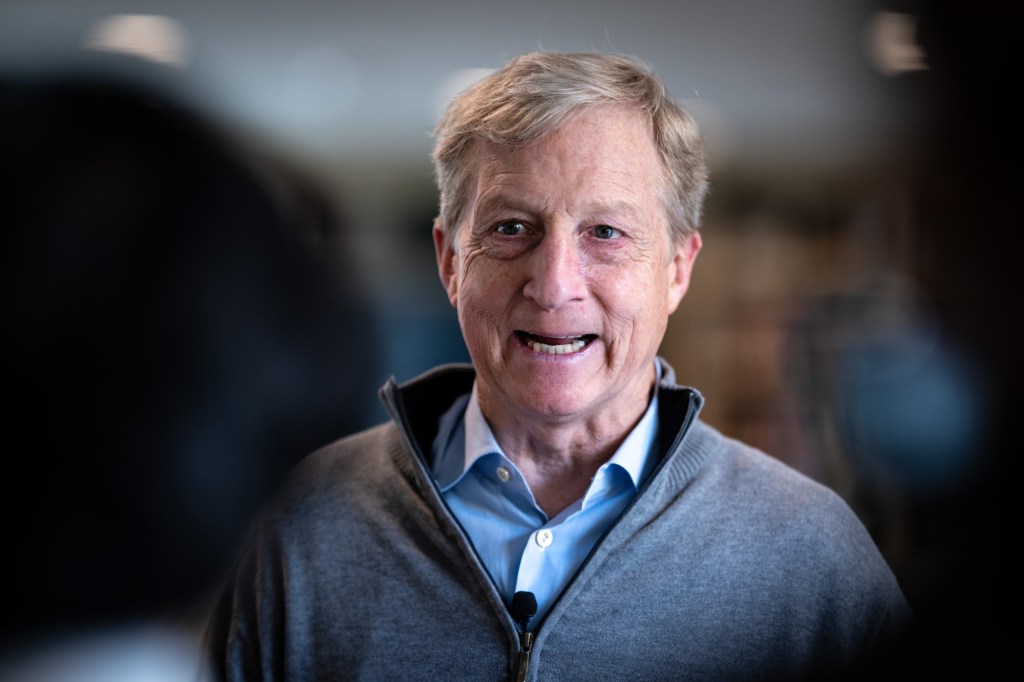
Although I strongly disagree with Tom Steyer on too many fronts to discuss here, he may just be the person who could right the ship of state. As someone who graduated from Yale, summa cum laude, and earned his Masters from Stanford Graduate School of Business, it shows he’s not an empty suit “game show host.”
Having worked at Morgan Stanley and Goldman Sachs and having run his own hedge fund, I would like to think that if Steyer were elected governor of California he would quickly think something like, “Forget the focus on climate change, what Sacramento really needs is a fiscal turn around.”
Steyer would realize immediately that government is not an investable opportunity. It’s bloated. It’s not run by management, but by the employees. Sacramento has no Chief Operating Officer. Its payroll and benefit costs are far in excess of that found in the private sector. It has no competition to keep all of these concerns in some state of balance.
It would be great to see this so-called billionaire investor-activist have his natural talents focused on reducing California’s massive unrestricted net deficit. To make Caltrans go from one of the nation’s most inferior Departments of Transportation to one of the finest; moving the second worst roads to somewhere in the middle of the pack. To stop making California the worst place to do business, according to CEO Magazine, for at least once in the last couple of decades. To actually reform the California Environmental Quality Act (CEQA), so infrastructure could be built again.
Just imagine a real fiscal analysis that shows that the high-speed rail will never break even and actually having a governor who follows through on “being real.” Addressing climate change may be important, but the real existential threat to our state is its fiscal well-being. Perhaps Steyer could be independent and strong enough to “blow up the boxes” and restore the lost luster to what has become a failing state. And then, after righting the ship of state, he can enjoy his well-deserved unused vacation time after his four year term has concluded.
John M. W. Moorlach previously served in the California State Senate, on the Orange County Board of Supervisors and as treasurer of Orange County.