
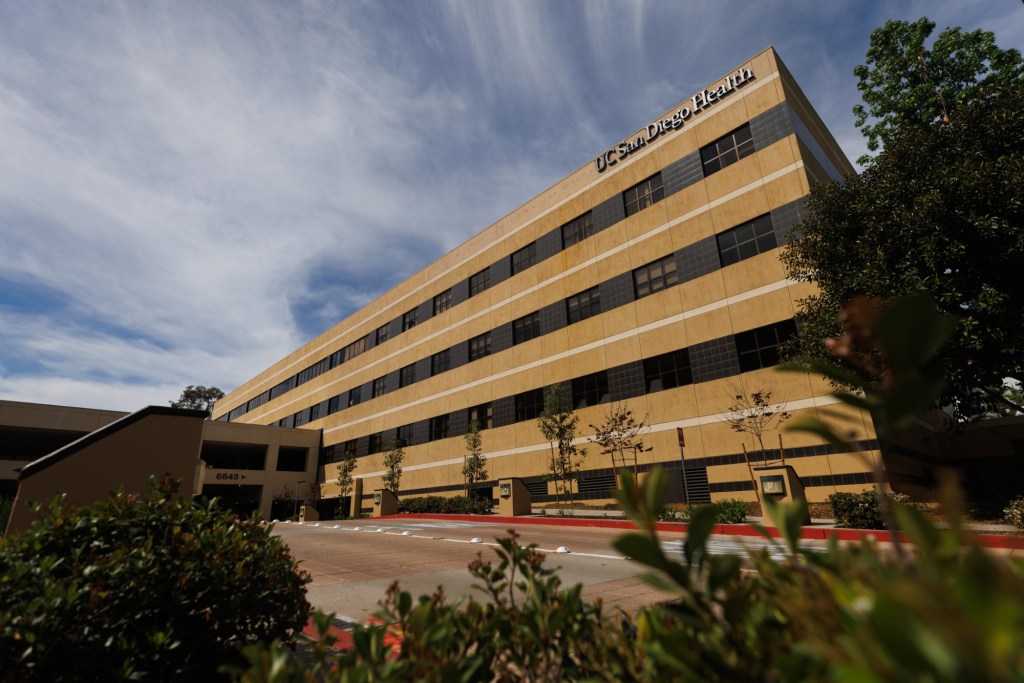
Two years after purchasing the struggling college-area hospital, UC San Diego Health is more than doubling its investment in East Campus Medical Center.
Called Alvarado Medical Center when UC San Diego purchased the facility in October 2023, the hospital on Interstate 8 recently received a significantly improved assessment of its quality. The Leapfrog Group, an independent organization that issues highly cited safety grades nationwide, bumped East Campus’ grade from a C to an A in its most-recent release.
“It’s actually leading our academic campuses in some key quality metrics,” said Patricia Maysent, chief executive officer of UC San Diego Health, in a recent presentation to the UC Board of Regents.
The university health system’s boss said that previous plans to “decant” patients from UC San Diego’s busy main hospitals in Hillcrest and La Jolla has worked well, with a recent statement indicating that more than 4,000 patients have chosen to transfer to East Campus from those two main destinations.
It is a striking change. In many cases, these are patients who previously drove right past East Campus to reach UC San Diego Medical Center in Hillcrest or Jacobs Medical Center in La Jolla.
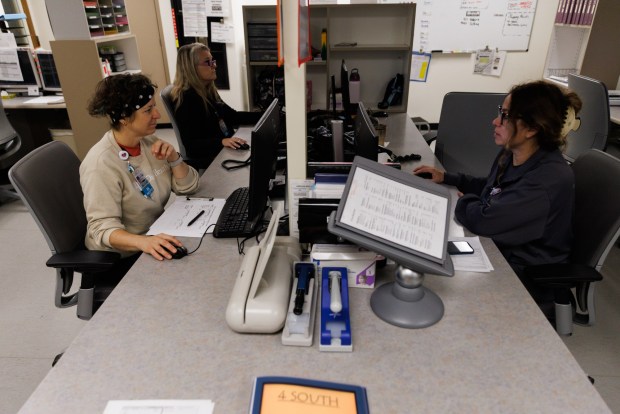 The redone nurse station on the telemetry floor at UCSD East Campus Medical Center, formerly Alvarado Medical Center. (Kristian Carreon / The San Diego Union-Tribune)
Maysent and UC San Diego Chancellor Pradeep Khosla faced zero questions last month when they asked the Regents for an additional $322 million to repair and upgrade East Campus. That investment comes on top of the $200 million that UC spent in 2023 to acquire Alvarado from Prime Health Care.
Plans call for that additional cash to fund seismic upgrades and an extensive remodeling effort that would refresh patient rooms, add capabilities and switch most of the facility from double to single-bed occupancy.
Walking the halls Friday morning, Nick Macchione, chief executive of East Campus and chief health officer at UC San Diego Health, said that Alvarado’s entire third floor and half of its fourth floor were unused at the time of the purchase in 2023. Patient volume was low, with the hospital averaging 32 admitted patients per day. Two years later, he said, the facility averages about 110 patients per day.
At purchase, there as only enough surgical volume to use two of the hospital’s eight operating rooms. Today, five are regularly occupied and a sixth will be put into full rotation with additional surgical staff arriving.
“We saw a 37% increase in surgical volume in the last 13 months,” Macchione said.
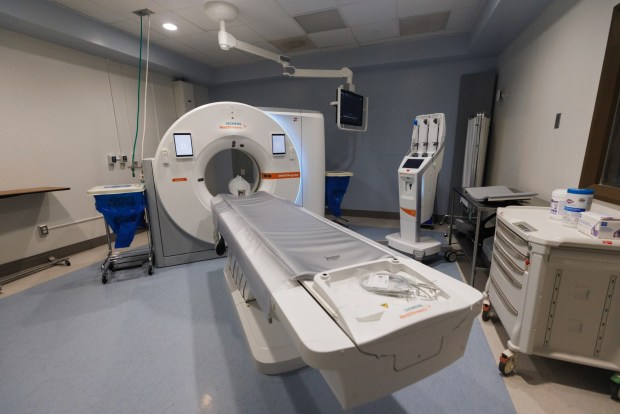 A 64-slice CT scanner at UCSD East Campus Medical Center. (Kristian Carreon / The San Diego Union-Tribune)
He added that it is not uncommon for UC San Diego faculty to use the same operating rooms as community doctors. It is usually difficult, he added, for community doctors to work in academic medical centers because doing so requires a teaching affiliation.
“There wasn’t a natural place where they could be shoulder-to-shoulder with faculty, learning the latest stuff and sharing, except for here,” Macchione said.
And sometimes, he added, community physicians end up teaching faculty. Such is the case with aquablation, a robot-assisted minimally invasive technique that uses a high-velocity waterjet to remove tissue from the prostate when it becomes enlarged.
“A community doctor who is held in high regard by our chair, he’s the one who taught our faculty how to do aquablation, and he still practices it here,” Macchione said, adding that East Campus is currently the only UC San Diego facility to offer the procedure.
Plans also call for an acute rehabilitation department in the second East Campus’ west medical tower, occupying space that was unused at the time of purchase. UC San Diego refers its acute rehab cases to other medical providers in the area, so adding the service in the east will be a first.
Already, UC San Diego has invested millions in upgrading the hospital’s medical records system so it can communicate with the rest of the system’s hospitals and clinics. Most of the equipment that was in place, said Michelle Ziemba, chief operating officer at East Campus, has been replaced over the past two years. That includes most patient beds, as the hospital moved to the latest “smart” versions with built-in monitors and other functions that can help prevent bed sores.
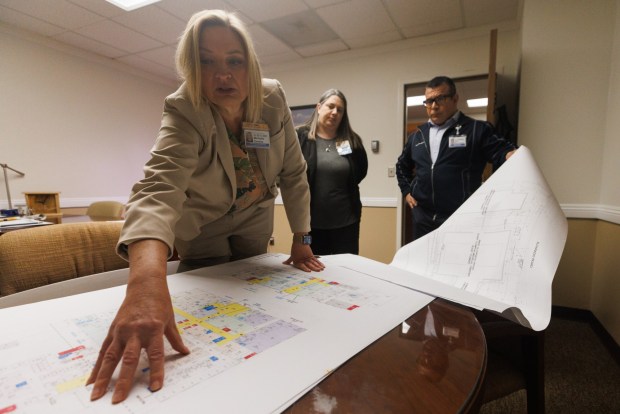 Michelle Ziemba, chief operating officer at UCSD East Campus Medical Center, goes through blueprints of the hospital. (Kristian Carreon / The San Diego Union-Tribune)
Many investments have been made with the goal of increasing the hospital’s capabilities.
“An example is the new 64-slice CT (scanner), which is specialized for perfusion,” Ziemba said. “It will allow us to enhance our neural and stroke capabilities so now we can do perfusion studies of the brain.”
Perfusion studies can detect whether blood flow to the brain or other tissue has been blocked or otherwise damaged, allowing quick diagnoses in situations where a delay of just minutes can impact survival.
Some upgrades are designed to please patients in less technical ways.
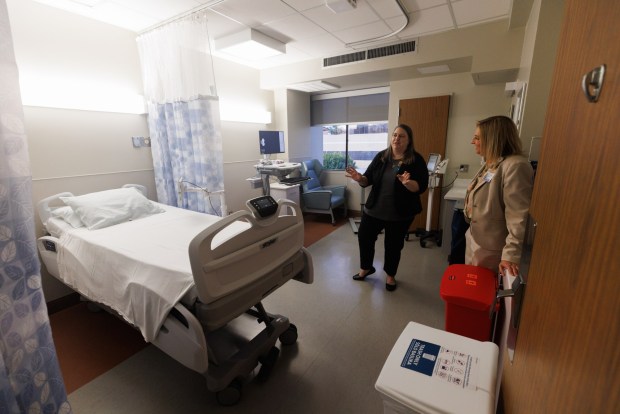 Laura Chechel, a registered nurse and senior director of nursing, shows a redone patient room on the telemetry floor at UCSD East Campus Medical Center. (Kristian Carreon / The San Diego Union-Tribune)
Renovations to the roughly 140 patient rooms in the hospital’s six-story east tower are now underway, with nearly half of the rooms on the fourth floor completed. New flooring, lighter colors on the walls, new furniture and other amenities are designed to increase functionality and ambiance.
About $120 million of the renovation funds approved by the Regents will pay for seismic renovations necessary to make East Campus compliant with state earthquake safety laws, which currently require completion by 2030.
Upgrades will require significant reinforcement of some walls and elevator shafts, though engineers have found ways to do the work by pouring new concrete footings and installing additional steel bracing without significantly impinging on internal spaces or being visible on exterior surfaces.
How did UC San Diego increase the quality scores at East Campus? Laura Chechel, a registered nurse manager dispatched to help lead the effort to bring the hospital’s workforce into the fold, said improvements came down to a million details from prestaging supplies for common activities such as dressing changes to asking workers to attend UC San Diego boot camps so they would understand how operating procedures work in day-to-day practice.
University physician groups also took over anesthesiology and emergency services at the hospital from medical groups that ran the services under its previous owner.
“I think the biggest thing is, we came in and we asked people ‘what do you need,’” Chechel said.