
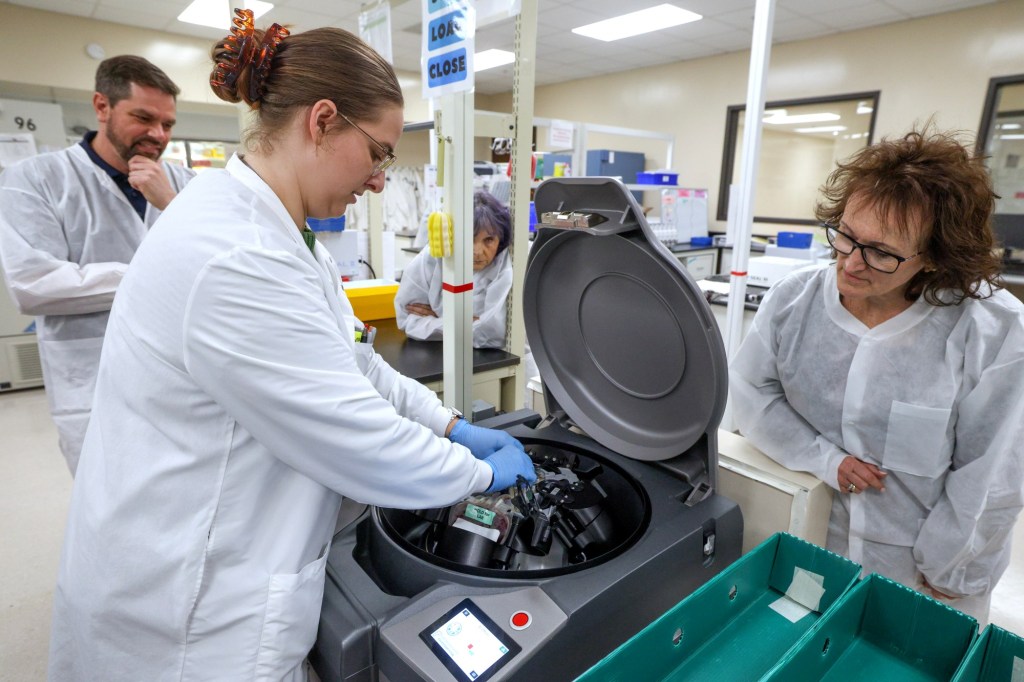
A blood centrifuge rotates between 3,000 and 5,000 times per minute, causing blood to separate into three distinct layers: dark and dense red blood cells at the bottom, a very thin layer of white blood cells and platelets in the middle and a thick layer of yellowish plasma on top.
Generally, blood bank technicians have had to work on decanting these layers one unit at a time in order to produce the distinct products that are routinely used to treat everything from severe blood loss to cancer. But new advances in automation allow much more-efficient operation.
San Diego Blood Bank is the first in California and among the first in the nation to begin using a new set of high-tech centrifuges that are able to spin up four units of whole blood simultaneously, directing the different types of cells into separate plastic bags automatically without the need for more time-consuming manual steps that have been a significant part of the process for decades.
Looking like a row of high-tech washing machines, the system, made by Tokyo-based Terumo Group, relies on advances in optical sensing to detect when one layer ends and the next begins, triggering valves to direct each group of cells and other blood components into their own separate containers.
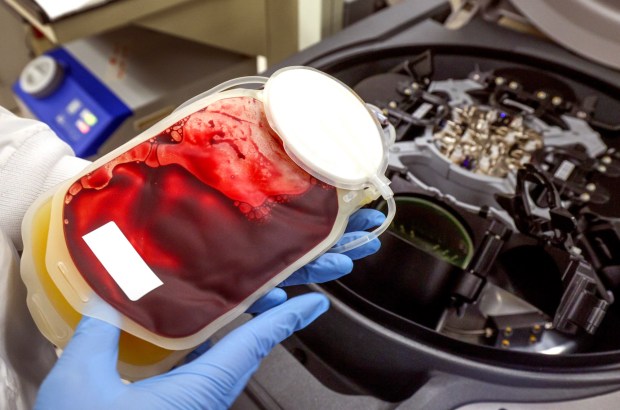 Sarah McHenry, Assistant Manager of Component Production, holds blood that has been separated into platelets, plasma, and red cells by the Reveos Automated Blood Processing System. (Hayne Palmour IV / For The San Diego Union-Tribune)
“You put four units in this device, you push a button, and you walk away,” said Douglas Morton, the blood bank’s executive director, before a presentation on the system Friday.
With three machines running daily, the operation is able to automatically process about 60 donated units of whole blood every day, managing the output of four of the bank’s 10 collection centers across the region. While the bank will continue using the more manual one-at-a-time method for much of this work, adding the automated system, which Terumo calls Reveos, is expected to significantly increase the overall number of blood units that San Diego Blood Bank is able to process, pushing the organization to increase its collection efforts.
“It’s about a 50% improvement in efficiency,” Morton said, noting that the gains should translate to a similar increase in the number of blood units that the blood bank can produce.
These gains require only one technician to realize, begging an obvious question: Will these machines cause layoffs?
Morton said that there are no plans to reduce the labor force, and part of the reason is that the new machines are better at separating platelets and white blood cells, components that are used in cancer treatment and research, respectively.
Because platelets and white blood cells are such a small part of each whole blood unit, comprising just 1% of total volume, it has not generally been worth the effort to attempt to separate them.
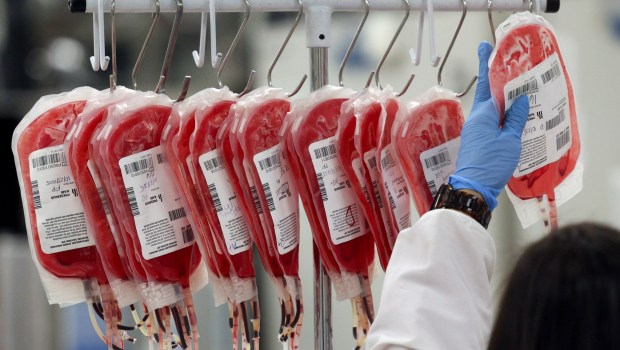 Lab technician Alice Nevarez works with bags of donated blood as she modifies red cells at the San Diego Blood Bank on Oct. 23, 2025. (Hayne Palmour IV / For The San Diego Union-Tribune)
Instead, blood banks routinely use special “apheresis” machines to collect whole units from single patients. They are able to do so by using their own small centrifuges to cull out just platelets or other components while returning the rest of the blood to the donor’s body in real time, making it possible to remove low-volume components from the bloodstream without draining too much blood in the process.
Platelets, which cause the blood to clot, are particularly difficult to handle because they have a shelf life of only five to 14 days and must be continuously agitated in order to keep them from clumping together and becoming unusable.
Automated processing, with its ability to handle so many whole blood units at the same time, produces enough simultaneous platelet volume to make separation viable.
It takes five units of whole blood to produce a single unit of platelets, which can be achieved by “pooling” individual collections together after they are separated during the automated process.
But pooling remains an automated process, one that needs its own workers.
“We are not looking at any layoffs,” he said. “We take the staff that were doing the separation process and move them to pooling.”
Pooling is not a new idea. It is how platelets were collected for use before apheresis machines were invented. The industry eventually moved away from pooling due to concerns that combining donations significantly increased the risk of patient infections because each dose came from multiple donors, each with their own chance of carrying an infectious disease.
But blood centers have gotten much better at detecting the presence of infectious agents since pooling was last used.
Nucleic acid testing and bacterial management methods mandated by the U.S. Food and Drug Administration in 2021 have increased safety, said Dr. Mark Edmunds, the blood bank’s chief medical officer.
“What we have seen is that there is no clinically significant difference between the risk of septic transfusion reactions or transfusion-transmitted infection,” Edmunds said during a presentation Friday to blood bankers in town for the annual meeting of the Association for the Advancement of Blood & Biotherapies.
Locally, two hospitals have already begun accepting pooled platelets while two others are in the process of beginning to use them. Other hospitals, officials said, have not yet indicated they will use pooled platelets, citing infection concerns that were prevalent about two decades ago.