
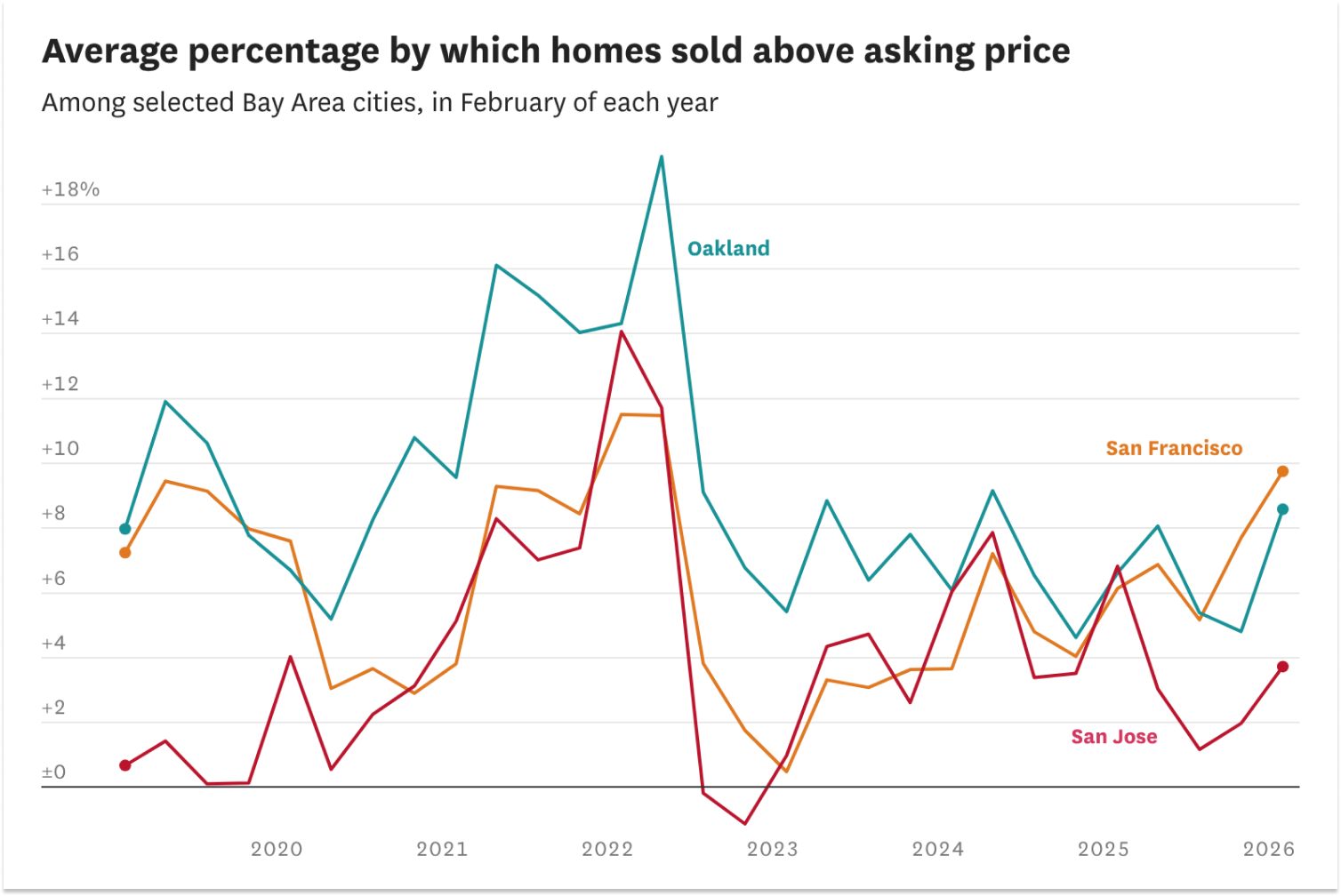
In February 2026, San Francisco’s home sale-to-list ratio reached its highest February level since 2022, at 10%, according to Redfin.
Yalonda M. James/The Chronicle
It’s long been common for Bay Area homes to sell above asking price. But in some parts of the region, the number on the for-sale sign and the number on the buyer’s check is growing even further apart.
San Francisco homes sold in February for, on average, nearly 10% more than the listing price, according to data from real estate brokerage Redfin. That means that a home listed at $1.5 million sold for $150,000 more on average — more than a down payment in most of the country.
San Francisco’s sale-to-list ratio reached its highest February level since 2022, and up from 6% in 2025, Redfin’s data shows. It was also the second-highest of any Bay Area city with at least 30 home sales in February. And while San Francisco sellers often set prices artificially low to encourage bidding wars — the “price to entice” strategy — real estate agents say what’s happening is more than mere marketing.
Article continues below this ad
If anything, said San Francisco real estate agent Arrian Binnings, the data suggests that some agents may not be pricing high enough, not realizing how much demand has rushed back to the city, especially at the upper end.
“The market has shifted so quickly that pricing models built on recent (sales) are coming in too low,” said Binnings, an agent at Christie’s International Real Estate. “That is not ‘price to entice.’ That is the market outrunning everyone’s expectations.”
The boom of artificial intelligence startups in San Francisco has brought a wave of demand for homes. While that’s good news for sellers, with some even holding off on listing until the market heats up more, most households simply can’t fight a bidding war at current prices and mortgage rates.
San Francisco Chronicle Logo
Make us a Preferred Source to get more of our news when you search.
Add Preferred Source
One Parkside house, for example, listed for just over $1 million, which would make mortgage payments affordable to the typical San Francisco household — except that the home sold for nearly $700,000 more.
Article continues below this ad
San Francisco’s not the only city where home sales brought the owner much more than they asked. Berkeley had the largest price gap, at roughly 20%. In part, that’s because the “price to entice” gap between sale and list prices has consistently been wider in East Bay cities like Berkeley and Oakland.
But recently, the ratio in San Francisco has overtaken that of Oakland. In San Jose, the sale-to-list ratio even dipped from last year, falling below San Francisco’s for the first time in any February since 2020.
Realtors differed on whether the Berkeley market is heating up. Emma Morris, an East Bay Realtor at Red Oak Realty said she thinks the large price gap in Berkeley is due more to the prevalence of the price-to-entice tactic than a market warming. The model works very well for sellers, she added — so well, in fact, that deviating from it usually means the sale price suffers.
“It’s just become a cycle we haven’t been able to change or break out of,” Morris said.
Article continues below this ad
Daniel Stea, a Berkeley-based Realtor, was more certain that the Berkeley market is getting more competitive. He pointed to a recent sale in the city’s Elmwood neighborhood. The home, which he described as “far from perfect” and in need of a new foundation, was listed for less than $1.7 million. It sold for more than $2 million.
“I can’t say it’s all (from) AI people, but that’s the brunt of it,” Stea said.
However, Binnings emphasized that the San Francisco market could cool just as quickly as it warmed up, bringing sales prices closer to list prices again. Morris said that she’s already seeing fewer offers for Berkeley homes this year, though the offers that do come in are usually very competitive, amid the Iran war and global uncertainty.
“We do not know how long this lasts,” Binnings said. “It could be a blip — a particularly hot moment in time — as opposed to a regime change.”
Article continues below this ad