
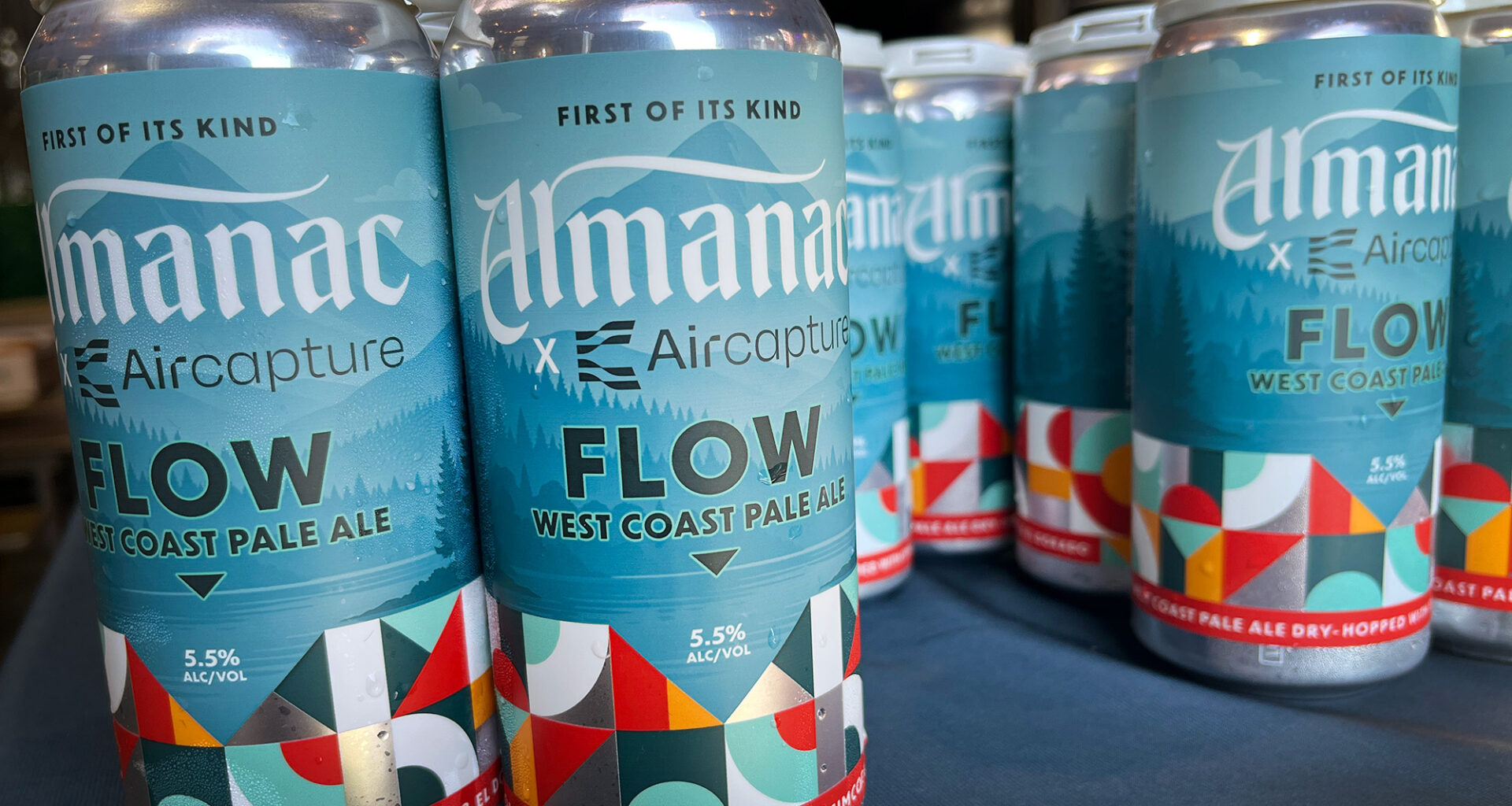
Call it climate coping with a twist. Almanac Beer Company has introduced a pale ale carbonated with carbon dioxide captured from the air, turning a familiar indulgence into a modest experiment in reuse.
The beer is made possible thanks to Aircapture, a Berkeley-based start-up whose direct air capture technology, installed inside Almanac’s Alameda brewery, can pull CO2 from the atmosphere, liquefy it and purify it into beverage-grade form. Along with carbonating beverages, Aircapture’s technology can be used in the creation of synthetic fuels, concrete manufacturing, greenhouse and vertical farming, and dry ice production, along with sequestering carbon underground.
Aircapture was founded by Matt Atwood with the idea that atmospheric CO2 is not only a threat, but an opportunity.
 Aircapture founder and CEO Matt Atwood at an event unveiling Flow. Aircapture developed a system for processing carbon dioxide pulled from the air into beverage-grade form. Credit: Courtesy of Aircapturte
Atwood was first introduced to direct air capture technology at the 2009 Copenhagen Climate Change Conference, COP15. At the time, he was running a company that used algae to treat wastewater and make fuels, and needed access to plenty of carbon dioxide to grow the algae.
“Fast forward several years later, I kept thinking about direct air capture, and I knew it was going to be a high-impact way to address climate change and produce technologies for markets and companies that need CO2,” he said.
In 2019, Atwood launched Aircapture in West Berkeley.
Atwood likes to say that “the global economy runs on carbon.” It’s in the air we breathe, in the food we eat, in the fuels we burn. It’s used in agriculture, in food manufacturing, in cold chain refrigeration.
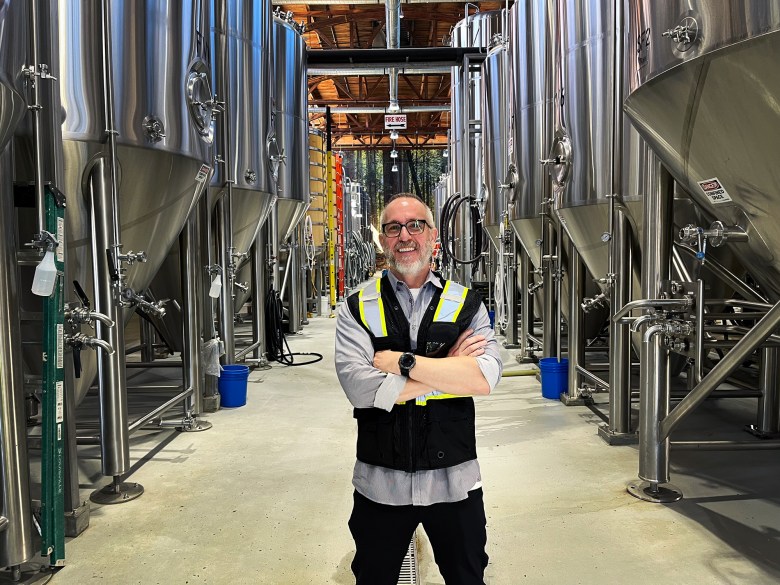 Almanac CEO Damian Fagan started using Aircapture’s technology to brew Flow, a pale ale, but is incorporating the CO2 captured from the air into the brewery’s entire production chain. Credit: Nathan Dalton for East Bay Nosh
Carbon dioxide is also one of the most important elements in brewing beer, according to Damian Fagan, founder and CEO of Almanac Beer Co. It not only gives beer its satisfying fizz, but is used across the brewing process, from cleaning to fermenting, canning to kegging. It helps keep beer fresh and powers the taps in barrooms.
“ There’s no process in this brewery we can do without CO2,” said Fagan.
While Fagan did not share details about the deal with Aircapture, he said that it will ultimately save the brewery about 15% per pound of CO2 used.
“But the single biggest benefit of this entire endeavor is actually not cost-related,” said Fagan. “It’s about consistency and reliability.”
The supply chain for liquid CO2 can be volatile, according to Fagan. He said that Almanac has actually had to stop production in the past due to CO2 shortages.
Atwood said that the CO2 supply chain is being further disrupted by the war in Iran, bringing with it rising costs.
“CO2 prices are heavily correlated to natural gas prices,” he said. “A lot of the CO2 comes from ammonia, which is made from natural gas. So if natural gas pricing is too high, oftentimes the ammonia plants shut down, and so that causes major supply disruptions.”
Buying CO2 also comes with delivery fees and surcharges. Having a source of CO2 in-house will save the brewery from having to pay these secondary costs.
Fagan chose Flow, a pale ale Almanac has been brewing since 2022, as the first beer to use this technology, because “the name Flow dovetails nicely with this idea of moving air,” he said.
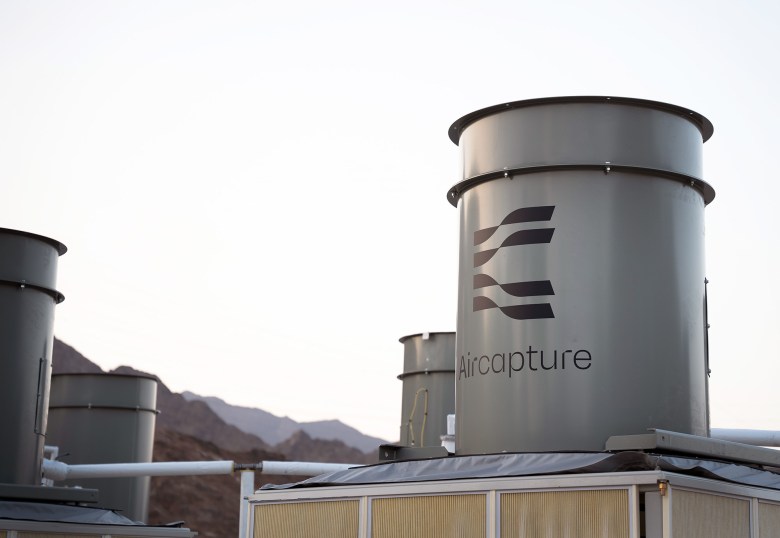 Aircapture was founded in Berkeley in 2019, and provides an alternative source for carbon dioxide, which can be subject to volatile market swings and has traditionally come from bioethanol, ammonia and hydrogen production plants. Credit: Courtesy of Aircapture
The new Flow was unveiled to the public on Saturday during a family-friendly event at Almanac Adventureland & Brewery (651B W. Tower Ave., Alameda), promoted as a “celebration of climate innovation, craft beer and community.” Aircapture displayed a model of its modular unit and explained how it was able to pull carbon dioxide from the air inside the brewery and convert it to 99.998% pure CO2.
Almanac also donated $1 to the nonprofit Carbon180 for every pour of Flow and other select beers sold at the event.
Flow is not the first beer from Almanac with planet-preserving in mind. Its Seaside West Coast IPA supports the student-led ocean conservation nonprofit Aquameridian. Almanac also brews beer to support the Oakland LGBTQ Center, and another that supports the Pink Boots Society, a nonprofit that trains women to work in the beer industry.
Almanac began using Aircapture’s technology a month ago, and Fagan said that it’s currently providing about 15% of the brewery’s CO2. He anticipates that by the end of the first full year, close to one hundred percent of its CO2 will come from Aircapture.
“Flow was the very first beer that we turned the system for,” said Fagain. “But it is now fully integrated into our CO2 workflow, which basically means it’s in every beer we make.”
Fagan said Almanac used about 106,000 pounds of CO2 last year. While that may sound like a lot, it’s a far cry from the 7-9 billion tons of CO2 removal needed to meet Paris Agreement goals, according to the State of Carbon Dioxide Removal report. But direct air capture technology is still in its infancy, and Aircapture is already making plans to work with other breweries and industrial manufacturers.
The carbon dioxide industry has a significant environmental impact. According to Aircapture, for each ton of commercial carbon dioxide delivered to a customer, the process to produce can produce two or more tons of CO2 released into the atmosphere, not including the emissions related to transportation.
For now, beer drinkers can at least take pleasure in knowing they’re doing their small part to reverse climate change. So drink up, the planet is counting on you.
Related stories
The César team is staging a comeback, with help from author Michael Lewis
March 30, 2026March 30, 2026, 3:18 p.m.
How thorny regulations and tariffs led Xocolate Rockridge to melt down
March 25, 2026March 25, 2026, 12:13 p.m.
Inside Berkeley’s new restaurant devoted to the art of masa
March 11, 2026March 11, 2026, 3:57 p.m.
“*” indicates required fields