When 2028 arrives, Long Beach will be one of the most vital locations for that year’s Los Angeles Summer Olympic and Paralympic Games.
Without the proper context, it may seem as if Long Beach was bestowed a large lineup of events — a total of 18 spread across the two competitions — solely for some combination of its sizable population, waterfront location and proximity to greater LA.
That viewpoint omits the century plus lead up to the city’s most significant date with Olympic destiny, a lineage that’s laid out in sentimental detail through the exhibition “Olympics on the Golden Shore” at the Historical Society of Long Beach (HSLB).
Julie Bartolotto, executive director of the HSLB, says work began on the project in fall 2024, starting with an extensive research paper presented to the city manager. While compiling the report took over half a year, Bartolotto said learning how the Olympics came to the city made it easier to tell the stories laid out in the exhibition. From there, it allowed the team of roughly half a dozen historians and archivists to work on “the fun stuff.”
“Olympics on the Golden Shore” opened in August 2025, marking the Historical Society’s first-ever Olympics-centered exhibition. It consists of archival materials, memorabilia, photographs and physical memories that cover the local connection to the 1932 and 1984 iterations of the Summer Olympic Games, both hosted in Los Angeles.
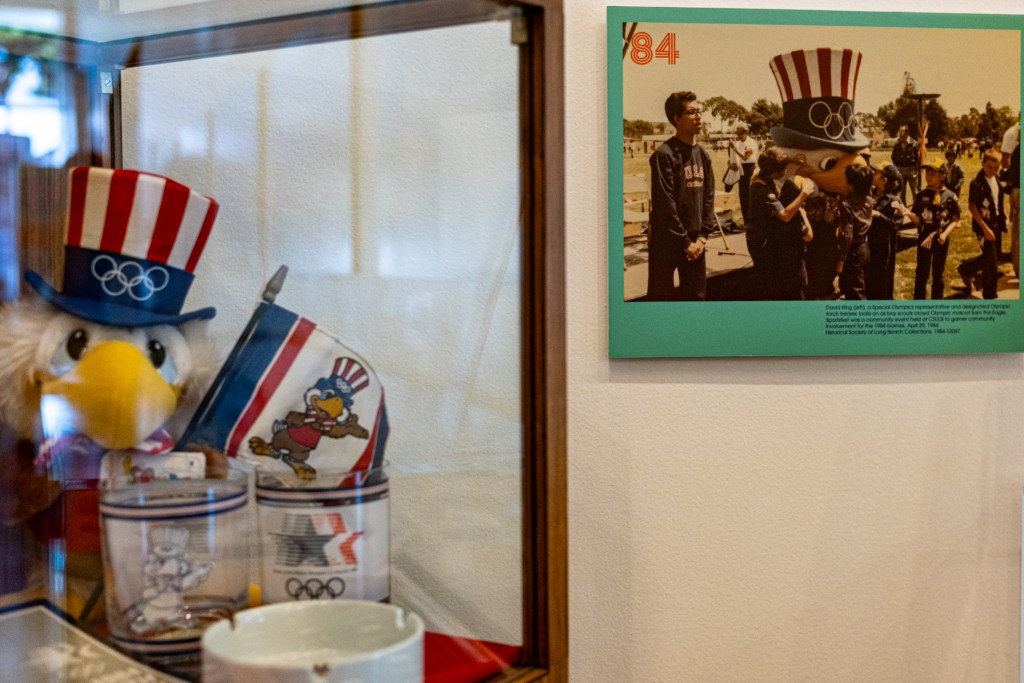 Items featuring Sam the Olympic Eagle, the official mascot of the 1984 Summer Olympics in Los Angeles, are displayed in the Historical Society of Long Beach’s “Olympics on the Golden Shore” exhibition on March 20, 2026. (Justin Enriquez | Signal Tribune)
For those alive during one of the city’s previous Olympic endeavors, the exhibition is a nostalgic reminder of Long Beach’s sporting history. As for locals who’ve yet to experience a SoCal olympiad, it’s an opportunity to learn about past athletic glories and the stories that line the city’s presence on the international stage.
This stroll through history includes a detailed explainer on the formation of Marine Stadium. The waterway played host to rowing during the 1932 Games, in the process becoming the first manmade rowing course in the United States. Declared “the world’s finest course for one of the world’s greatest sports” by then-International Olympic Committee President Henri de Balliet-Latour, Marine Stadium helped put the city, and the entire region, on the global map.
“I think that ‘32 really does put Los Angeles as a meaningful place in the United States,” Bartolotto said.
Want more local news?
Sign up for the Signal Tribune’s daily newsletter
Visitors can see a large snapshot of the 1932 men’s rowing competition, as well as a diagram of early Marine Stadium and a map that directed fans to the venue’s seating area. This insight places the city’s gradual event infrastructure gains into a grounded context, showing how Olympic history is proudly weaved into Long Beach heritage.
As the ‘32 Olympics coincided with the Great Depression, there was significant criticism about hosting a large sports spectacle while residents experienced massive unemployment and inequality. Similar arguments have popped up yet again since the announcement of LA28. To somewhat remedy the situation, the Olympic committee in 1932 employed several local out-of-work folks as vendors, who then were able to keep a portion of the profits.
Despite the Olympic opposition, local excitement for the Games was palpable. This is evident through “Marathon,” an award-winning poem from the pages of Long Beach Polytechnic High School’s 1932 Caerulea yearbook.
Written by student Chiye Mori, “Marathon” vividly chronicles the highs and lows of competition. Mori would go on to become a notable journalist for The Kashu Mainichi and The Nisei Weekender, as well as the first female editor of the Manzanar Free Press, the newspaper operated at Manzanar concentration camp during the United States’ internment of Japanese Americans in World War II.
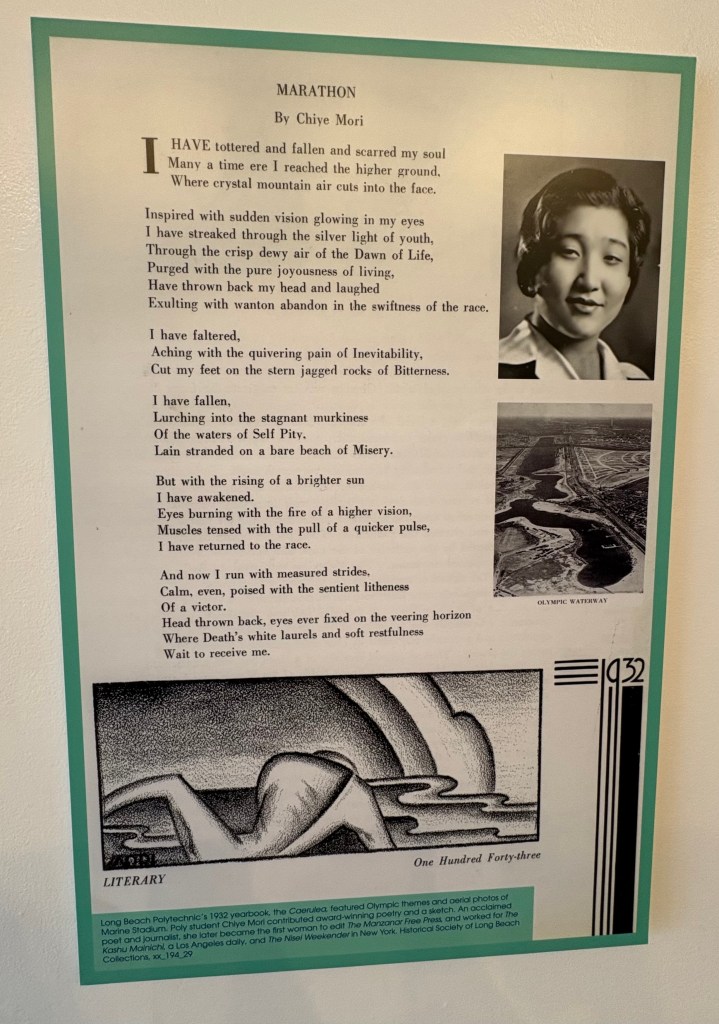 Chiye Mori’s poem “Marathon” is on display in the Historical Society of Long Beach’s “Olympics on the Golden Shore” exhibition on March 20, 2026. (Ryan Hardison | Signal Tribune)
With the ‘32 Olympics proving to be a success — and even turning a profit — efforts immediately began to bring it back. Though it took 52 years to make it happen, the groundwork in Long Beach was already laid for an even bigger impact this time around.
“One of the key things for Long Beach for ‘84 is that the Arena already existed, the Terrace Theater already existed, El Dorado Park already existed…they used all of these areas and they didn’t have to build anything from scratch,” Bartolotto said.
While rowing was the only event held in Long Beach during the ‘32 Games, the 1984 edition featured four sports: yachting at Shoreline Marina, archery at El Dorado Park, volleyball at Long Beach Arena and fencing at the Terrace Theater and exhibition hall. This period is where the exhibition gets its most nostalgic touch.
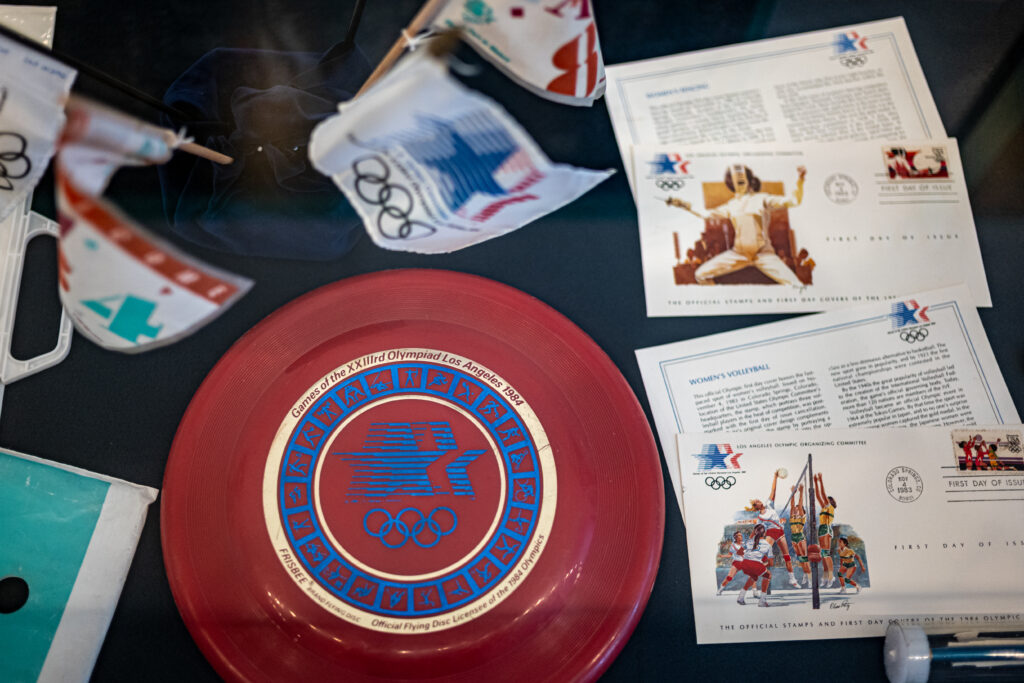
Personal mementos from the 1984 Games, such as banners, pins, booklets and even a flying disc, can be found in or on top of the display cases, while a donated volunteer uniform is prominently shown as well. The more eccentric items include a bottle of 1980 Parducci cabernet sauvignon with the tagline of “Saluting Los Angeles Summer 1984” and a massive sonotube, a wayfinding device with calm yet vibrant rings of teal, purple and orange.
Accompanying these souvenirs are vintage images from fencing, volleyball and archery competition, as well as blown-up articles from the Press-Telegram highlighting the likes of track & field icon Carl Lewis, who won gold in the 100m, 200m, 4x100m and long jump at the ‘84 Games.
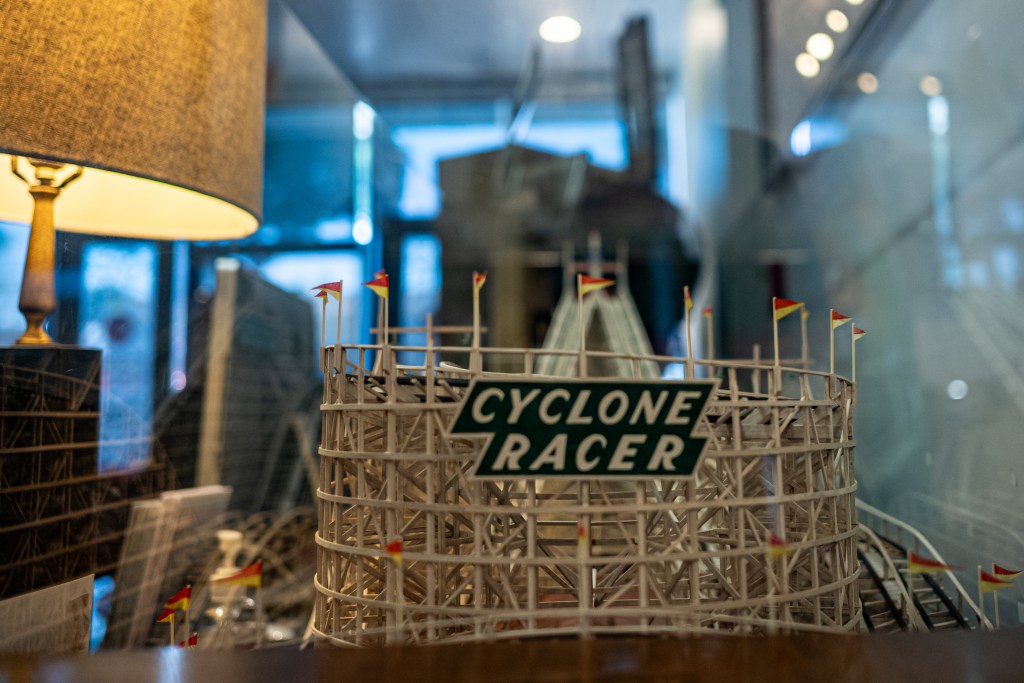 A model of the Cyclone Racer is displayed at the Historical Society of Long Beach on March 20, 2026. (Justin Enriquez | Signal Tribune)
There’s also a feature on local volunteers such as Long Beach pharmacist Vic Hwang, portrayer of Sam the Olympic Eagle, the ‘84 Games mascot. Eagle-eyed observers may even notice recognitions of Long Beach Olympians like water polo player and 2024 bronze medalist Max Irving or swimmer Susie Atwood, winner of a bronze and silver medal at the 1972 Summer Olympics in Munich, Germany.
One thing that’s evidently felt in perusing the exhibition is the spirit of community, owing from the city’s communal Olympic remembrance. It both adds a poignant depth and properly sets the stage for what’s to come in two years time.
Ninety-six years after Olympic rowing’s first race across Marine Stadium, it will return July 14-30, 2028 as part of a jam-packed event lineup in Long Beach, featuring beach volleyball, water polo, handball, sailing and more. The 2028 Games will also mark the city’s first time hosting the Paralympics, set to take place Aug. 15-27, 2028.
Once those chapters are written, the city’s Olympic connection will readily expand once more. As for how we got here, those answers can be found in “Olympics on the Golden Shore.”
Admission to “Olympics on the Golden Shore” is free and open to the public. The HSLB, located at 4260 Atlantic Ave., is open Tuesdays, Wednesdays and Fridays from 1-5 p.m., Thursdays from 1-7 p.m. and Saturdays from 11 a.m. to 5 p.m.