
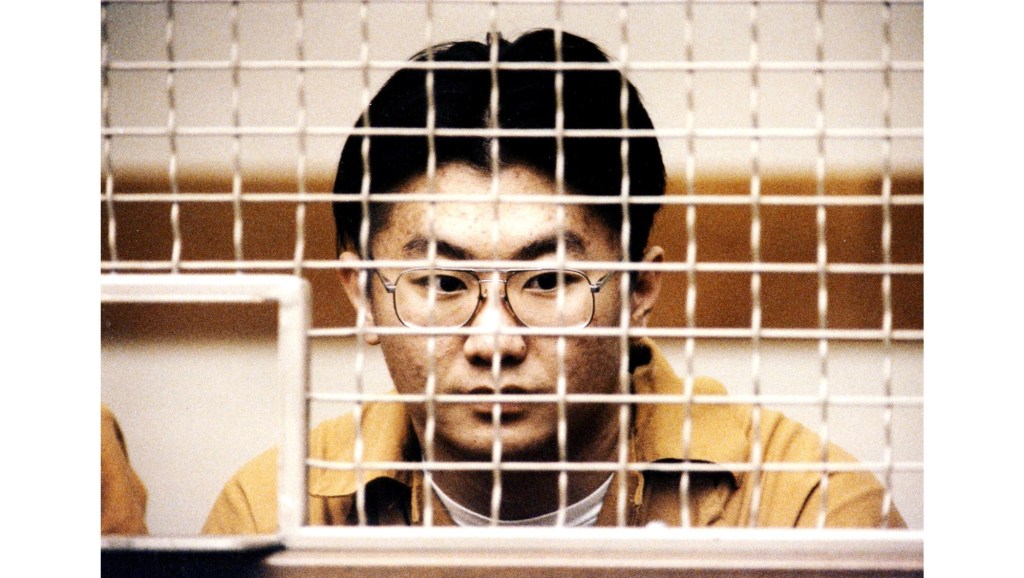
A long-running request by a man who spent more than a decade in prison for serving as a lookout during the notorious 1992 “honor roll murder” of a teen by his high school-age peers to have his conviction overturned has been denied by an Orange County judge.
Kirn Young Kim, then 16, denied in recent testimony that he was a knowing participant in the plot to kill Stuart Tay at a Buena Park home on New Year’s Eve 1992. Kim, recently taking the stand for the first time decades after the killing, said he believed the plan to beat Tay to death and bury him in a makeshift grave was pure fantasy, until it suddenly became all too real.
The killing of Tay, an honors student, by a group of similarly academically gifted teens who largely grew up in affluent families drew international attention and helped inspire a Hollywood movie. Kim was convicted for his role in the killing, paroled after becoming a model prisoner and more than seven years ago moved to vacate his conviction.
Robert Chan, at the time a valedictorian candidate at Sunny Hills High School in Fullerton, orchestrated Tay’s killing. Chan’s plot was spurred by a falling out he had with Tay over a mutual plan to rob a computer salesman. Prosecutors allege that Chan laid out his plan to kill Tay to four other teens, including Kim. Chan showed the other teens a shallow grave he had dug in one of the teen’s’ backyard, and walked them through a “rehearsal” of the killing, which took place in an adjacent garage.
Chan persuaded Tay to go with him to the Buena Park home, where Chan and another teen beat Tay with baseball bats and at one point a sledgehammer while Tay begged for help. Chan then forced Tay to drink rubbing alcohol and sealed his mouth with duct tape — leading him to choke on his own vomit — before burying Tay in the makeshift grave.
While the other teens beat Tay to death and buried him, Kim was sitting in his car down the street. Prosecutors say he was acting as a lookout. After the killing, Kim drove Tay’s car to Compton and abandoned it.
Kim, in recent testimony, acknowledged hearing Chan say he planned to kill Tay. But he added that Chan had a history of making grandiose and false claims — including lying about killing people — and described the deadly plan that Chan crafted for Tay as “unbelievable.”
Changes to state law meant that, unlike at the time of Kim’s trial, prosecutors are no longer able to argue a natural and probable consequences theory that anyone involved in the plot that led to Tay’s death could face the same charges as the actual killers. Prosecutors now had to prove that Kim was fully aware of the plot, was an active participant and aided and abetted the killers.
Kim’s attorney, Ray Chen, argued last month that Tay’s kiling was “basically an ad hoc, hastily thrown together, ridiculous plot hatched by a person (Chan) who was ostensibly the smartest of the group.” A prosecutor, Brian Fitzpatrick, responded that Kim “knew what was going to happen, intended to help him happen, and played his role.”
Orange County Superior Court Judge Gary S. Paer determined in a written ruling released late last week that there was “overwhelming direct and circumstantial evidence” that Kim “directly aided and abetted” in Tay’s murder. As a result, the judge found that prosecutors had proved beyond a reasonable doubt that they could still convict Kim of Tay’s murder under current state law.
“Defendant (Kim) knew Chan wanted to kill Tay, he knew Chan’s plan to kill Tay, and he knew his role in helping Chan accomplish his plan to kill Tay,” Paer wrote. “From start to finish, defendant (Kim) carried out his role in helping Chan accomplish the killing… Stuart Tay’s murder involved a detailed plan involving five perpetrators, four locations, three vehicles, decoy items, disguises, hidden weapons, theft of property, abandonment of property and a shallow grave.”
Paer described Kim’s claims that he didn’t know Chan would kill Tay as “unbelievable.”
“Defendant (Kim) assisted Chan in digging a hole for Tay’s body, attended a rehearsal before the killing, served as a lookout at two locations, disguised himself for several hours, retrieved Tay’s car from Chan’s house, drove Tay’s car to Compton to abandon it and took a share of the victim’s money after the murder,” the judge wrote. “These actions all show defendant (Kim) knew Chan was serious and intended to kill Tay.”
The judge focused a significant part of his written ruling on Kim’s relationship with Chan. Kim began hanging out with Chan after a falling out with his old friends, whom his mother didn’t like because they weren’t academic achievers. Chan, by comparison, was a valedictorian student with early college acceptance.
The judge noted that Kim told a parole board in 2011 that “I made a very poor choice. I was desperate for acceptance, and, in doing so, I overrode all sense of morals,” later adding “I am responsible because I chose to go along with Robert Chan.”
Kim’s attorney did not immediately respond to a request for comment regarding the ruling.