
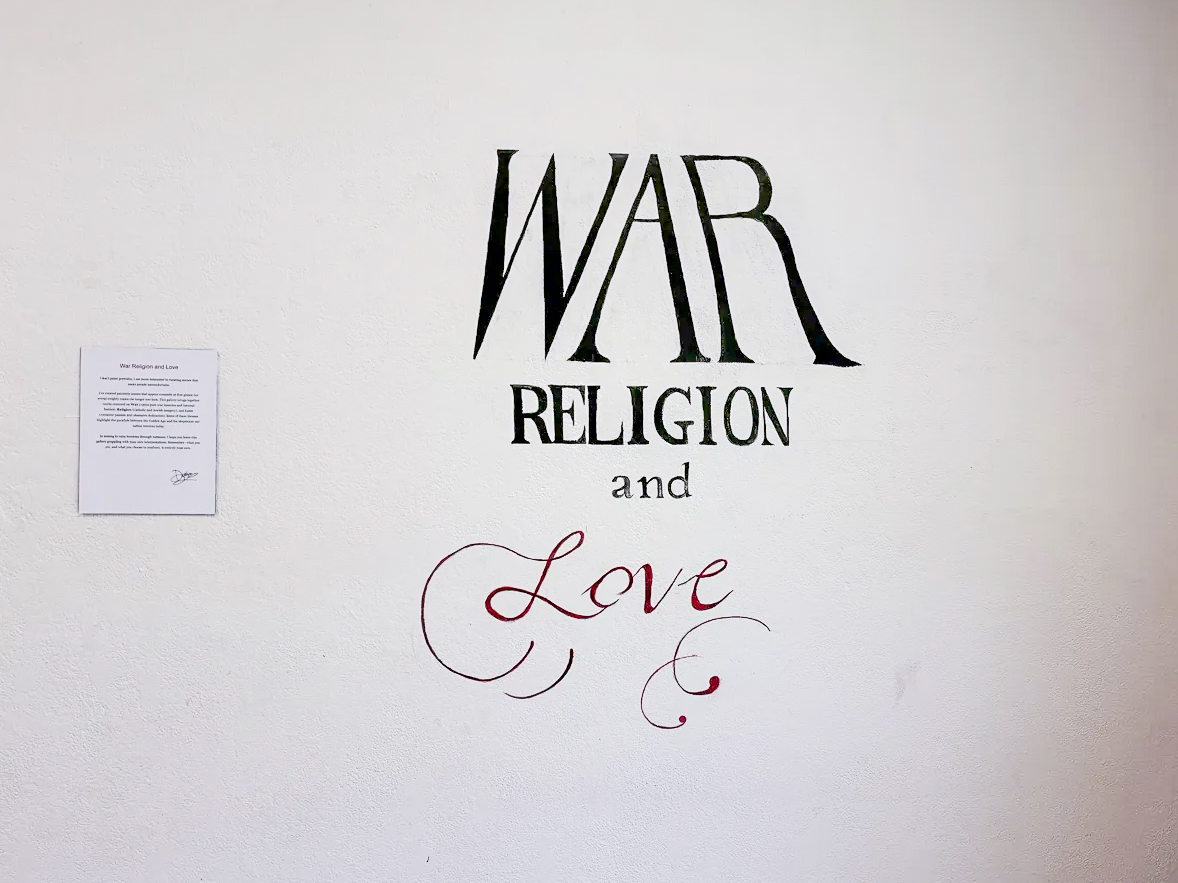
Desiree Thomas, a third-year fine arts major, moved quickly across the gallery with flowers and supplies filling her arms as she prepared for her art show. Her paintings lined the walls of Kadema Hall’s R.W. and Joyce Witt Gallery on Thursday afternoon in “War, Religion and Love,” a solo exhibition curated by Thomas herself.
“I don’t paint portraits,” a plaque welcoming visitors read. “I am more interested in curating scenes that make people uncomfortable.”
Guests moved slowly from painting to painting, stopping, leaning in and whispering to each other. Some just stared. Sofia Prenga, a second-year nursing student and lead in the exhibition’s live performance, said the show captured something she rarely sees in the way these topics are discussed today.
RELATED: Crocker exhibition ‘[Placeholder: Flooding Fields]’ connects students with land, art and community
“On social media, on news outlets, everything has negative, dark aspects,” Prenga said. “This is highlighting love. A lot of people, when World War II was happening, looked to art and entertainment as a positive outlet. I think that’s really the whole aspect of what she’s trying to get across.”
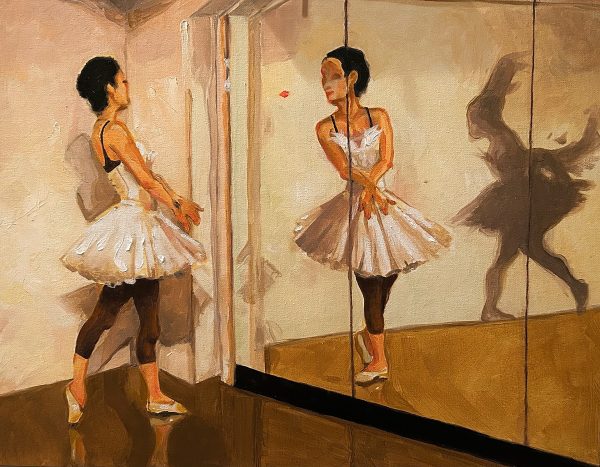 “The Fine Line Between Ambition and Insanity,” a 2026 oil on canvas by third-year fine arts major Desiree Thomas, hangs at Kadema Hall’s R.W. and Joyce Witt Gallery at Sacramento State on Thursday, April 2, 2026. Thomas said that the ballerina’s mismatched reflection represents an internal battle with herself. (Photo by Jaqueline Ruvalcaba)
Sometimes war is quieter and more personal. It is the kind that happens in private, in a dance studio, in front of a mirror.
“War can mean war with yourself,” Thomas said.
In “The Fine Line Between Ambition and Insanity,” a ballerina faces her reflection. Her posture is graceful, but if one looks closely, her pose and reflection do not match. The shadow cast by her reflection looks contorted and broken.
“She’s having an internal battle,” Thomas said. “She feels detached from herself. She is at war with herself.”
“Home” portrays a soldier and a woman in red embracing and kissing at the center of a warmly-lit dining room. A young girl in pink watches from the shadows. At first, it looks like a love story, then the details hit.
A revolver sits casually on the dinner table. Behind the child, a ghostly figure is barely visible – the Holy Ghost. The setting, Thomas said, is a Nazi household. It is the duality of the unsuspecting facade concealing something darker underneath that runs through the entire exhibition.
Above the embracing couple in “Home,” the Star of David overlaid with the Cross fuses Jewish and Catholic symbols on the wall. They are the painting’s spine, forcing two faiths into the same frame at one of history’s darkest moments.
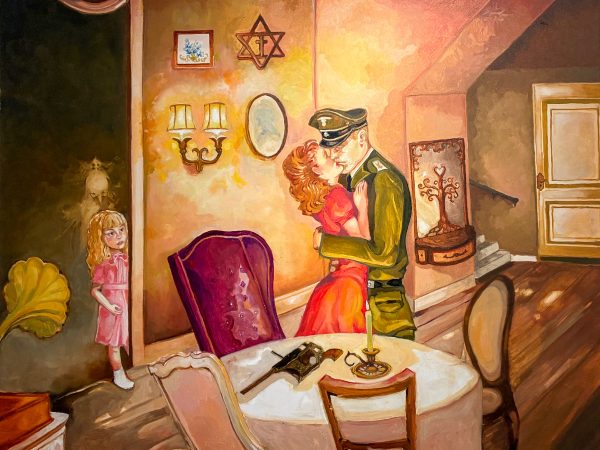 “Home,” a 2026 oil on canvas by third-year fine arts major Desiree Thomas, hangs at Kadema Hall’s R.W. and Joyce Witt Gallery at Sacramento State on Thursday, April 2, 2026. The painting depicts a Nazi soldier embracing a woman in red, while a young girl watches from the shadows and a ghostly figure lingers behind her. (Photo by Jaqueline Ruvalcaba)
“When I was a child, I was feeling disconnected from God,” Thomas said. “When I grew more passionate about art, I felt more of a connection with my religion.”
The religious symbolism and connections were visible throughout the exhibit. The Cross and Star of David in “Home” are not incidental details. Thomas said she wanted the work to give people a space to talk about religion with an open mind.
“When you show them, just put it in their face, it’s so different,” Thomas said. “They are not forced to think a different way, but they are more inclined.”
The painting drew a different reaction from nearly every person who stood in front of it. Jayden Burrows, a second-year administration of justice major who performed at the show, said that kind of open-ended tension is what made the exhibit work.
“You’ve got your Cross and the Star of David,” Burrows said. “You’re going to have different people get different meanings. I just think all of this is very provocative.”
Mikhail John, a fourth-year media arts major who helped build and install several pieces in the exhibition, said Thomas never shied away from the discomfort of her vision, even when he questioned it.
“When she told me about some of these paintings, I was like, ‘Are you sure?’” John said. “But when I see them hanging up and people looking at them, talking about them, — art is meant to be talked about.”
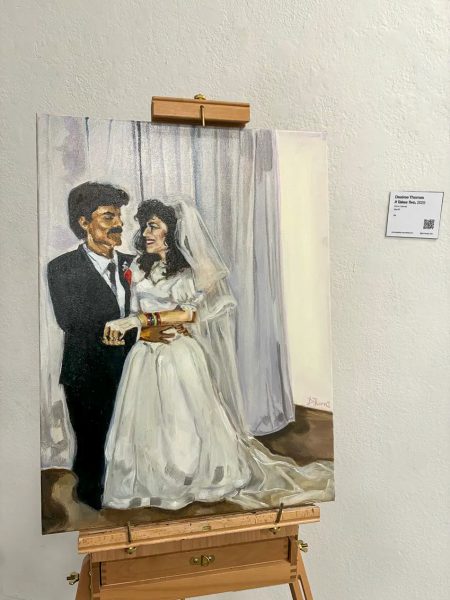 “It Takes Two,” a 2025 oil on canvas by third-year fine arts major Desiree Thomas, hangs at Kadema Hall’s R.W. and Joyce Witt Gallery at Sacramento State on Thursday, April 2, 2026. Thomas said the painting is a tribute to her parents, who immigrated to the United States in 1993. (Photo by Jaqueline Ruvalcaba)
While almost every painting in the exhibition hid disconcerting details, “It Takes Two” featured a man in a suit and woman in a wedding dress, looking at each other, as a smile forms across the woman’s face.
“My mom and dad immigrated here in ‘93. They adapted and loved this country,” Thomas said. “It’s a nod toward their marriage before they immigrated here.”
Prenga said this was the painting that stayed with her, and she knew how much it meant to Thomas.
“It has a lot of meaning behind it,” Prenga said. “I think it’s a soft spot for everyone.”
But love, Thomas said, can also mean obsession. The same ballerina in “The Fine Line Between Ambition and Insanity” locked in a battle with her own reflection was also a painting of someone consumed by dedication to her craft.
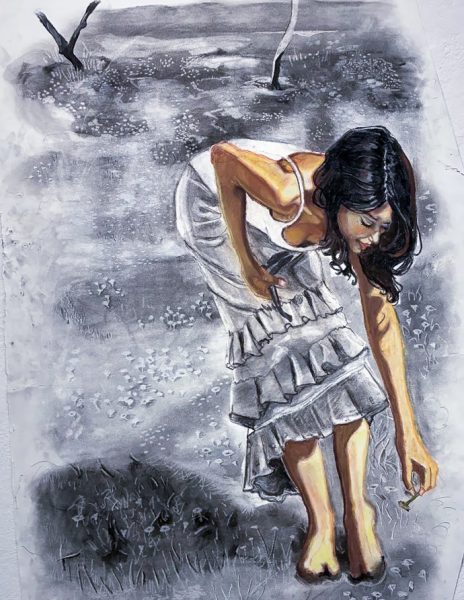 “Savanna,” a 2025 conté crayon on paper, hangs at Kadema Hall’s R.W. and Joyce Witt Gallery at Sacramento State on Thursday, April 2, 2026. The large-scale drawing drew different interpretations from visitors who stopped in front of it. (Photo by Jaqueline Ruvalcaba)
Burrows pointed to “Savanna,” a large charcoal drawing of a woman in a white dress alone in a field. He saw Vietnam. His girlfriend saw innocence.
“Everyone just seems to have a different opinion,” Burrows said. “I like that nobody has said the same thing about it.”
Thomas said curating the show changed how she saw her own work. Pieces that had been sitting in her garage for years suddenly had context and an audience. John said watching strangers stop and wrestle with the works was the whole point.
“It’s just been amazing to see how much love she’s put into this,” John said.
In her own words, written on the gallery entrance plaque, Thomas left visitors with one final thought.
“In aiming to raise tensions through romance, I hope you leave this gallery grappling with your own interpretations,” Thomas wrote. “Remember, what you see and what you choose to confront is entirely your own.”