
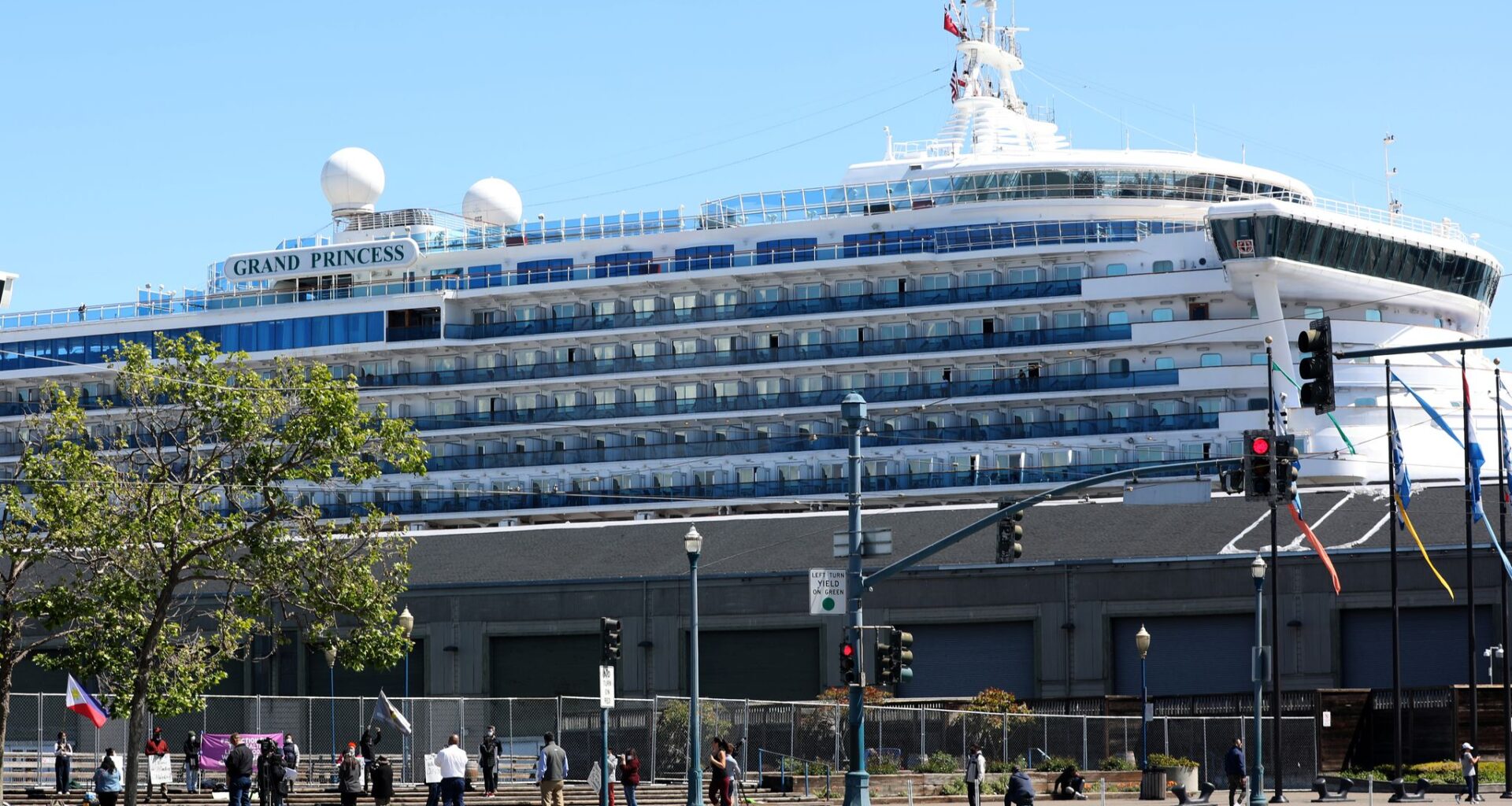
The Grand Princess cruise ship docks in San Francisco in 2020 after a COVID outbreak forced more than 3,000 passengers to be quarantined and bused to Travis Air Force Base.
Liz Hafalia/S.F. Chronicle
Six years ago, the Grand Princess cruise ship was rerouted to the Bay Area after passengers and crew developed flu-like symptoms on a voyage from Hawaii. The California National Guard airlifted in COVID-19 test kits by helicopter to what some called “the last cruise ship on Earth” as it sat offshore.
When the vessel finally docked in Oakland, more than 3,000 passengers entered quarantine and were bused to Travis Air Force Base. At least 122 people tested positive for COVID-19. Seven died. I was part of the public health response that helped decommission that ship after it became one of the most visible symbols of a pandemic the world was just beginning to understand.
I carry those weeks with me not as a political memory, but as a clinical one. The Grand Princess showed what happens when public health infrastructure collides with political convenience — and political convenience wins. The lessons should have permanently changed how we think about infectious diseases on cruise ships. They did not.
Article continues below this ad
Last month, 193 people on the Star Princess, another ship in Princess Cruises’ fleet, got sick with norovirus during an eight-day Caribbean voyage. The Centers for Disease Control and Prevention deployed a field team. The ship docked in Fort Lauderdale, Fla., on March 14, was cleaned and set sail that same day with a new load of passengers. No subsequent outbreak has been reported, but regulations only require the cruise industry to report outbreaks to the CDC. They do not require the industry to disclose them to the passengers about to board, who should be entitled to that information.
Six years after the Grand Princess tragedy, Princess Cruises (a division of Carnival Corp.) is operating the same model, in the same conditions, with similar results. The only thing that has changed is that the federal infrastructure behind the response to outbreaks on cruise ships is smaller than it was then.
San Francisco Chronicle Logo
Make us a Preferred Source to get more of our news when you search.
Add Preferred Source
In 2025, the CDC logged a record number of gastrointestinal illness outbreaks on cruise ships; 2026 is tracking similarly. These outbreaks are the predictable result of putting thousands of people in a confined environment with shared dining, entertainment and air systems, then cycling them through international ports. Norovirus thrives in these conditions. So does influenza. So does COVID-19. And so will the next pathogen we have not met yet.
Meanwhile, the CDC’s Vessel Sanitation Program depends on a broader public health infrastructure that is being systematically weakened. Over the past year, the Department of Health and Human Services has laid off thousands of public health workers. Research funding across the National Institutes of Health, CDC and Food and Drug Administration has been cut. Advisory committees have been dismissed. The Trump administration has publicly stated it will no longer fund pandemic response. Meanwhile, H5N1 avian influenza has produced its first recorded human death in the United States, whooping cough is spreading, and the Americas have lost their measles-free status.
Article continues below this ad
There is a dimension to this risk that rarely enters the conversation. The cruise industry’s workforce is drawn overwhelmingly from low-income and middle-income countries. Filipinos alone account for roughly 30% of the global cruise ship workforce, with large contingents from India, Indonesia and Eastern Europe. These crew members live in shared quarters below deck, two to four per cabin, working 10 to 12 hours a day for months without a day off. They are, by design, the most densely housed and most continuously exposed population on any vessel.
Infectious disease does not respect the boundaries we draw around it. A novel pathogen that emerges on a cruise ship does not stay on the ship. It disembarks with passengers in Fort Lauderdale and with crew in Manila, Mumbai and Jakarta. The same conditions that make these workers vulnerable on board (dense housing, limited medical access, economic pressure to work through symptoms) are mirrored in the communities they call home. This is how localized outbreaks become international ones, and the cruise industry’s labor model is engineered to accelerate the process.
The Cruise Lines International Association forecasted nearly 38 million cruise passengers last year. If a pathogen with pandemic potential emerged on a cruise ship today, the federal response capacity would be meaningfully diminished compared to where it stood even two years ago. And the more than 200,000 crew members who keep those ships running would be among the first exposed.
There is a pattern that repeats across every major pandemic: crisis, response, political fatigue and abandonment. Cruise ship outbreaks are no different. Each one generates a news cycle, a statement about enhanced cleaning, and the ship sets sail again the same evening, with passengers who are likely unaware of what occurred prior to boarding. We treat these outbreaks as consumer inconveniences. But they are a recurring signal that we do not take infectious disease preparedness seriously outside of the moments when it terrifies us. Norovirus is rarely fatal, but the next shipboard pathogen may not be so forgiving.
Guest opinions in Open Forum and Insight are produced by writers with expertise, personal experience or original insights on a subject of interest to our readers. Their views do not necessarily reflect the opinion of The Chronicle editorial board, which is committed to providing a diversity of ideas to our readership.
Read more about our transparency and ethics policies
The solutions are not complicated. Preparedness needs to go beyond gastrointestinal response plans to permanently integrate respiratory pathogen protocols, improved ventilation and onboard testing capacity. The CDC’s Vessel Sanitation Program needs sustained investment, not cuts. And the public deserves honest communication about the real risks of cruise travel before they board.
Article continues below this ad
Six years ago, I watched the Grand Princess sail into San Francisco Bay carrying a virus the world did not yet understand. We said we would learn from it, but we continue to ignore the lesson.
Dr. Tyler Evans is the author of “Pandemics, Poverty and Politics,” founder and CEO of Wellness Equity Alliance and a public health policy expert focused on global health security and equity.