
A century ago, “one of Berkeley’s best known citizens for 35 years” passed away on April 10, 1926, at the age of 90. He was Capt. William Harrington Marston.
Marston was a former mayor of Berkeley who was credited with arranging for the purchase of the land where Berkeley City Hall now stands on Martin Luther King Jr. Way (the former Grove Street). He had also been a strong supporter of volunteer firefighting companies, one of which was named in his honor.
“His life was a most picturesque one and whether sea-faring man or private citizen, it was filled with deeds of service for others,” the Berkeley Daily Gazette reported. In an accompanying obituary, the editors wrote that “Captain Marston was, indeed, a good father and good citizen, and Berkeley is the richer for having counted him among its leading citizens for so many years.”
Marston had been born in Maine and went to sea as a boy, working his way up over 30 years of seafaring to be captain of several ships.
“Captain Marston came to California in 1860 by way of the Isthmus (of Panama) and to him San Francisco was his ‘home port,’ ” the Gazette reported. “For many years Captain Marston was president of the Shipowners Association of San Francisco and director of the Mercantile Trust Company.”
At the time of Marston’s death, he was living at 1500 Arch St., where a large 90th birthday celebration had been held in November 1925.
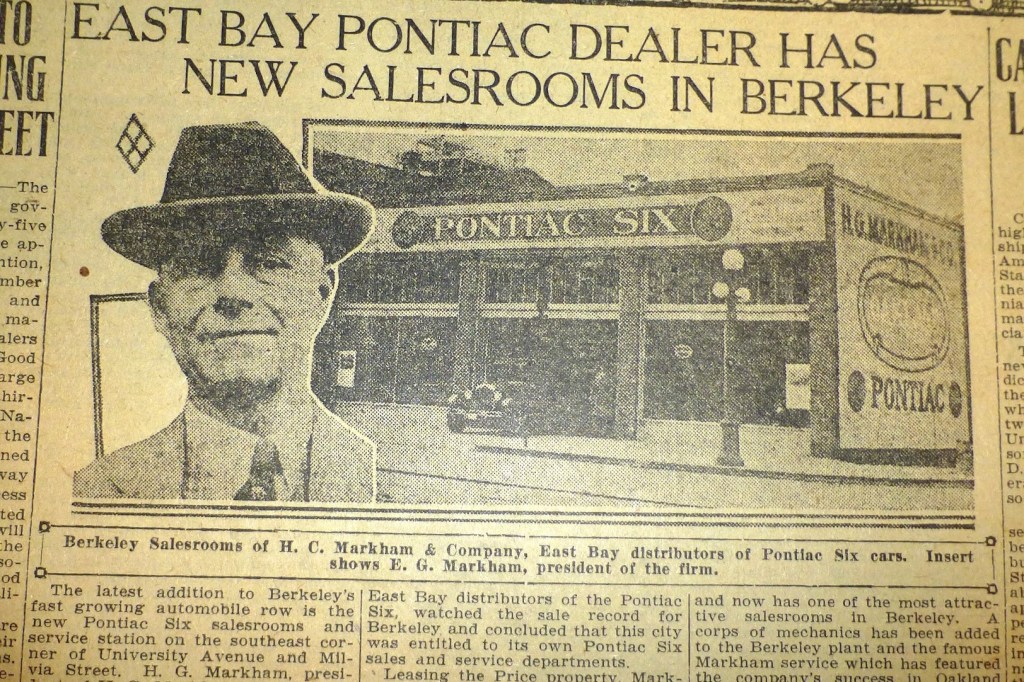
Car sales: Automobile-related businesses continued to expand in Berkeley in early 1926. South Shattuck and University avenues had concentrations of such businesses. In 1926, a building at the southeast corner of Milvia Street and University Avenue was being converted to a new Pontiac dealership. In later generations that building would house Dutch Boy Paints, then the Au Coquelet restaurant before being demolished a few years ago.
Engines: On April 9, 1926, the Gazette reported that the large Hall-Scott Motor Co. was likely to remain in Berkeley despite being sold to an East Coast company. The Berkeley based business was expecting to be able to manufacture “50 motors a day to be used on Faegol buses. … We expect to be able to build all the bus motors … right now we are planning engagements of our plant for this purpose,” said the company’s Percy S. Williams.
Williams explained that Hall-Scott, a West Berkeley manufacturer, had pioneered the making of certain auto parts and had switched during World War I to fabricating airplane engines. Later, before and during World War II, Hall-Scott would manufacturer engines for hundreds of small, fast, military patrol and rescue boats.
Workforce: Exactly 39,645 residents of Berkeley over the age of 10 were “engaged in gainful occupations,” the Gazette reported April 10, 1926. This was out of a total estimated population of 80,691 residents.
There were more than 5,000 women than men living in Berkeley, 8,376 male and 937 women workers in Berkeley were in manufacturing jobs, the largest single category of employment. Appreciable numbers of people also worked in “professional service,” “trade,” transportation, clerical and “domestic” work, the latter probably meaning household servants. “Trade” most likely meant those working in retail.
Lieutenant governor: A man arrested in Oakland confessed to police that he had robbed the Berkeley home of California Lt. Gov. C.C. Young at 2820 Regent St. He had hidden in a garage behind the house and watched it, then slipped in the back door when a servant came out and went to the basement.
He took a camera, jewelry and Young’s “overcoat and shaving outfit.” He was caught in Oakland attempting to pawn jewelry from the robbery.
Bay Area native and Berkeley community historian Steven Finacom holds this column’s copyright.