

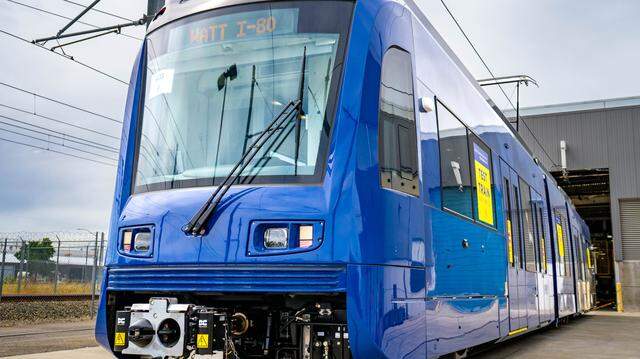
One of Sacramento Regional Transit’s new low-floor trains is demonstrated to the media at SacRT’s heavy rail facility on Wednesday, May 3, 2023. RT is hoping to staff more trains with transit ambassadors by hiring between 10 and 20 people for the position.
Cameron Clark
Sacramento Bee file
Sacramento Regional Transit ambassadors — charged with keeping peace and taking fares on the light rail — are not present for every train ride. But the agency wants them to be.
Regional transit is aiming to hire about 15 new transit ambassadors this month, bringing the total to 55, said Lisa Hinz, RT’s vice president of security, safety and customer satisfaction. The ambassadors, who are tasked with maintaining a calm travel environment on trains, are expected to start monitoring rides in July.
The hiring push is a part of a larger objective to enhance security on buses and light rail trains and make riders and existing transit ambassadors feel safer aboard.
The job of transit ambassador entails a mixture of responsibilities not necessarily implied by the name. The workers check tickets and fares, answer questions and perform other customer service functions, issue citations for violating train rules, attempt to maintain peace, assist operators and track the number of passengers and sort them into different fare categories. They report people they kick off and often remain with disturbed passengers, according to transit ambassadors that spoke at an RT board of directors meeting in October.
Transit Ambassadors are not peace officers and cannot carry firearms or knives, according to RT. But they are certified by California’s law enforcement standards agency.
The push for security and hiring of more ambassadors comes after existing ambassadors detailed safety concerns and a fatal stabbing.
In June 2025, a Sacramento Regional Transit ambassador stabbed 16-year-old Michael Berry at the Mather Field/Mills Transit Center on Mills Station Road in Rancho Cordova, according to authorities. The ambassador, who was not identified or criminally charged, stabbed Berry during a struggle that began after the ambassador asked Berry and a teenage girl to stop vaping on a bus. Berry later died at a hospital.
The RT board of directors voted at the October meeting to shift $1 million to the effort after listening to reports of transit ambassadors being harassed and assaulted, including instances where they were spit on and dogs were sicced on them.
In addition to hiring ambassadors, money will also go toward adding staffers in the security operations center, which collects feeds from more than 2,000 cameras, and security guards who are typically law enforcement. The Sacramento Sheriff’s Office, which began its contract with RT in January, currently has a lieutenant, three sergeants, and 11 deputies, Hinz said. Starting in July, there will be 18 deputies.
The agency late last year also increased the number of citable violations from five — including fare evasion, eating or drinking onboard, smoking, or incorrectly using a discount ticket — to 25. By the end of the year or early 2027, the agency will begin banning riders for certain periods of time following a certain number or type of violations, said Devra Selenis, RT vice president of communications and partnerships.
The agency secured a restraining order in October 2025 against a rider who Hinz said was a “bully” who “was completely inappropriate with staff and with riders.”
“My goal is to make sure that everyone riding feels safe and secure and wants to come back tomorrow,” Hinz said during a transit ambassador recruitment event.
The event — the first that RT has organized for a specific position — was held March 20 at RT’s midtown auditorium at 1400 29th St. A second similar recruitment event will be from 3-5 p.m. Wednesday at the same location.
During the March event, 26 attendees went through five stations where they learned what the job entailed, received information about the three-month academy training, spoke with human resources regarding the job application and could begin applying. . Hinz said she had the idea for the event after going through 70 interviews where many people did not know key job requirements.
“Many people didn’t know that we write citations every day to hold people accountable for fare evasion and other violations,” Hinz said, adding others didn’t know about the academy, which includes scenario-based instruction from former law enforcement
As of Friday, 13 have applied for the open ambassador positions, Gonzalez said.
Sacramento resident Eboni Eckford said she submitted her application before even stopping by the March recruitment event. Eckford, who works as a security guard, attended to get a better understanding of what was expected of transit ambassadors, though she had a good idea based on previous conversations with current workers during her daily light rail commute. She also wanted to gauge if she was still interested in the job.
“I feel like if I was a transit ambassador that would be my good deed for the day, you know, help somebody,” she said. “That’s what they do.”
Other attendees, such as Jay Bolds, came to the event after hearing about it at the Tri-County Job Fair held the day before in Rancho Cordova. Bolds has been riding RT routes since he was a child.
“It’s a decent starting pay, and it’s in the field of customer service, and I’ve been in customer service for about 20 years,” Bolds said.
The ambassadors’ starting hourly wage is $25, Selenis said.
In 2024, transit ambassadors earned an average of $38,027 in regular pay, excluding part-time workers, according to data RT released to The Sacramento Bee. No one, including “lead transit ambassadors,” earned more than $51,300.
On Friday afternoon, the Gold Line, which extends from Historic Folsom to the Sacramento Valley Station, was monitored by transit ambassadors that popped in and out of certain cars and asked people to show their “tickets or passes, please.” One made small talk with a rider who held up images on their phone and talked about “Godzilla.”
Riders on both north- and southbound routes, most of which said they rode every day, said they frequently see the ambassadors on trains.
Ryan Scowcroft, 39, of Sacramento, said he has seen an increase in the presence of transit ambassadors and security within the past six months — more than he has seen in his 20 years of riding the light rail.
“Usually a lot of people get away with riding for free and not buying a ticket,” Scowcroft said. “Now, you have to buy a ticket no matter what. They are cracking down on that.”
Scowcroft said the increased presence has led to a better experience, specifically because fewer people are able to ride for free.
Rancho Cordova resident Byron Espinoza, who speaks Spanish, said he wishes more transit ambassadors could speak other languages. He called it a problem in the system that can prevent him from communicating or asking the workers for help. Another Spanish-speaking rider, Pedro Martinez, also from Rancho Cordova, said he wishes that there were more Latino ambassadors.
Hinz said she is hoping to hire all the ambassadors before the next three-month academy begins April 16, which would allow them to begin their jobs in July. Applications close April 13.
Related Stories from Sacramento Bee

The Sacramento Bee
Madison Smalstig covers transportation for The Sacramento Bee. Before joining The Bee, she reported on breaking news, focusing on crime and public safety, in the North Bay for three years. Smalstig is a born and raised Hoosier and earned degrees in journalism and Spanish at Indiana University.