
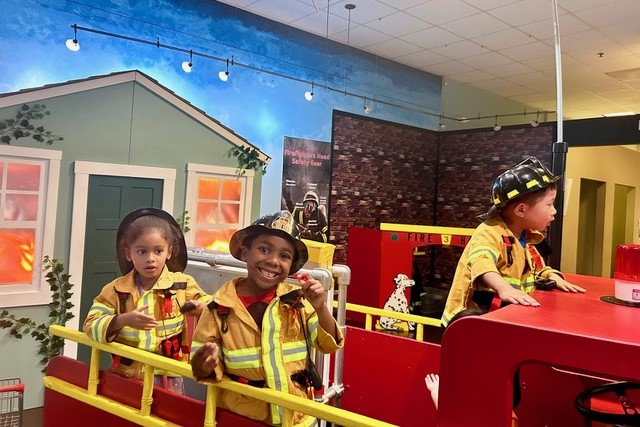
The COVID-19 pandemic has been officially over for a few years; but the damage is going to last a lot longer than that, especially among organizations that serve our youngest children, newborns to 5-year-olds.
This should worry all of us because today’s toddlers will be running run the world someday, and the experts keep telling us that if they miss out on these crucial first five years of learning they’ll be playing catch-up forever.
One of my favorite youth organizations, the Habitot Children’s Museum in Berkeley, was one of the pandemic’s victims. It was evicted from its longtime space in the basement of the old Hink’s department store in 2021, when the building was bought by developers who gave Habitot the heave-ho, but Executive Director Gina Moreland refused to give up.
She turned Habitot into a mobile pop-up museum, taking its popular Waterworks water play exhibit, Giant Blue Building Blocks, Rocket Launcher, Magnetic Ball Wall, Boat and Rocket Maker Stations and other art and sensory activities to cities all over the East Bay.
These events take place in community centers and libraries, offering a rotation of sensory learning experiences that are key for early childhood development: exploring slime, Play-Doh, bubbles, art materials and hands-on craft and building projects. They take place in buildings with lots of floor space for open-ended construction and building.
The kids view these events as fun games to play with, not realizing that they’re actually learning about the world they live in. It’s not a drop-off place but rather a place where parents can learn alongside their children, the better to explain and reinforce the lessons when they get home.
“Our goal is to have children arrive at kindergarten ready to learn,” says Moreland.
Unfortunately, this pop-up situation can’t go on forever. Continually taking down the exhibits, packing them up and transporting them to another location is time-consuming and exhausting, and parents have a hard time anticipating when and where Habitot is coming to their neck of the woods. So Moreland is appealing for people with expertise and connections to join her newly created Real Estate Committee to help Habitot find a permanent home.
“We’re looking for developers, financial deal makers, architects, government relations people — anyone with real savvy in the world of property acquisition who can help us do that,” she says. “What we have now is not sustainable. If we really want a children’s museum in the East Bay, we need the community to come together and make it happen.”
If you can help, please email her at gina@habitot.org.
STEM Day on the Hornet: Speaking of young people, the USS Hornet, which was not only one of the Essex Class aircraft carriers that won World War II in the Pacific but also the ship that fished the Apollo 11 astronauts out of the sea after their historic first trip to the moon, is holding a STEM Day aboard the ship this Sunday, and any Alameda County resident 18 or younger will get in for free.
All you’ll need is a driver’s license, an identification card or a bill with your name, address and photo identification. Whether you’re a budding engineer or a future astronaut, there will be something on the hangar deck to spark your curiosity.
Learn how to code robots, see physics in action as you manipulate air pressure in the depressurization chambers, design and test your own catapult to learn about potential and kinetic energy, test your logic with mind-bending brain teasers and learn what it takes to protect a fragile payload from a high-altitude plunge in the Ultimate Egg Drop Contest.
You can also view all the cool things that are permanently aboard the ship, including lovingly restored vintage aircraft, a flight simulator, the ready room where the aviators (you never say “pilot” in the Navy) were briefed before battle and the isolation trailer where the astronauts were forced to live for three weeks because NASA officials were afraid the moon might have germs (it doesn’t).
Also on view will be artifacts of the Hornet’s beloved skipper during World War II, Adm. J.J. “Jocko” Clark, the first Native American to graduate from Annapolis, who was adored by his men (one of them told me, “There was nothing we wouldn’t do for him because there was nothing he wouldn’t do for us”) and fought all his nighttime battles wearing polka-dot pajamas and fuzzy slippers. Check him out on YouTube. There are plenty of videos.
Some of the events (for instance, the egg drop) will require a little preparation at home first, so for more information visit uss-hornet.org/event/free-alameda-youth-day online.
Martin Snapp can be reached at catman442@comcast.net.