
Sign up for the Slatest to get the most insightful analysis, criticism, and advice out there, delivered to your inbox daily.
For the past several months, California Democrats have been in a bind of their own making. Fortunately for them, Donald Trump decided on Monday to step in with a helping hand.
Here was the dilemma. None of the many candidates to replace term-limited Gov. Gavin Newsom—including Rep. Eric Swalwell, billionaire donor Tom Steyer, former Rep. Katie Porter, San Jose Mayor Matt Mahan, former Los Angeles Mayor Antonio Villaraigosa, former Health and Human Services Secretary and state Attorney General Xavier Becerra, and others—have been able to break from the pack. And since it is quite a loaded pack, it has presented Republicans with an opportunity in a state where Democrats outweigh them roughly 2-to-1. Under California’s nonpartisan primary system, the top two vote-getters advance to the general election in November. With so many Democratic candidates diluting the Democratic vote, there was a real possibility that the top two primary finishers could both be Republicans.
This is not a new fear altogether for Democrats in California elections. It’s a dynamic the party has regularly dealt with in congressional and state legislative races since the top-two system was implemented in 2012. But it is a fresh sight in governor’s races, after Gov. Jerry Brown served eight years and then seamlessly handed the baton to Newsom for another eight. Concerns about Democrats getting “locked out” rarely actually end in Democrats getting Democrats getting locked out, and the party had tools available to them to resolve the situation before the June 2 primary.
What state Democrats may not have been expecting, though, was for President Trump to do that work for them.
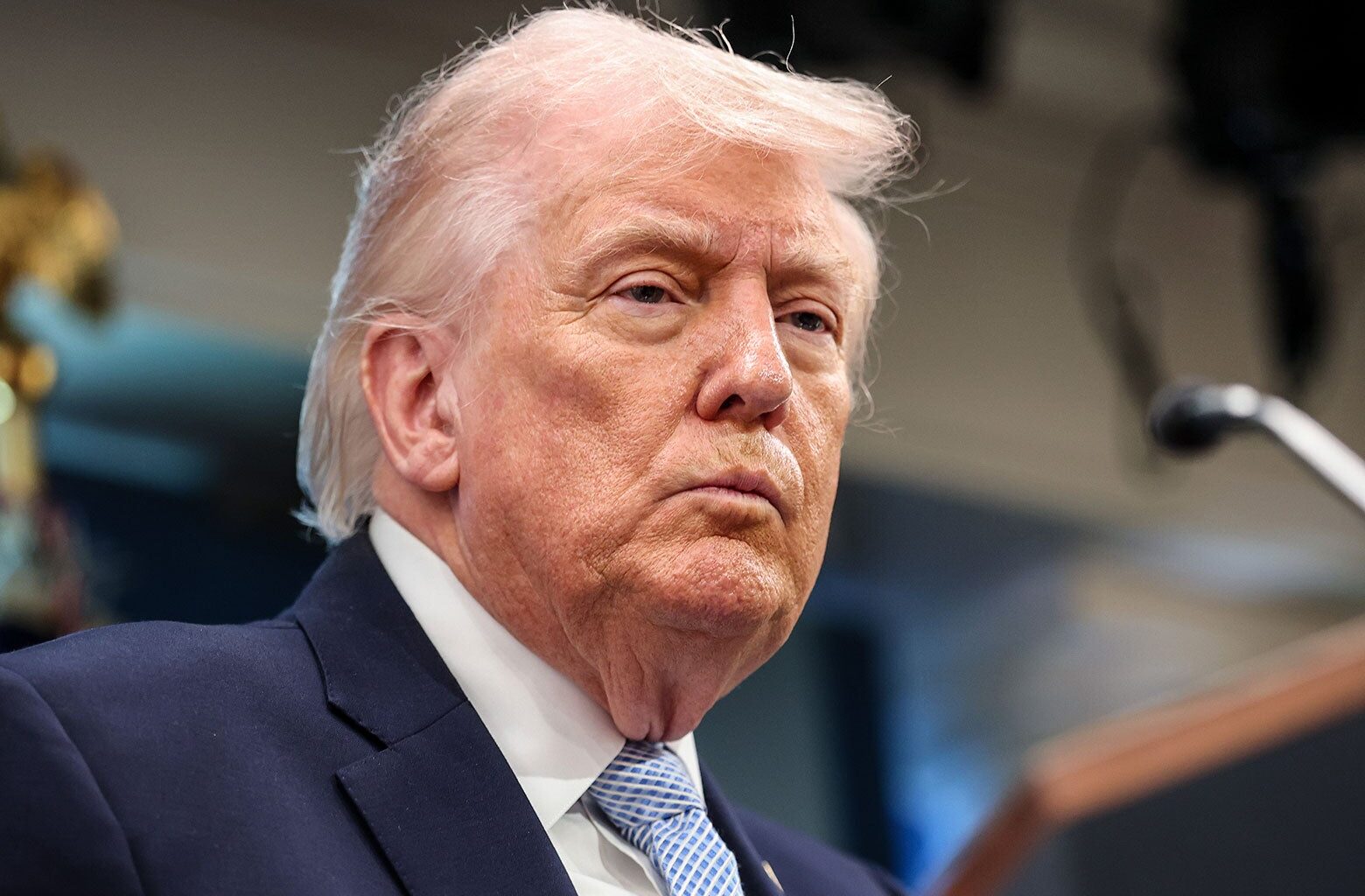
On Monday, Trump endorsed Republican candidate Steve Hilton, a British-born policy adviser and former Fox News host. Hilton had been splitting the GOP share of the primary vote with Chad Bianco, the MAGA Riverside County sheriff whose campaign stunts included a recent seizure of hundreds of thousands of ballots cast in a state redistricting referendum last year. Although the margins between the top five candidates in the governor’s race are tight, polling averages show that Hilton and Bianco, the two top Republicans in the race, rank narrowly at the top. The most likely effect of Trump’s endorsement of Hilton, then, is to consolidate the statewide Republican vote behind Hilton, send Bianco tumbling downward, and clear the space for a Democratic candidate to advance out of the primary, whether or not Democrats actually get their stuff together and coalesce behind a candidate.
The endorsement “means, more likely, that one Republican will find their way to 20 percent support or more, and there will be a Democratic candidate in the race,” Mark Baldassare, survey director at the Public Policy Institute of California, told me. “That now becomes the most likely outcome.”
If the primary does pan out that way, it means that Trump effectively ended whatever slim chance Republicans had of winning the California governor race with his endorsement. There is one upside for Trump’s party: The move wards against having two Democrats on the ballot in November, which could have been a disaster for statewide Republican turnout. That said, it eliminates the chance for what could have been the flukiest—and most consequential—win for the GOP of the upcoming cycle. Two Republicans finishing atop the primary and advancing to the general election in November, while not probable, was at least plausible. But a Republican beating a Democrat in a statewide California election—particularly a Trump-endorsed Republican, and particularly in a pro-Democratic national political environment—is not, as they would say in Steve Hilton’s native patois, bloody likely.
Ian Prasad Philbrick
Donald Trump’s Awful Approval Ratings Probably Don’t Matter—Except in One Crucial Way
Read More
Hilton, in a statement Monday, said he was “honored” and “grateful” for Trump’s support, saying that “together, we can turn things around and make California truly Golden Again.” Bianco, meanwhile, said on social media that “for too long, politicians and insiders from Sacramento to Washington have tried to pick our leaders for us. That’s not leadership. That’s a coronation.”
Hilton, in an interview with the New York Times, also dismissed the possibility that Trump’s endorsement would help Democrats, arguing—in the Times’ words—“that he never believed that Democrats would allow two Republicans to sweep the top spots.”
He’s got a point. Was Democrats being locked out of the general election ever a realistic hope Republicans held? Or was it more a source of panic from Democrats who can’t allow themselves a second of calm?
“I don’t know if it’s Republicans’ grand dream,” Democratic consultant Andrew Acosta told me, but “it was the Democrats’ worst nightmare. That’s all we’ve been hearing, is angst-ridden Democrats. Most voters can’t tell you who’s running, but they know that there’s potential for two Republicans.” The panic has percolated enough that political consultant and data guru Paul Mitchell set up a model predicting the likely makeup of the top two. It can run thousands of simulations at the click of the button. Treat yourself.
But California Democrats have lived with the top-two system for a while now, and know how to avoid the worst-case scenario if need be. The state is still a couple of months from the primary and, as voters pay more attention, one Democrat candidate may break from the logjam of names stuck between 5 and 12 percent in the polls—either through their own efforts, or with an endorsement from the likes of Newsom, or another prominent Democrat, offering a signal boost.
But another tried-and-true play is for Democrats to give Republicans their own signal boost, the way that Adam Schiff elevated Republican Steve Garvey in the 2024 Senate race to avoid a November matchup against another Democrat. (That other Democrat, coincidentally, was also Katie Porter.)
What Kind of Person Talks Like This—Let Alone a President at War?
This Content is Available for Slate Plus members only
J.D. Vance Might Be in Trouble as Trump’s Heir Apparent. He Won’t Like Who Is Taking Up the Mantle.
She Was Put in Jail in Texas for an Abortion. Blame the Supreme Court for What Happened Next.
“What we’ve seen in the past is a group comes in and tags one of the Republican candidates as ‘the Trump candidate,’ and then all the voters sort of get a signal, on the Republican side, that that’s the candidate we need to go vote for,” Acosta told me. “We’ve seen that in legislative races up and down the ballot over the last several cycles—I mean, I’ve done it in races I’ve done, where you just sort of tag one Republican as, ‘That’s the Republican,’ and it drives all the vote over to that Republican.” Then, he explains, it’s up to individual Democratic campaigns “to do your thing to make sure you’re part of the top two. And that’s really the name of the game.”
The net effect of what Trump has done with his endorsement, then, may be to save California Democrats this step. The Republican “tag” has been applied, not by a Democratic campaign or mischievously named Democratic super PAC, but by the president himself. California Democrats can now worry less about the possibility of life under a Republican governor, and focus more on whether Tom Steyer, Eric Swalwell, Katie Porter, or someone else further down the list fulfills their dreams of the future.
Trump seems less likely to help them with that job.

Sign up for Slate’s evening newsletter.