
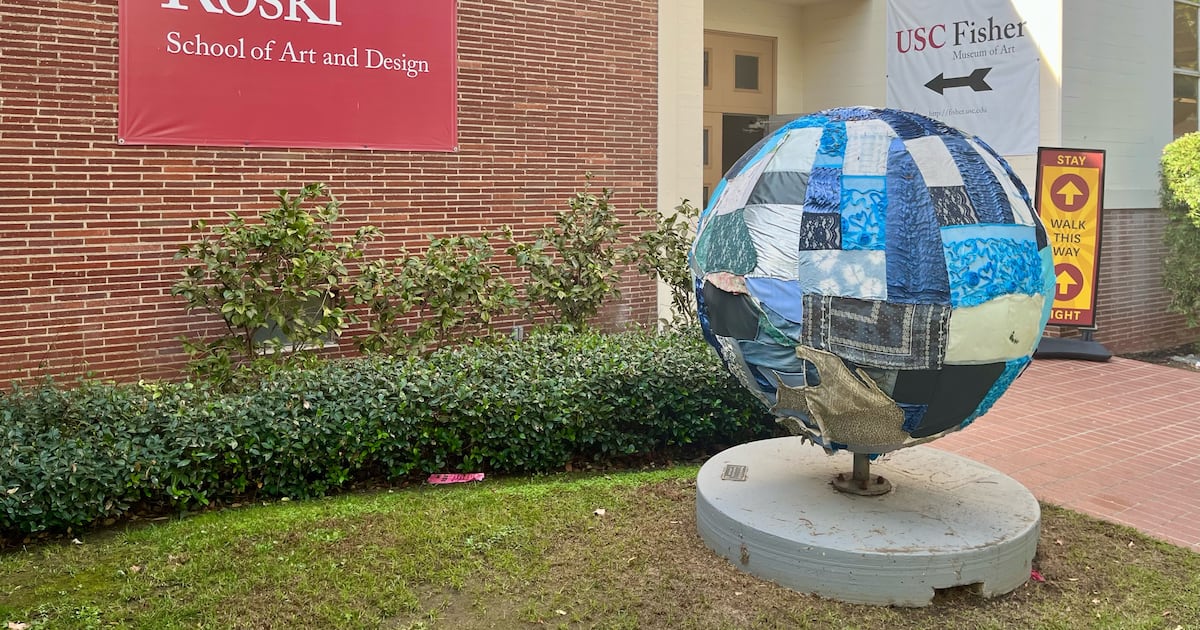
Advocates for USC’s disabled community say one campus building presents accessibility challenges, although the building is technically compliant with infrastructure standards under the Americans with Disabilities Act.
A Reddit user on Sunday posted concerns about Harris Hall, Roski’s Art and Design building. The second floor of Harris Hall is only accessible via stairs or an elevator across the courtyard in a neighboring building. The user noted that locked doorways and card access can make accessibility more challenging for students with disabilities.
Under the 2010 ADA Standards for Accessible Design, buildings that are either less than three stories or have less than 3,000 square feet per story do not require an elevator. Harris Hall only has two stories.
But the situation at Roski suggests a gap between policy and reality, raising questions about whether accessibility at USC is consistently built into campus spaces or still handled case by case. Beyond the immediate frustration at Roski, the accessibility issues point to a longer-standing gap in how the university supports students with disabilities.
Lilly Grossman is a graduate student at USC and the founder of Beyond the Box Advocacy, a disability policy organization that provides support systems for Americans with disabilities. She’s written publicly on her experiences as a woman with a disability and navigating spaces in a wheelchair.
Grossman said that student concerns about Roski reflected a broader pattern of accessibility at USC being considered at the surface level, but not carried through in reality.
“Meeting technical requirements does not always translate into spaces that are usable and reliable in everyday life,” said Grossman.
A 2024 Daily Trojan opinion piece highlighted the lack of a dedicated disability-affinity center, as well as years-long concerns about accessibility and support. USC has since expanded its accessibility infrastructure, including the creation of reporting systems and strengthening administrative offices. According to USC’s “Report a Barrier” website, there is little public evidence that long-standing physical barriers in older buildings have been fully resolved.
“In my experience, USC can be responsive, but that responsiveness is often reactive with change happening after issues are raised instead of proactive design and planning,” said Grossman.
In practice, accessibility can still depend on workarounds, as the recent Reddit post shows, such as navigating locked routes or requesting individual accommodations.
Teo Gonzales, a senior history major and photography minor, hasn’t had problems accessing Harris’ second floor, but said that Harris is a noticeably older building, and that he believes it should be remodeled.
“The issues in Harris would definitely be related to a disparity in how old buildings are on this campus,” said Gonzales.
Alia Chand, a junior majoring in art and communications, said she has experienced an array of issues with broken facilities at Harris. She said there were entire semesters where bathrooms and water fountains in Harris were non-functional.
She shared that students would either have to walk to the basement of Watt Hall for a functioning water fountain, or ask a staff member to fill their water bottles from the staff lounge.
“We all know it’s an issue and it’s kind of just a running joke that those things never get fixed,” said Chand.
Chand has spoken to faculty members before without much change. She wants a more clear, direct way to report the issues in Harris.
“It can be really demoralizing and demotivating to students to feel like your department isn’t cared for and like your problems are swept under the rug,” she said.
Chand said that broken facilities, on top of cuts to funding and staff, can feel a lot more significant at Roski because of having fewer students, faculty and less funding.
“All of those things together create a morale problem within the program and I wish the university would take that more seriously,” she said.
Grossman said she hopes the university will directly engage with affected students and examine similar barriers across campus with consistency.
“When concerns lead to clear changes, communication, and accountability, trust can grow,” said Grossman. “When issues are acknowledged without full resolution, it can create hesitation among students who are directly affected.”