
Environmental law expert Ann Carlson recalls how Los Angeles challenged polluters and cleaned up its act in “Smog and Sunshine”
Ann Carlson was an active kid growing up in Orange County in the 1960s and ’70s. “I was pretty athletic playing tennis and softball all summer,” says the author of Smog and Sunshine: The Surprising Story of How Los Angeles Cleaned Up Its Air, out this month from University of California Press. “I didn’t stay in despite the admonition to not exercise during smog alerts, but they were so regular that you couldn’t have a regular childhood if you listened to the advice.”
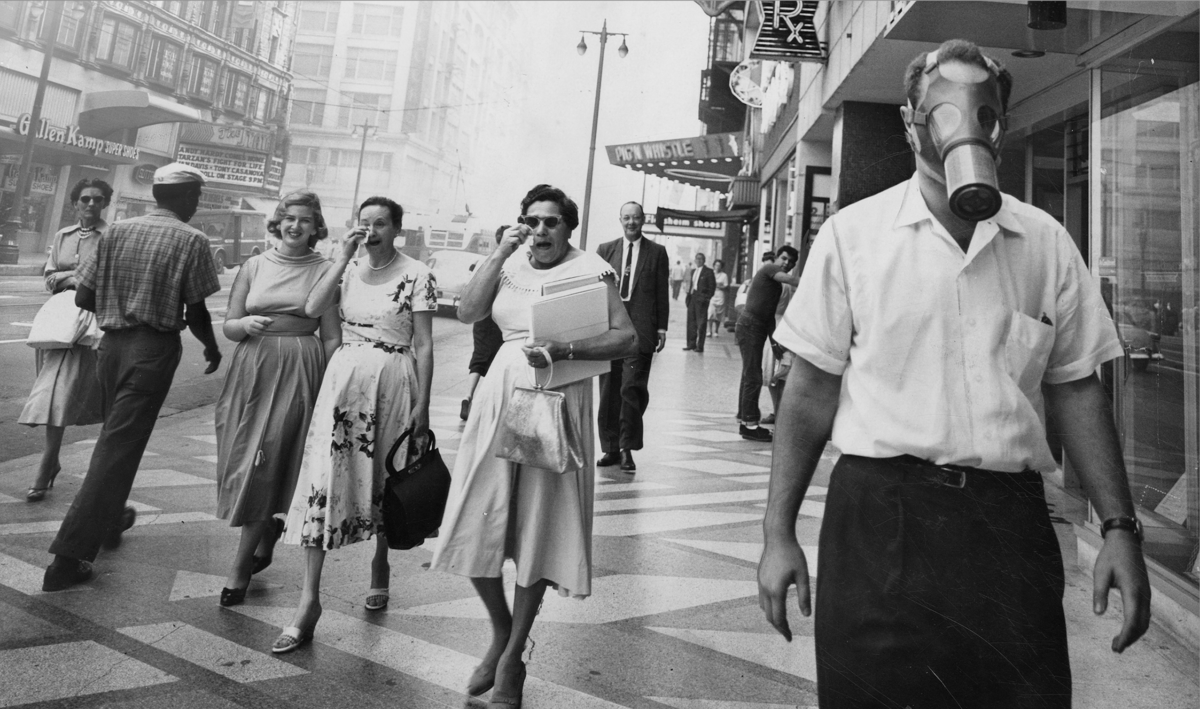
Summer skies in the years that Ronald Reagan was governor were usually one of two colors: murky brown or hazy white. “My lungs hurt and my eyes stung,” Carlson says. “I had a persistent runny nose and a hacking cough. Those are symptoms of the types of pollutants that were in the air in Fullerton.”
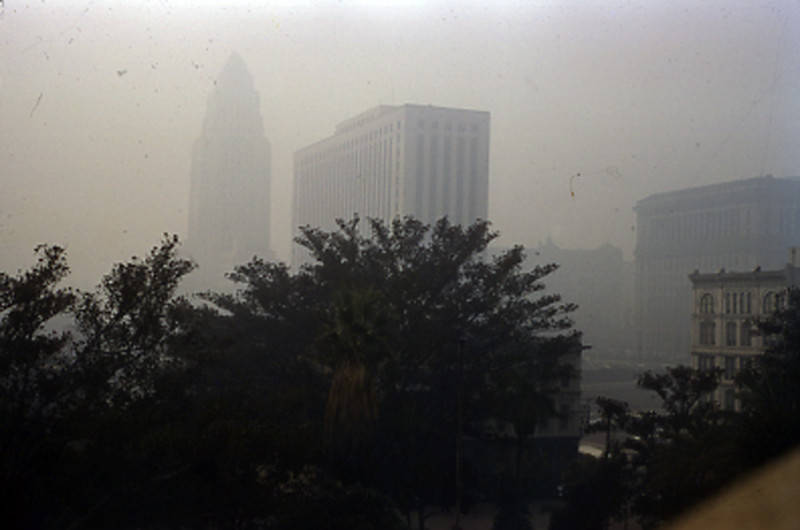
La Plaza and Civic Center, smoggy day in 1955Credit: L. Mildred Harris/Los Angeles Public Library
Carlson earned her law degree from Harvard, worked at a public interest law office and taught environmental law at UCLA. The legal scholar went on to steer the National Highway Traffic Safety Administration as chief counsel and later, acting administrator of the agency which shares responsibility with the U.S. Environmental Protection Agency (EPA) in regulating greenhouse gas standards.
“So much of the great work we did is now under attack,” Carlson says of the February decision by the EPA to repeal all motor vehicle greenhouse gas emission standards under the Clean Air Act. “We worked really hard with federal agencies and the auto industry to craft standards. They’re all being eliminated.”
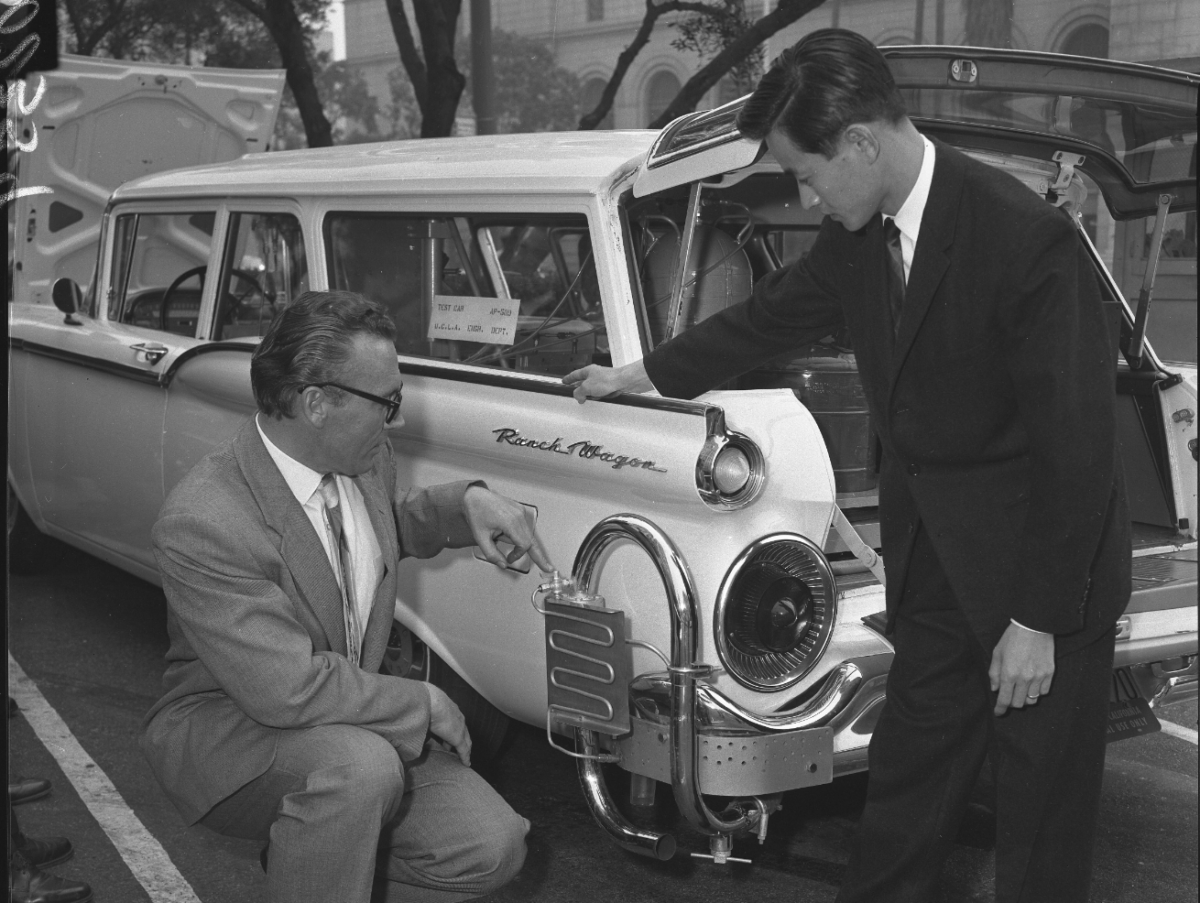 Richard D. Hopa and Hiroshi Kimura demonstrating anti-smog device for automobiles in Los Angeles, Calif., 1960Credit: Los Angeles Times Photographic Collection/University of California, Los Angeles. Library. Department of Special Collections
L.A.’s battle against smog goes back to at least World War II, when an especially noxious haze lingering low over Downtown was mistaken by some for chemical warfare. Southern California was on edge following the Japanese attack on a Santa Barbara oil field and a hyped-up, if imaginary, enemy squadron spotted over San Pedro, which caused some to fear that invasion was imminent.
The toxic invader turned out to be butadiene, a noxious gas that the Los Angeles County Health Department identified as spewing from a synthetic rubber plant near Union Station. Following protests on the streets and at the Board of Supervisors, air pollution inspectors were hired to monitor the skies, and a smog control board was appointed, which eventually led to the formation of the South Coast Air Quality Management District (AQMD) in 1976. The first efforts to tamp down the poison focused on identifying the biggest polluters in heavy industry before the major culprit was identified: automobile tailpipes.
Scroll to continue reading
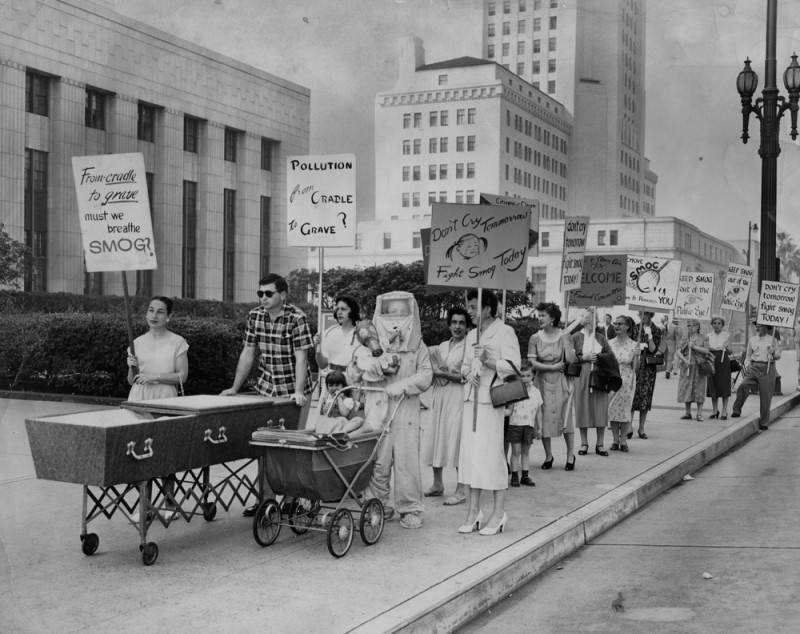 Citizens picket smog probe hearing outside Los Angeles City Hall, 1956Credit: Los Angeles Herald Examiner Photo Collection/Los Angeles Public Library
Our natural hills and valleys are partly to blame for the unique way L.A.’s topography shapes the atmosphere. “We have a lot of sunlight,” Dr. Sarah Rees of the AQMD explains. “We’re in a basin that traps the air pollution, so it’s able to cook and create smog.”
Scientists have been studying it since the 1950s. “The county set up all these monitoring stations,” Carlson explains. “The worst smog was along the San Gabriel mountains. The places that caused the worst smog didn’t necessarily experience its worst effects,” she says about how toxic air travels on wind and is trapped by the inversion layer. “All the way to San Bernardino and Riverside,” she says, “the air was poisonous.”
We didn’t notice it so much when 100,000 Model Ts were kicking out black smoke in 1920 but by the beginning of World War II, there were 1.2 million Packards and Pontiacs beginning to clog L.A. streets. When the war was over, we were on our way to easily-financed cars, endless freeways and far-off commutes, which led to millions of tons of the brown stuff blotting out the skies.
“The big breakthrough came when we came to understand what formed smog,” says Rees. “Researchers at Caltech were able to generate smog in a smog chamber by taking emissions and exposing them to sunlight.”
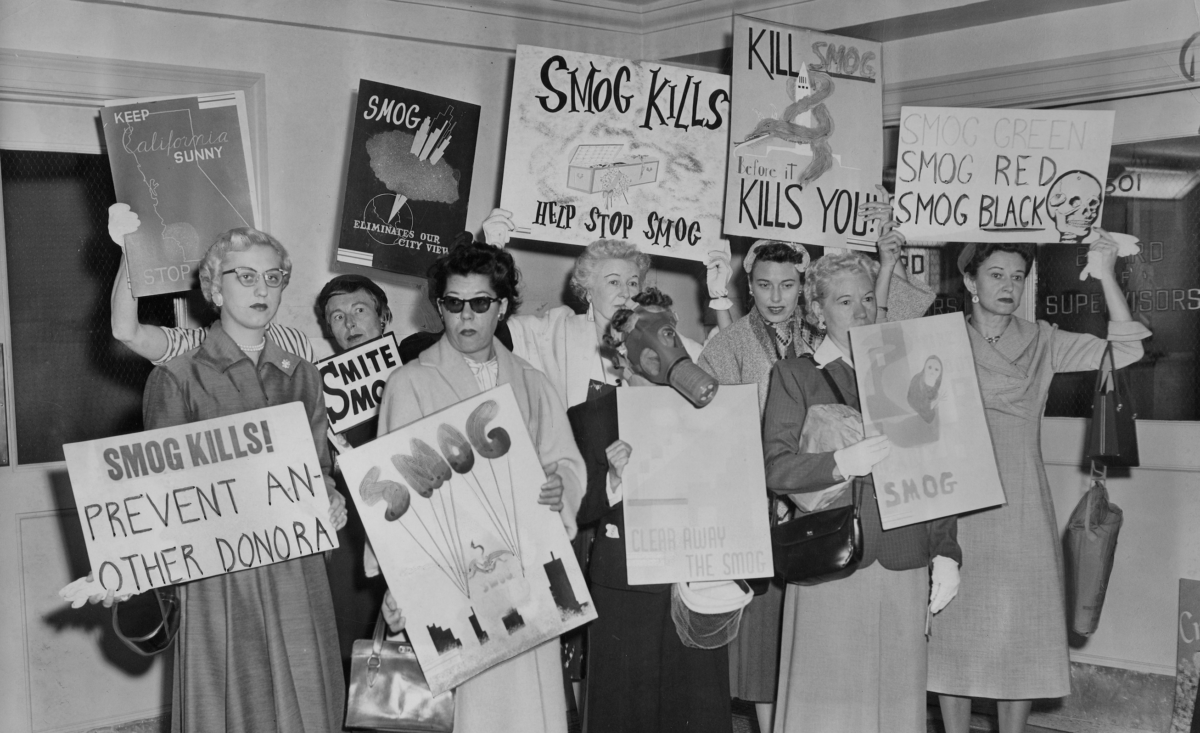 Smog protestors in Los Angeles, 1955Credit: Herald Examiner Collection/Los Angeles Public Library
Mediating all that poison took decades of arm-twisting, environmental regulation, political wrangling and scientific invention, which Carlson expertly describes in her book. “This is a decades-long process,” Carlson says. “It’s not a one-shot deal.”
L.A. residents used to burn their garbage in backyard incinerators until 1957. The catalytic converter appeared in the 1950s but was not widely adopted until the 1970s. The EPA mandated that gas stations offer unleaded gas and toxic lead gradually disappeared.
Experts agree that today’s internal combustion engines are 99.9 percent cleaner than they were in the 1960s. The first smog check stations were riddled with fraud and cars could easily be made to pass until automakers added onboard diagnostics.
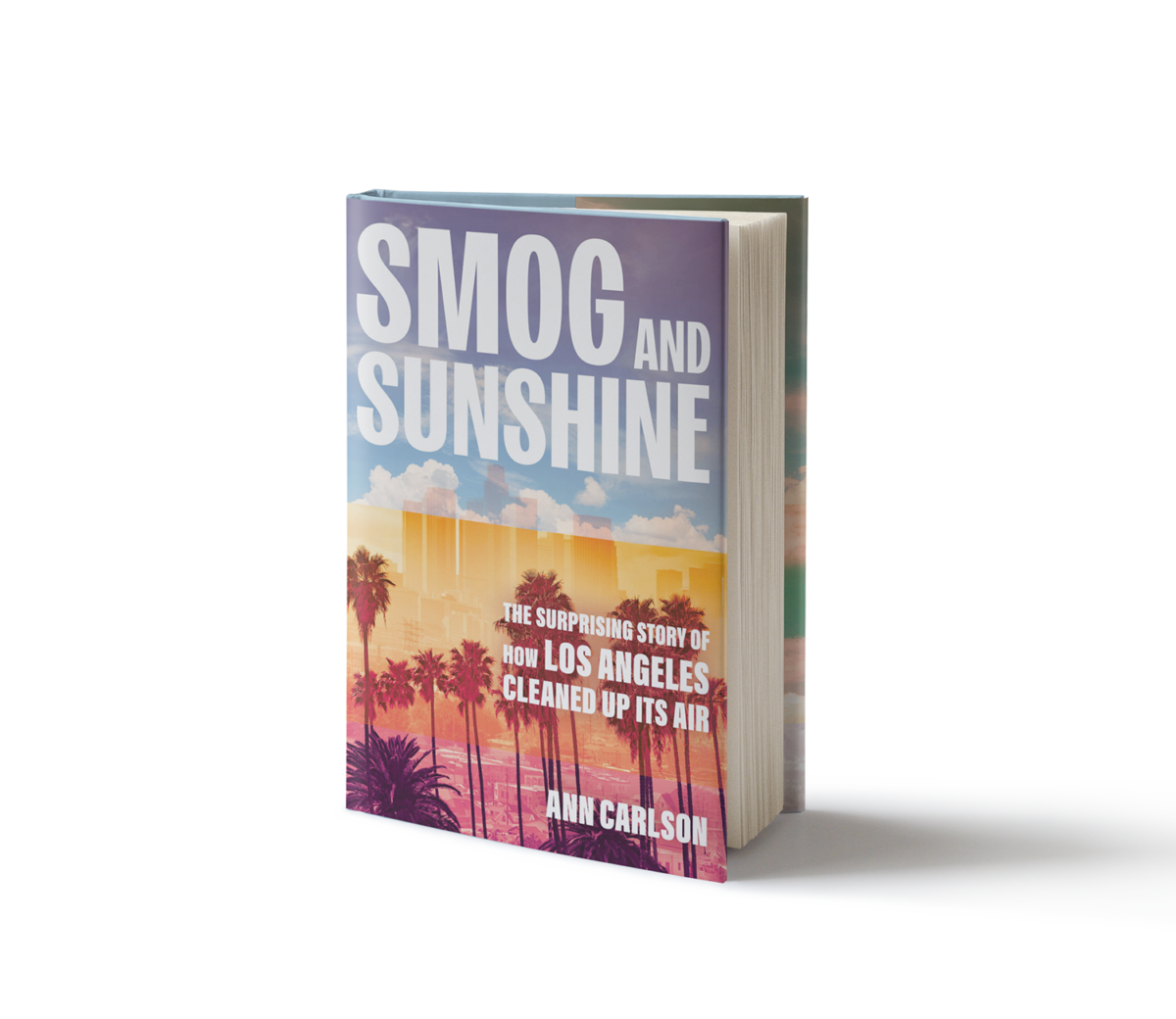 Smog and Sunshine by Ann CarlsonCredit: Courtesy University of California Press
Regulators started looking at how to clean up pollution from diesel trucks, boats and Jet Skis. “Cars are actually really clean these days,” says Rees. “It’s really the heavy-duty mobile sources like trucks, aircraft, ships and locomotives. They are mostly subject to federal and, with aircraft, international authority.”
Regulators faced pushback when they attempted to clean up backyard barbecues, lawn mowers and household paints. “When I was nominated to head NHTSA [National Highway Traffic Safety Administration],” Carlson says, “Ted Cruz said I was a radical environmentalist and attacked me in the press.” She ended up withdrawing her nomination.
“We used to violate lead, carbon dioxide and nitrogen dioxide standards regularly. We used to have smog alerts more than half the year,” she says with cautious optimism. “We haven’t had a smog alert since 2003. We continue to have problems, but we have accomplished extraordinary reductions in pollutants and huge achievements for better health.”