
IN EARLY MARCH, the Utah Jazz signed Andersson Garcia to a 10-day contract. Garcia was a college backup, an off-the-radar undrafted prospect and a defensive-minded role player for the Mexico City Capitanes this season. The Jazz then played Garcia 25, 29, 43, 24 and 48 minutes in five games, sending him back to free agency a day after not subbing him out the entire night.
“I’m super grateful, but at the same time, I was really surprised,” Garcia told reporters during his brief tenure. “I wasn’t expecting to be here right now.”
The Jazz, trying to protect a top-eight protected pick they owe the Oklahoma City Thunder, were outscored by 69 points in Garcia’s 169 minutes. They signed Bez Mbeng on March 13. Mbeng is currently getting more minutes per game for Utah than he did for the Sioux Falls Skyforce. The team is minus-146 with him on the floor this month.
The Memphis Grizzlies, having lost 15 of 17, have started an NBA record 25 different players this season. In recent weeks, they’ve deployed a similar appearing tactic with the signings of Lucas Williamson, Adama Bal and Lawson Lovering.
It’s a popularizing strategy — adding, activating and overusing midtier G League players — that NBA sources insist spawned in Oklahoma City a few years back.
“It’s a copycat league,” an executive on a currently tanking team told ESPN. “All the models and ideas, there are always further iterations. That’s what happens when it works.”
In the final week of a rapid two-year rebuild, the Thunder signed Georgios Kalaitzakis, Melvin Frazier and Zavier Simpson to their roster to close out the 2021-22 season.
The three, all considered non-NBA level talents, were then given 40-minute per night roles for the final four games. The Thunder were outscored by 85 points in Kalaitzakis’ court time, 92 in Frazier’s and 95 in Simpson’s.
Kalaitzakis and Frazier haven’t been in the league since. Simpson was given a similarly brief cup of coffee on a plummeting Grizzlies team two Aprils later.
Those final three blowouts kept the Thunder at 24 wins, one behind the Indiana Pacers, clinching the league’s fourth-worst record. On lottery night, the Thunder jumped to second and the Pacers dropped to sixth. Oklahoma City drafted Chet Holmgren. Indiana drafted Bennedict Mathurin.
Holmgren started at power forward for a title team three years later.
In the past several years, the NBA’s tanking problem has grown from a subtle, largely ignored side issue to a full-on epidemic spreading across the bottom third of the league like wildfire, culminating this season with an arms race between at least eight teams to lose as much as possible to increase their lottery odds for a loaded draft.
In ESPN’s conversations with dozens of players, coaches and front office executives, a consistent theme emerged: Nobody likes it — “I hate it,”Golden State Warriorscoach Steve Kerr said — but not many deny it is often the most prudent team-building path when stuck near the bottom. Different seasons and different drafts will generate different forms, but everyone agrees it’ll continue until the NBA figures out either the proper rules or punishments to curb it.
“These teams are doing the whole gamut: sitting guys in the fourth, playing analytically bad lineups, drawing up plays for bad shots,” one Western Conference general manager said. “The creativity is impressive and I don’t blame them. It’s the best strategy to get better. Look at all the most promising teams in the league: Thunder,Spurs,Pistons,Rockets,Hornets. Years of being bad and building up on high picks. It’s painful but worthwhile.”
The strategies are growing in audaciousness and frequency of use. The orders from management are coming in earlier in the season, creating months of competitively compromised and often unwatchable basketball. The average margin of victory in NBA games this season is 13.1 points, the largest spread in history, and a record 89 games have been decided by 30 or more points.
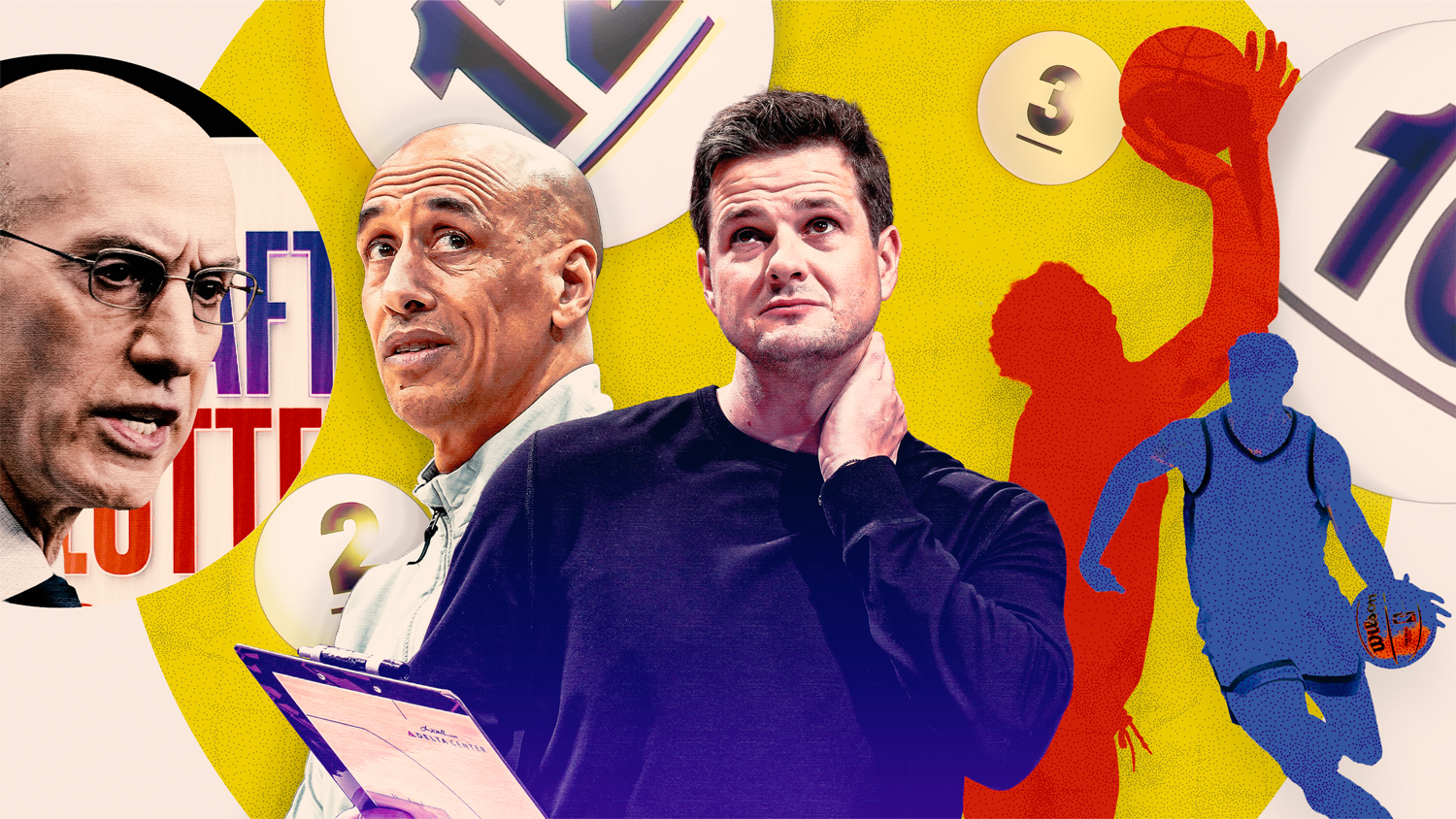
“There is an aspect of team-building that is called a genuine rebuild — a rebuild with integrity,” commissioner Adam Silver said at a late March news conference. “The problem we’re having these days is it’s become almost impossible to distinguish between the tank and rebuild. … It’s one that we take very seriously, and we are going to fix it. Full stop. And I want to say that directly to our fans.”
ON THE NIGHT of March 27, seven of the 10 NBA games featured a tanking team. That included a late tip between the Washington Wizards and Warriors.
The Wizards were without Trae Young and Anthony Davis and the Warriors were without Stephen Curry andJimmy Butler III, leaving undermanned rosters and a matchup that remained tight deep into the fourth quarter.
But they had contrasting motivations. Golden State, still clinging to fading playoff hopes, were incentivized to win. Washington, intent on retaining the top-eight protected draft pick they owe the New York Knicks, were incentivized to lose. The sides acted accordingly.
Alex Sarr, the second-year center at the heart of Washington’s rebuild, had two fouls at halftime. He committed his third, fourth and fifth within the first four minutes of the third quarter. Wizards coach Brian Keefe didn’t pull him.
So Sarr, the 2024 No. 2 pick, hacked away and committed his sixth with 5:31 left in the third, disqualifying him after 22 minutes of action and more than 17 minutes still left in the game.
It’s an example of the casual hoops many around the league warn as a side effect of tanking, generating bad and sometimes unbreakable habits for players marinating for months in meaningless hoops with little consequence.
“Losing leaks into your DNA,” a former NBA general manager said. “I mean, it can really, really f— kids up.”
Keefe was asked about leaving Sarr out there to foul out and said the 20-year-old had a minutes cap and would’ve missed the fourth quarter anyway. It’s also the reason, Keefe explained, that he didn’t go back to two other early 20s rebuild performers: Bilal Coulibaly, limited to 19 minutes, and Bub Carrington, limited to 26.
They both watched the entirety of the fourth quarter from the bench as a five-man lineup of undrafted Leaky Black and four bench players logged all 12 minutes together and a five-point lead became a five-point loss.
“It’s a strange phenomenon,” Kerr said postgame when asked about his opponent benching their best players in the fourth quarter. “I think it’s pretty unique to this season. I haven’t really seen this in the past. This is different.”
The Warriors have seen plenty of it over the past month: The status of their depleted roster has kept them in competitive fourth-quarter games against the league’s worst teams, forcing them to get creative with their lineups. The Wizards, Grizzlies, Jazz, Brooklyn Nets and Chicago Bulls all went away from their better players in the second half.
The NBA delivered the Jazz a $500,000 fine in February for this practice after they benched Lauri Markkanen and Jaren Jackson Jr. in the fourth quarter of tight road games in Orlando and Miami.
“Overt behavior like this that prioritizes draft position over winning undermines the foundation of NBA competition and we will respond accordingly to any further actions,” Silver said in a statement.
In the two months since, there have been no fines for the midgame benching tactic despite its frequent and increased usage. Like the Wizards, Utah coach Will Hardy used the minutes cap explanation as reasoning.
“I get fined when I do wrong,” Warriors’ Draymond Green said on Tuesday. “Just fine the hell outta people. They love taking money from players. Keep fining teams. I’ve seen two fines. As players, they snatch that money in a heartbeat. Why isn’t it the same? Everybody love money.”
Several members of coaching staffs across the league tell stories of these tanking teams yanking even their midrotation players the moment one of them gets hot, essentially searching for the worst possible combination for the given moment. Others have noted that the advent of the three two-way roster spots has made it easier in recent seasons to generate these G League level lineup combinations.
Almost every franchise has been guilty of tanking in the past few decades. Former Dallas Mavericks owner Mark Cuban was fined $600,000 in 2018 after admitting on a podcast with Julius Erving that he was in the process of executing the strategy that would later help them acquire Luka Doncic.
The Mavericks were fined again in 2023 for tanking in an effort to keep a top-10 protected pick, which would help them secure Dereck Lively II. The Warriors have had a front office executive later admit to a purposeful tank late in the 2011-12 season to keep their top-seven protected pick, which became Harrison Barnes.
“It’s been going on for so long, but people have just sort of ignored it because one or two teams were doing it at a time — not 10,” an East executive said. “If it didn’t work, 10 teams wouldn’t be doing it.”
THE INDIANA PACERSwerealso fined by the NBA in February for what the league deemed a violation of the player participation policy. They ruled that Pascal Siakam and two starters “could have played under the medical standard” but didn’t.
Pacers coach Rick Carlisle, who served a two-decade tenure as the president of the coaches association, bristled at the league’s unilateral medical ruling, indicating a franchise priority to take a cautious injury approach in a lost season without Tyrese Haliburton, their best player.
“[The NBA] asked if we considered medicating [Aaron Nesmith] to play in a game when we were 30 games under .500,” he told a local radio station. “So I was very surprised.”
This isn’t the first season a Haliburton absence has altered the Pacers’ motivations. Haliburton missed 13 of the final 15 games in the 2022-23 season because of ankle and knee injuries and — as has been common practice for decades — the Pacers leaned into losing late when realistic playoff hopes faded.
But there’s always a trickle-down impact.
Buddy Hield was on that Pacers team. He believed he had a long-term NBA home and said Carlisle, who he considered “a mentor,” visited his house several times and assured him the franchise would take care of him that summer, despite a plan in the final weeks to move Hield to the bench and significantly reduce his minutes for the betterment of the organization.
“It was an extension year,” Hield said. “Then when it comes to extension talks, it was like, ‘Oh, the numbers, X, Y, Z.'”
Hield believed his value had been manipulated and, three years later, wonders whether that brief late-season tanking strategy sent his late prime down an altered path.
“It f—ed up the money,” Hield said. “Me and Rick are still close, but that really rubbed me in the wrong way. Tanking just f—ed everything up for everybody.”
The Pacers benefitted from the brief pivot. They earned a higher value draft pick to help remake their roster and made the conference finals the next two seasons and the NBA Finals in 2025.
But the shrapnel from tanking has generated collateral damage across the league. It’s a common complaint from countless veterans in their private moments. Multiple midcareer NBA players detailed their frustration to ESPN but noted that the problem would often only surface in the last week or two of the season earlier in their careers. Increasingly, the losing strategies are forcing them out of the picture in March, February or even January.
“It’s easier to stomach if it’s a young player they’ve just drafted with a future in the franchise,” one Western Conference player said. “But when they’re just bringing in dudes off the street and playing them over you in a contract year? That s–t will piss anyone off.”
Knicks forward Josh Hart was traded to a tankingPortland Trail Blazersteam at the 2022 deadline. He said that type of environment has a different impact depending on the human.
“Some players are just happy to be out there and just shoot terrible shots and just do whatever,” Hart said. “But for quote, unquote ‘winning’ players, it is extremely frustrating.”
There are tanking success stories on the player level. The infamous process-era Philadelphia 76ers, for example, rolled in waves of young players, delivered opportunity and sparked the careers of respected pros such as Robert Covington and T.J. McConnell.
Josh Giddey‘s career has been attached to tanking from the beginning. He was the initial reward — sixth draft pick in 2021 — for the first of two bad Thunder seasons.
In his rookie year, he was shut down in March with hip soreness as the Thunder found their way to that Holmgren draft choice. In Giddey’s second season, the rebuild exploded into an ultimate success story.
Before the Thunder’s first title run last season, he was traded to theChicago Bullsfor Alex Caruso, delivering OKC a final championship level rotation player while winding Giddey back into a tanking situation. After years in the muddled middle, the Bulls finally leaned into the tank at this past trade deadline.
“I don’t agree with tanking, but I also do understand being in the middle is probably not where you want to be,” Giddey said. “You either want to be the top end of the lottery, or you want to be competing for championships.”
Former Knickshead coach David Fizdale told a story recently on FanDuel TV about his brief tenure in New York.
The front office, as he relayed, was obsessed with the idea of a top pick in the Zion Williamson and Ja Morant draft and were also convinced they would sign Kevin Durant and Kyrie Irving in the summer of 2019.
Fizdale was left with a limited, losing roster. They went 17-65 in his first season and received the third pick in the lottery, missing out on Williamson and Morant. Durant and Irving opted for the Nets that summer. The Knicks opened Fizdale’s second season 4-18 and he was fired.
“All of us coaches come into this with our eyes wide open,” Kerr said. “Circumstances are everything. The average coach lasts probably less than three years. It might be because of the lack of talent. It might be because you don’t do a good job. It might be because of injuries. This is just kind of how the coaching profession exists. Now you add to it another [hurdle] with this tanking dynamic.”
Kerr and Carlisle mentioned Utah’s Hardy and Brooklyn’s Jordi Fernandez as widely respected young coaches working in tandem with their front offices through the rebuild, believing alignment can help a culture and coach sustain through the losing.
“Well, it hasn’t hurt Mark Daigneault,” Carlisle said. “We all have very unique jobs. Our job is to manage our situation, and the situations of each team are very much in flux on a year-to-year basis. … Daigneault is a great example. He was a G League coach, but he built a relationship in that organization and a partnership. And if you build those relationships and you become a real partner, the wins and losses element of it isn’t going to be that kind of a factor.”
THE SACRAMENTO KINGShave had a difficult season.
They didn’t enter October intent on bottoming out, but injuries and ineffectiveness sent them plummeting. Three of their highest-paid players, Domantas Sabonis, Zach LaVine andDe’Andre Hunter, had season-ending surgeries in February. They appeared ticketed for the league’s worst record.
But they didn’t lean all the way into the tank. The Kings — under new general manager Scott Perry preaching the need to create a winning culture — kept DeMar DeRozan and Russell Westbrook mostly active in high-minute, high-usage roles.
DeRozan, in particular, has had an impressive late run in his 17th NBA season, reaching career scoring milestones while leading the Kings to seven wins in their past 15 games — a positive stretch that should be celebrated on the surface.
But there’s been local frustration. The meaningless 7-8 stretch has taken the Kings from the top position in the lottery and a guaranteed top-five pick to the fifth-worst record, lowering their odds at a top-four pick in a loaded draft and creating a real possibility they will drop to seventh or eighth.
“Tanking is the last thing [I’d do],” Kings coach Doug Christie said after a recent win over the Jazz. “I respect the game too much. These young men, in my opinion, when you do things like that, it hurts them. Because when you asked them to give it [everything] for you, you just jeopardized it.”
As one coach recently put it, it can’t be “healthy” for a third of the fan bases across the country to be actively rooting against their teams for two months, embracing some of the more audacious strategies to influence losing.
“I do think ultimately this is a decision that needs to be made at the ownership level,” Silver said. “It has business implications, has basketball implications, has integrity implications for the league.”
Integrity is a notable word from Silver. The NBA — and sporting world in general — has embraced gambling to an increased degree and part of the league’s need to crackdown on tanking is the negative optics of manipulating results when so much public money is on the line.
Oddsmakers find ways to adjust. They’ve accounted for the tankers. Three teams — the Nets, Wizards and Jazz — entered the regular season with over/under totals below 21 wins, the most in the past 30 years. The average regular-season point spread has been 7.1 points, the highest since 1990-91. There have been 77 games with point spread of 15 or more points, the most in the past 35 seasons. But perception can be reality.
“It’s point shaving,” one former general manager said of the spreading tactics to self-induce losses.
In late March, ESPN reported the three comprehensive solutions the league presented to its board of governors in an effort to curb tanking.
All three proposals widened the lottery to 18 teams and flattened the odds further to differing degrees. One proposal would weigh a team’s record across two seasons. Another is referred to as the “five-by-five” method, giving the bottom five teams identical odds. None of them were embraced with much warmth around the league, sources told ESPN.
The trouble for the league is the wide array of opinions on what exactly is the best fix and the fact that many of the favored concepts — like flipping the benefits for lottery odds from losses to wins midseason — are extremely difficult to explain simply to the casual consumer.
Silver said he desires a solution in place before June, allowing the NBA to implement the agreed-upon new rules before the 2026 draft and free agency, allowing front offices time to absorb and plan before making big-picture roster decisions.
“We need to do something more extreme than we did with those incremental changes the last four times [we’ve changed lottery rules],” Silver said. “Certainly, going into next season, the incentives will be completely different than they are now.”
ESPN’s Jamal Collier, Vincent Goodwill, Baxter Holmes, Tim MacMahon and Dave McMenamin contributed to this report.br/]
Copyright © 2026 ESPN Internet Ventures. All rights reserved.