
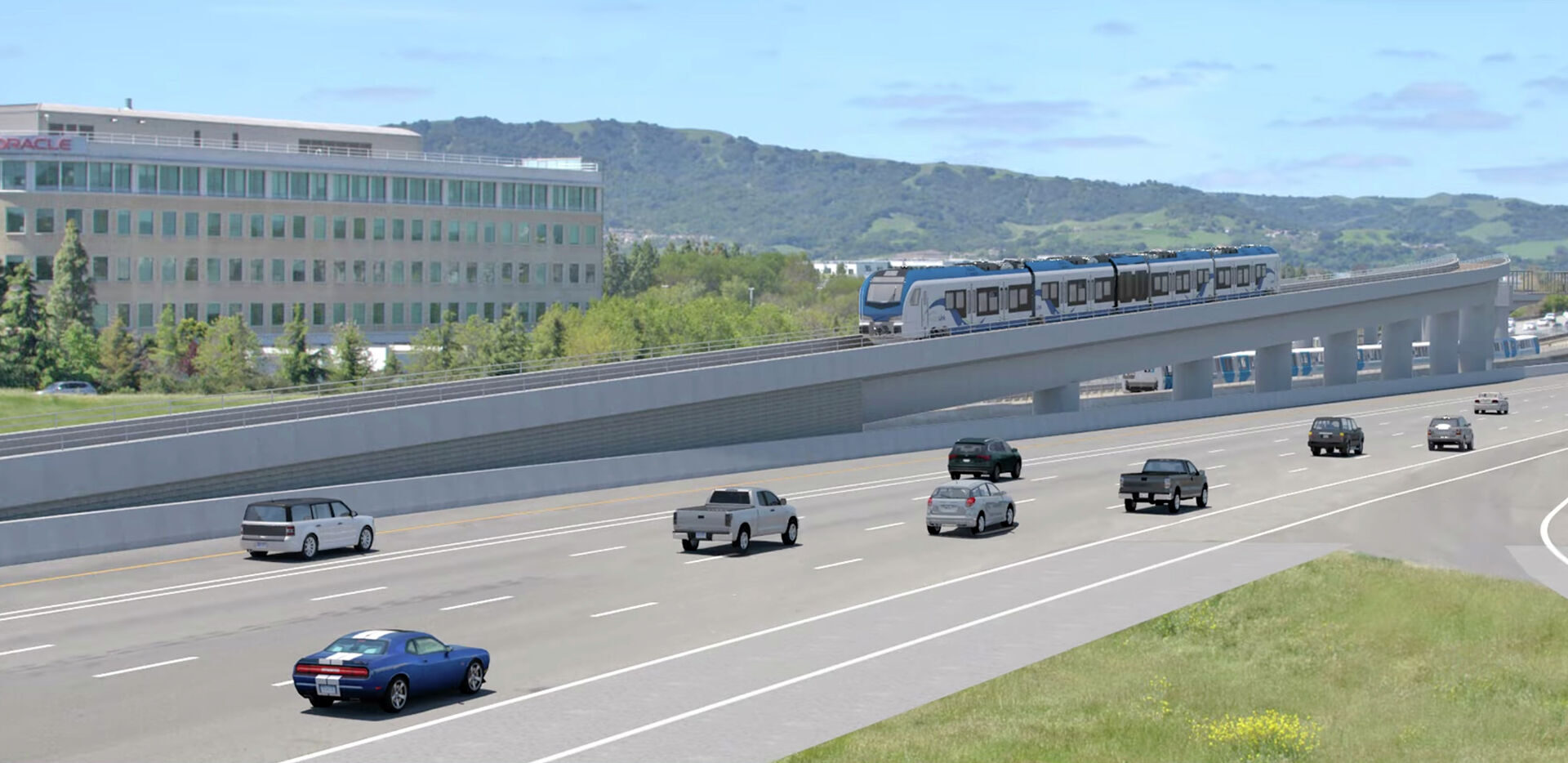
A rendering of the new commuter train system that would better connect San Joaquin County residents to the Bay Area.
Courtesy Of Kevin Sheridan
BART will never go to Livermore. So Tri-Valley officials are determined to build their own train.
They envision a railway of hybrid, hydrogen battery trains that would whisk people along tracks dug into the median of Interstate 580. Valley Link would start at Vasco Road in Livermore, picking up passengers from Altamont Corridor Express, or ACE, trains that chug in from the Central Valley. From there, it would zip to Dublin-Pleasanton BART Station, creating a pipeline to the central Bay Area. In a few years’ time, the small battery-powered rail could run deeper into San Joaquin County, serving super-commuters who currently slog through traffic over the Altamont Pass.
With $2 billion and a little faith, Valley Link could break ground in late 2028, transforming mobility in a booming corner of the Bay Area, said Kevin Sheridan, the project’s executive director. At a moment when BART and other transit agencies are mired in budget crises, Sheridan and other Valley Link boosters brim with sunny optimism.
Article continues below this ad
“What I feel is very unique about this project is it’s actually creating the connection to bring not only more ridership to ACE but also BART,” Sheridan said about the system that would be BART-adjacent. “That’s an untapped market. We are not expanding a service, we are creating a service to bring new riders.”
But many observers are wary. In their quest to secure more than $1 billion in federal and state funding to build Valley Link’s first phase, Tri-Valley and Central Valley leaders would have to compete for grant money with other long-pined-for transportation needs, including BART to downtown San Jose and the extension of Caltrain and future high-speed rail into downtown San Francisco. It would cost $4 billion to complete Valley Link’s full build-out, through Tracy and into Mountain House in western San Joaquin County.
Mapped plans for a new transit line that would better connect San Joaquin County residents to the Bay Area.
Courtesy of Kevin Sheridan
Skeptics question whether this is really the moment to plan a new train, with existing transit services facing huge deficits.
San Francisco Chronicle Logo
Make us a Preferred Source to get more of our news when you search.
Add Preferred Source
“If there were unlimited funding for transit, it would be a different story,” said former BART Board Director Rebecca Saltzman, who voted against the proposed $2 billion Livermore BART extension in 2018. She has long advocated for rapid buses along I-580 as a cheaper and more flexible solution.
Article continues below this ad
Politicians who represent that corridor say buses couldn’t run enough service to accommodate new development blossoming along the interstate, or tech jobs spawning from Livermore National Laboratory. They have their hearts set on heavy commuter rail.
“We are one of the fastest growing counties in the state of California and you look at our freeway congestion, we have one of the worst freeway commutes here in California from the valley to the Bay Area,” said San Joaquin County Supervisor Robert Rickman. He emphasized that a rapidly developing area cannot remain a transit desert. Saltzman noted that, for all their enthusiasm, San Joaquin County leaders had not been able to pass a transportation funding measure for their portion of the Valley Link project.
A rendering of a station for Dublin and Pleasanton for a new transit line that would better connect San Joaquin County residents to the Bay Area.
Courtesy Of Kevin Sheridan
Livermore Mayor John Marchand said he has already appealed to leaders in Washington D.C., arguing that a new transit system could free up capacity for freight on I-580 into the Central Valley.
“You could see the light bulbs go on over the heads of the people in the Department of Transportation,” Marchand said. “It hadn’t occurred to them that you could take traffic off a freeway by getting people into a train.”
Article continues below this ad
The dissension over Valley Link reflects a larger debate over how the Bay Area should grow. Urbanists, including many on the BART board, have argued that trains should run through downtowns where homes and industry are concentrated — not along freeways where stations function as “park-and-rides.” By contrast, politicians in more suburban and rural areas, including the Tri-Valley, believe that if you build transportation infrastructure, the jobs and housing will come.
Initially, Valley Link would comprise three stations, dipping west from the ACE platform on Vasco Road, to a stop at Isabel Avenue near the freeway, before terminating at Dublin/Pleasanton Station, where riders could switch to BART and head toward Oakland or San Francisco’s Financial District.
That could mean two or three transfers between different rail systems on morning and evening commutes. And Sheridan believes people would do it. Sitting on a train with your laptop is highly preferable to sitting in traffic, he said. A seamless ride across three rail systems (ACE, Valley Link and BART) would shave off minutes compared with driving, Sheridan said.
Commuters who currently take the ACE train from Tracy or Livermore to jobs in Silicon Valley agree that it’s superior to a soul-crushing car commute. Some wonder, however, if it might be smarter to invest the money toward beefing up ACE service instead.
“Personally, Valley Link wouldn’t work for me,” said Nick Mullen, who rides ACE from Livermore to Santa Clara and catches a shuttle to his office. He said many of his neighbors in the Tri-Valley take similar routes.
Article continues below this ad
Joshua Dunn of Tracy said he would consider riding Valley Link if the train ever reached his city or nearby Mountain House. He drives over the Altamont Pass from Tracy to Livermore on days he has to be in the office. When traffic is flowing he can make the 19-mile drive in 20 to 25 minutes. But it could be an hour-and-a-half slog during a heavy rush hour, or if a broken-down car clogs a lane.
Indeed, freeways have steadily grown more congested as more residents flock to the Central Valley. Tracy Mayor Dan Arriola said when he was a kid his dad would wake up at 3 a.m. to drive to Sunnyvale for a tech job and often didn’t come home until the late evening. Now the trip would likely take longer and consist of more crawling and braking. Of 100,000 residents in Tracy, nearly 68% commute out of the city for work.
“Many of our residents are folks who were priced out of the Bay Area … who come to the city of Tracy to live but their jobs are still in the Bay Area,” Arriola said. “That’s an everyday reality for our residents.”
At least one top BART official adamantly supports the new train project. Melissa Hernandez, president of the agency’s board, also chairs the Valley Link board. She contends that a BART-style commuter rail is critical to economic development in the Tri Valley. Hernandez is also running for the congressional seat soon to be vacated by Eric Swalwell.
Article continues below this ad
“Valley Link is a megaregional project that connects the Bay Area to San Joaquin County by creating a new direct rail connection between ACE and BART in Livermore as part of its initial phase,” Hernandez wrote in a statement. “For over four decades Livermore has desired a transit rail connection to BART.”
If successful, Sheridan said final design of the first segment would be completed by the end of 2027 with construction to start in 2028. By 2031, the new train could be open for business.