
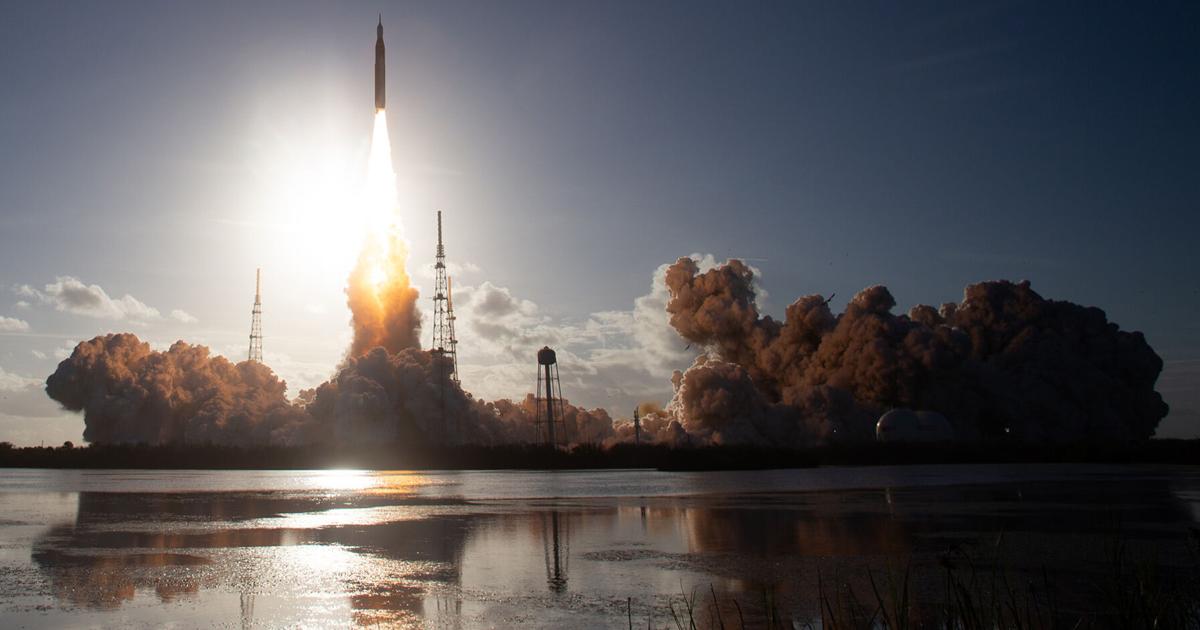
Around 12:47 a.m. on Tuesday, the UC Berkeley Space Sciences Laboratory, or SSL, established a connection to radio waves from the Orion spacecraft in NASA’s Artemis II lunar flyby mission.
This project, led by SSL application programmer Warren Rexroad and SSL programmer and analyst Bryce Roberts, is part of a larger global tracking effort to collect data on the Artemis II mission. The SSL is monitoring the direction and speed of the capsule as it orbits the moon, according to Rexroad.
The Artemis II mission marks the first time in more than 50 years that astronauts are leaving Earth’s orbit, with the last crewed lunar mission being Apollo 17 in 1972.
“The moon missions have always been this big thing that you could never touch … it was something you’d read about in history books,” Rexroad said. “Even though we’re playing a small role, it still feels good to be part of it in some way.”
The Berkeley Ground Station hosts an 11-meter-wide satellite dish, which tilts toward the direction of the signals. To track Integrity, the upward-facing dish spins down and around to point just above the horizon.

When connected to the spacecraft, a wall of screens lights up, transcribing real-time data. Screens display the frequencies the satellite dish is searching for. A screen below flashes between “Locked” and “Unlocked,” signaling whether the system is connected to Integrity and recording data.
To the left, the spectrum analyzer shows a graph tracking the frequencies received from the spacecraft. A tall, thin spike indicates the frequency at which the monitors are connected. When the spacecraft begins to transmit signals at a higher data rate, the spike flattens into static, and the connection is lost. Rexroad said for the first two days, the satellite did not establish a connection with the spacecraft.
Integrity — the name that the Artemis II crew has given to the spacecraft — normally sends signals at a frequency of approximately 2.2 gigahertz to a Deep Space Network ground station, part of NASA’s international array of giant radio antennas and much larger than the ground station’s 11-meter-wide satellite.
With exact knowledge of incoming data frequencies, participating satellite stations can configure their own receivers to search for a signal within 100 kilohertz. The difference between the observed frequency and the expected value, called the Doppler shift, indicates how fast the spacecraft is moving toward or away from Earth.
The values calculated from this data help NASA further refine the exact location of Integrity in a process called orbit determination. Data collected from the 34 volunteers selected worldwide is used as passive tracking, while NASA’s Space Communication and Navigation Program, or SCaN, provides primary support to Integrity.
“The Artemis II tracking opportunity is a real step toward SCaN’s commercial-first vision,” said Kevin Coggins, deputy associate administrator for SCaN at NASA Headquarters in Washington, during a press release. “This isn’t about tracking one mission, but about building a resilient, public-private ecosystem that will support the Golden Age of innovation and exploration.”
Rexroad spends his day to day managing the Mission Operations Center systems and writing software. He took on the project largely as a learning experience with the guidance of Roberts. With Integrity normally in view roughly between midnight and 8 a.m., he spends the early mornings tracking the spacecraft and recording data.
The ground station and software suite, SatTrack, were set up by past aerospace manager Manfred Bester in 1999, making most operations at SSL completely automated. The station and staff are mainly focused on the Escape and Plasma Acceleration and Dynamics Explorers mission, which will investigate Mars’ magnetosphere.
While Rexroad’s work with Artemis II must happen around the hours of ESCAPADE, he is excited about adding to the sum of the parts worldwide.
“The fact that they are really pushing this out for everybody to be watching and participating in, I think it’s really special,” Rexroad said.