

“It didn’t make sense,” she said. “My job wasn’t really making enough of a contribution to justify that kind of expense.”
By the time the school year ended, Malekzadeh decided to quit, even though she didn’t want to leave a profession she loved.
“My grandparents were both educators,” she said. “They were beloved by their community, and they were really excited when I chose to become a teacher. So that was my plan, and I didn’t ever expect to deviate from that.”
The move is saving about $600 a week in child care. The older two are in public school, and the youngest is still in preschool. While he’s in care, Malekzadeh takes classes at Diablo Valley College as she pursues a master’s degree in math, which she hopes will ultimately lead to a higher-paying job to make up for time away from the labor market.
“When you quit to stay home with your kids, it creates gaps in your resume that a lot of places don’t necessarily look nicely at,” Melakzadeh said. “You have to have some kind of explanation for that, which might translate into less pay.”
Child care prices vary by region and depend on a child’s age and the type of provider. In California, full-time infant care in 2024 cost an average of $22,628, which is 16% of the average married couple’s income and 50% of a single parent’s. Bay Area families pay the highest child care prices compared to other parts of California.
 Annie Malekzadeh plays a card game with her daughter as they wait for her older son to finish school at Valhalla Elementary School in Pleasant Hill on April 1, 2026. (Tâm Vũ/KQED)
The spike in prices came as companies began mandating employees return to work and child care providers lost federal funds meant to help them recover from the pandemic. Less flexibility and high costs led to a decline in labor force participation for moms of children under the age of 5, and college-educated moms in particular, according to an analysis by the financial firm KPMG.
Their labor force participation declined by 2.3 percentage points, while the number of college-educated dads of young children who were working or seeking a job continued to increase.
“Families are facing child care prices that are higher than the price of rent or mortgage. So this is a huge problem. It’s one of the biggest expenses in a family’s budgets,” said Julie Kashen, a researcher at The Century Foundation.
 Nolan Cruz eats oatmeal for breakfast in the morning on Oct. 27, 2025. (Martin do Nascimento/KQED)
The progressive think tank conducted an October survey of 1,400 voters about their affordability concerns. Kashen said that while all families are facing rising costs, it’s women who experience a greater threat to their economic security.
“Women are faring worse in terms of taking on debt to cover their basics, borrowing from friends and families to pay the bills,” she said. “So when you add child care on top of that, I think it’s incredibly challenging.”
Those challenges led Amy Cruz to walk away from a six-figure nursing job to freelance as a dance teacher and care for her 3-year-old son, Nolan.
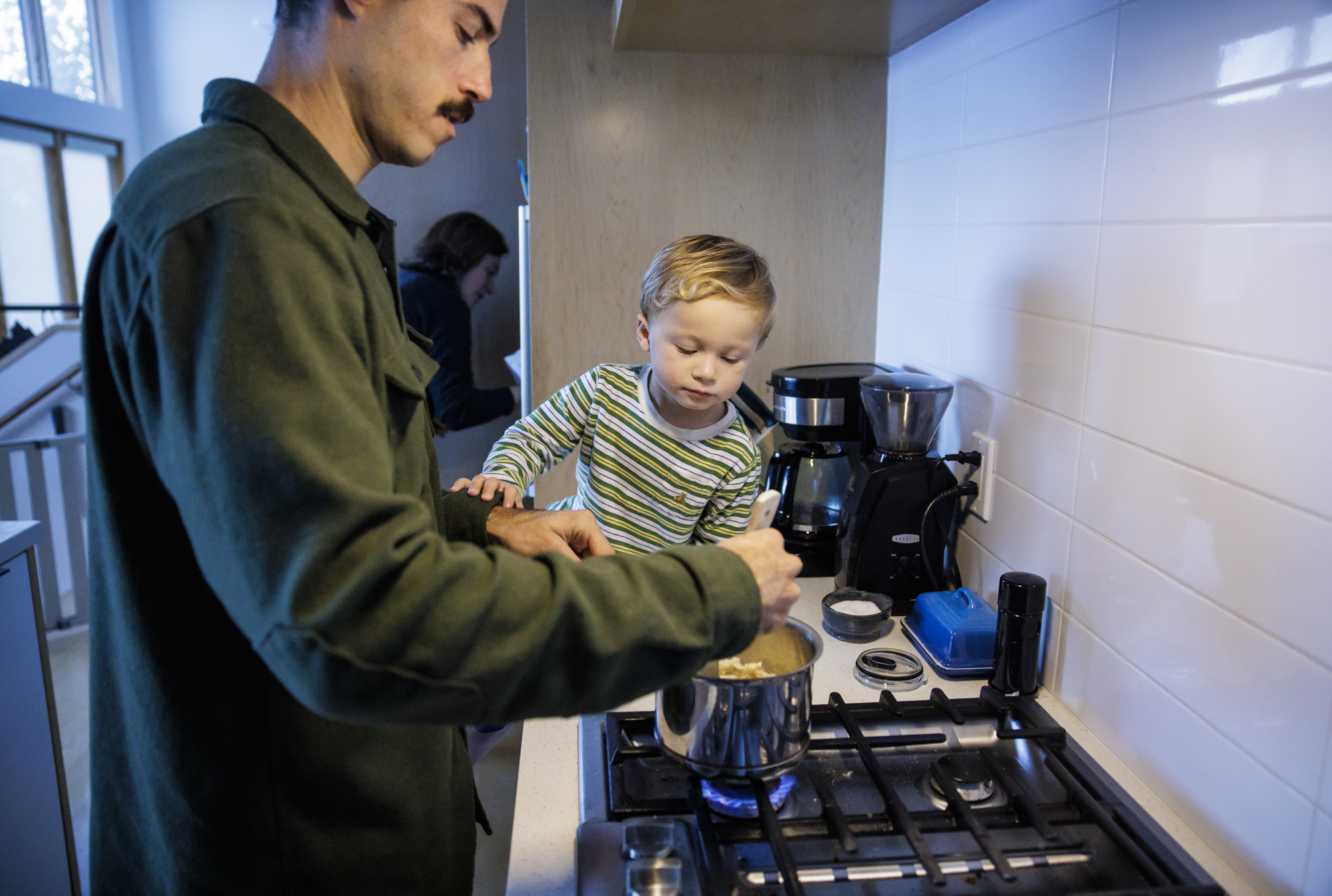 Brandon and Nolan Cruz cook oatmeal for breakfast on Oct. 27, 2025. (Martin do Nascimento/KQED)
Until he was about two years old, Cruz paid $3,000 per month to share a nanny with another family for just four days a week of child care (on the fifth day, she leaned on family members to look after him). While child care wasn’t the only reason she left her job, it was a significant factor.
“Essentially, half of my monthly income was going to child care,” Cruz said. “Watching that much money leave our account every month was tough.”
Once Nolan was old enough to start preschool, she enrolled him in a three-day program near her Berkeley home, which cut her child care costs in half. When he’s there, she teaches dance — something she did professionally before going to nursing school — to afford his tuition. With a second baby on the way, she also figured that it was “worth it to make a little less money but be able to be with my kids more.”
 Amy Cruz picks raspberries for her son Nolan’s breakfast in the morning on Oct. 27, 2025. (Martin do Nascimento/KQED)
Economists call child care a broken market because the actual cost of providing care is a lot more than what families can afford to pay. In California, the demand for licensed infant care exceeds supply because it’s the most expensive and labor-intensive. Babies need constant care, and California has strict rules limiting the number of children each adult can care for in a licensed child care home or center.
At the same time, low pay and benefits have made it tough for child care providers to attract or retain early educators. In January, nearly half of providers said they didn’t have enough staff to enroll children at capacity, according to a survey by the National Association for the Education of Young Children.
“For providers, energy costs, food, insurance have all gone up,” said Matthew Nestler, senior economist at KPMG. “They can’t necessarily raise their workers’ wages to the degree that they would like to.”
 (From left) Brandon, Amy and Nolan Cruz prepare breakfast and pack a lunch for Nolan in the morning on Oct. 27, 2025. (Martin do Nascimento/KQED)
The shortage can cause parents to weave in and out of the workforce. Malezadeh first left her job when her eldest child was born eight years ago, and she couldn’t find an open infant care slot when her maternity leave ended. She didn’t know she had to reserve one month in advance.
“We didn’t actually find any kind of daycare spot for him until he was two, and by then, I was already expecting my second child,” she said.
Malekzadeh stayed out of teaching for four years and went back to work when her first two kids were a little older.
But after a year, the costs of infant care for her youngest, combined with her older children’s care, were too great, and she left her job again.