
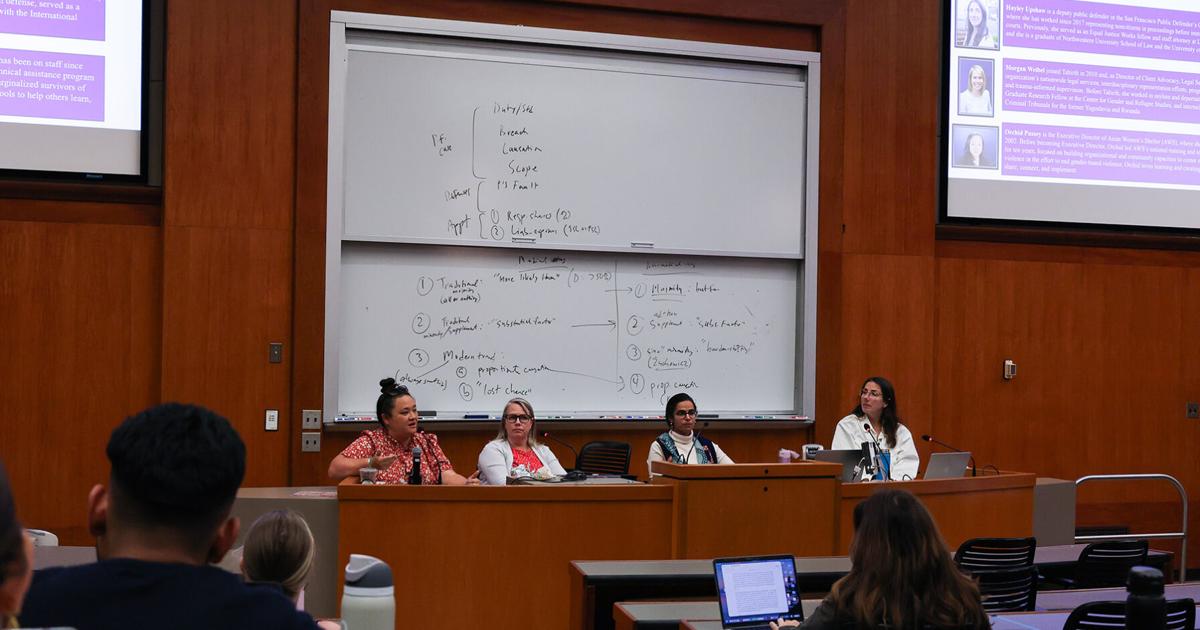
Dozens of students from the UC Berkeley School of Law gathered April 7 to discuss the ways gender-based violence has shaped recent activity by U.S. Immigration and Customs Enforcement. Brave Resistance Against Violence and Exploitation, a law student-led organization focused on gender and race equity, hosted the panel.
BRAVE builds on previous campus efforts to address gender-based violence and support survivors within the law school community, according to Melissa Cook, a first-year law student.
“We seek to help future lawyers and leaders in law understand how to apply a gendered lens to their work and oppose violence and support survivors, no matter what they end up doing with their career,” Cook said.
Panelists including activists and attorneys who work directly with immigrants in the Bay Area spoke on how current immigration practices heighten fear and instability for those experiencing gender-based violence. The event was moderated by Berkeley Law professor Mallika Kaur, who is also the director of the law school’s Domestic Violence and Gender-Based Violence Practicum.
Panelists pointed to detentions at routine immigration check-ins, hostile court environments and stricter bond policies as issues that complicate how immigrants interact with legal and social services.
“The courtrooms are very hostile right now,” said panelist Morgan Weibel. Weibel serves as the director of client advocacy at Tahirih Justice Center, which offers legal and social services to victims of gender-based violence. “We really had to script attorneys in a way that we never did before because it is really hard when you’re there in the moment to think on your feet.”
Orchid Pusey, another panelist and the executive director of the Asian Women’s Shelter — which supports domestic violence survivors — described how fear has reshaped the operations of organizations serving survivors.
Though ICE has never come to the shelter, according to Pusey, the organization has had to create new protocols in case immigration agents ever do appear.
“I am always preparing people just for the physiological reality because being (in a courtroom) asks things of a body that a body is not made to do,” Pusey said during the panel. “A body is meant, when it is scared, to run or freeze or shake and cry or do all the things that you are not allowed to do in court.”
Weibel also emphasized that the tense conditions are taking a large emotional toll on both clients and those supporting them, describing the fear as “real and tangible.”
Cook said she believes the death of Renée Good, a white woman fatally shot by ICE earlier this year, has brought increased attention to the intersections of gendered violence and immigration enforcement.
“That was a white woman (who) was killed, and I think seeing that so visibly happen, and the reporting on it, has awakened a lot of people to how violent this administration is, this enforcement is, and how it has compounding effects on survivors of other violences, particularly gender-based violence,” Cook said.